


Smart Tech
Smart Technology in Agriculture: Where It Pays — and for Whom
 September 22, 2026
The question surrounding smart technology in vegetable production is changing. Growers no longer need to be convinced that cameras can distinguish weeds from crops, or automated equipment can take over some field tasks. Automated weeders and thinners, in particular, have moved into commercial use on large vegetable operations.
The harder question is whether smart technology pays.
And according to Cornell University Weed Scientist Lynn Sosnoskie, even that question needs a qualifier.
“Under what conditions does it pay, and for whom?” she says.
A technology that makes economic sense across thousands of acres of high-value vegetables may be impossible to justify on a smaller diversified farm — even when both growers face the same labor pressures.
Start With the Problem
Labor is one of the forces driving interest in automation, but labor savings alone don’t determine return on investment.
Farm size, crop value, labor availability and production goals all influence whether technology makes economic sense, Sosnoskie says.
California research backs that up. In a UC Cooperative Extension survey of Salinas Valley vegetable industry members, 93% of respondents rated labor constraints, costs and regulations as very important factors in adopting automated technology. But reliability, speed and the ability to complete field operations on time also ranked as important considerations.
In other words, replacing labor isn’t much of an advantage if a machine can’t reliably get the job done when the crop needs it.
Utilization matters, too. A substantial equipment investment becomes easier to justify when a grower can spread the cost across more acres, crops or operating hours.
That helps explain why some of the clearest examples of commercial adoption have emerged among large operations growing high-value vegetables.
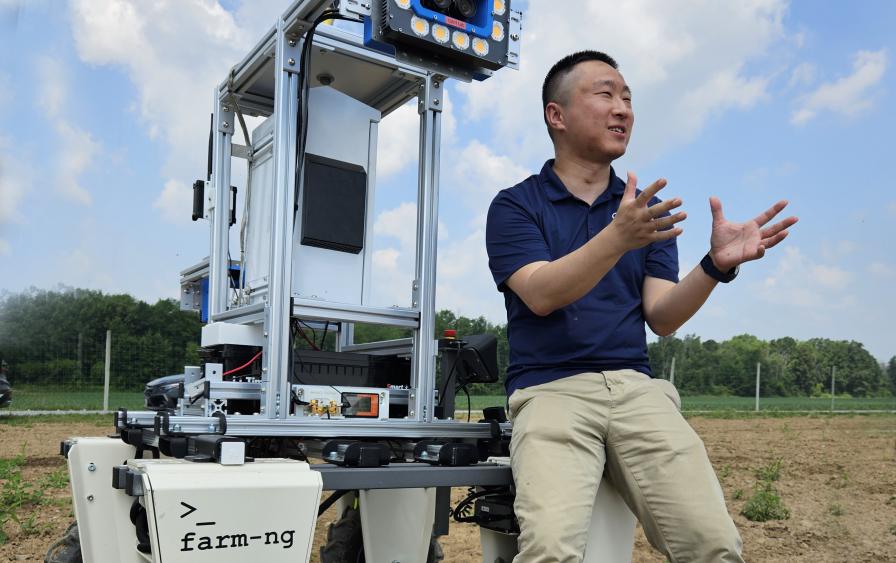
Not every farm robot needs to arrive fully assembled with a hefty price tag. Cornell University’s Yu Jiang is working with an experimental platform growers could largely build themselves using readily available parts and the mechanical skills many already use to maintain farm equipment.
Photo: Carol Miller
Look Beyond Labor
Other technologies can attack the ROI equation by reducing inputs.
Precision spraying is one example. UF/IFAS researchers report that AI-enabled targeted spraying can reduce herbicide use by more than 90% compared with conventional broadcast applications in research settings by applying product only where weeds occur.
USDA Agricultural Research Service researchers are taking another approach with intelligent sprayers that use sensors to adjust pesticide applications to the crop. Importantly for the economics, ARS designed its precision control system so growers can retrofit existing conventional sprayers rather than replace the entire machine.
Those approaches offer another way to think about smart-tech ROI: What expense is the technology replacing or reducing?
Proven — But for Whom?
One challenge for growers is determining where commercial promise ends, and independent evidence begins.
Sosnoskie says researchers are only beginning to generate the independent data growers need for many newer weed-control technologies. Until recently, universities had access to relatively few commercial units for replicated evaluation.
Now, she says, research is beginning to provide more information on efficacy, economics, reliability, and operational fit.
That distinction matters in a market filled with excitement around AI, robotics, precision spraying, laser weeding, and autonomous platforms.
Oregon State University researchers, for example, are evaluating an autonomous solar-powered system that seeds and weeds using precise GPS coordinates. Researchers are studying its potential to reduce labor and field passes, among other benefits.
Promising? Certainly. But that’s different from knowing the system will deliver an acceptable return across different farms and production systems.
Can Smart Technology Scale Down?
That leads to perhaps the biggest unanswered question.
“Are they optimized for a relatively small segment of agriculture, or are they on a path toward widespread adoption?” Sosnoskie asks.
Small and midsize specialty-crop growers face many of the same labor and regulatory pressures as their largest competitors but have far less capital available for technology.
Making smart tech accessible to them may require more than lowering equipment prices. Retrofittable systems, different financing or service models, and equipment that can perform multiple tasks or work across crops could all change the calculation.
For now, growers evaluating smart technology may be better served by starting with their own operation rather than the machine.
What problem needs to be solved? How often will technology be used? What does the current job actually cost? What training, maintenance and support will be required? And what happens if the machine goes down during a critical production window?
Smart technology doesn’t have to pay for every vegetable grower to have value.
It has to pay on your farm, for your crops, and for the problem you’re trying to solve.

For more Smart Tech topics, click here.
Subscribe Today For
