



Are Faster Growth Rates to Blame for Bitter Pit in Apples?
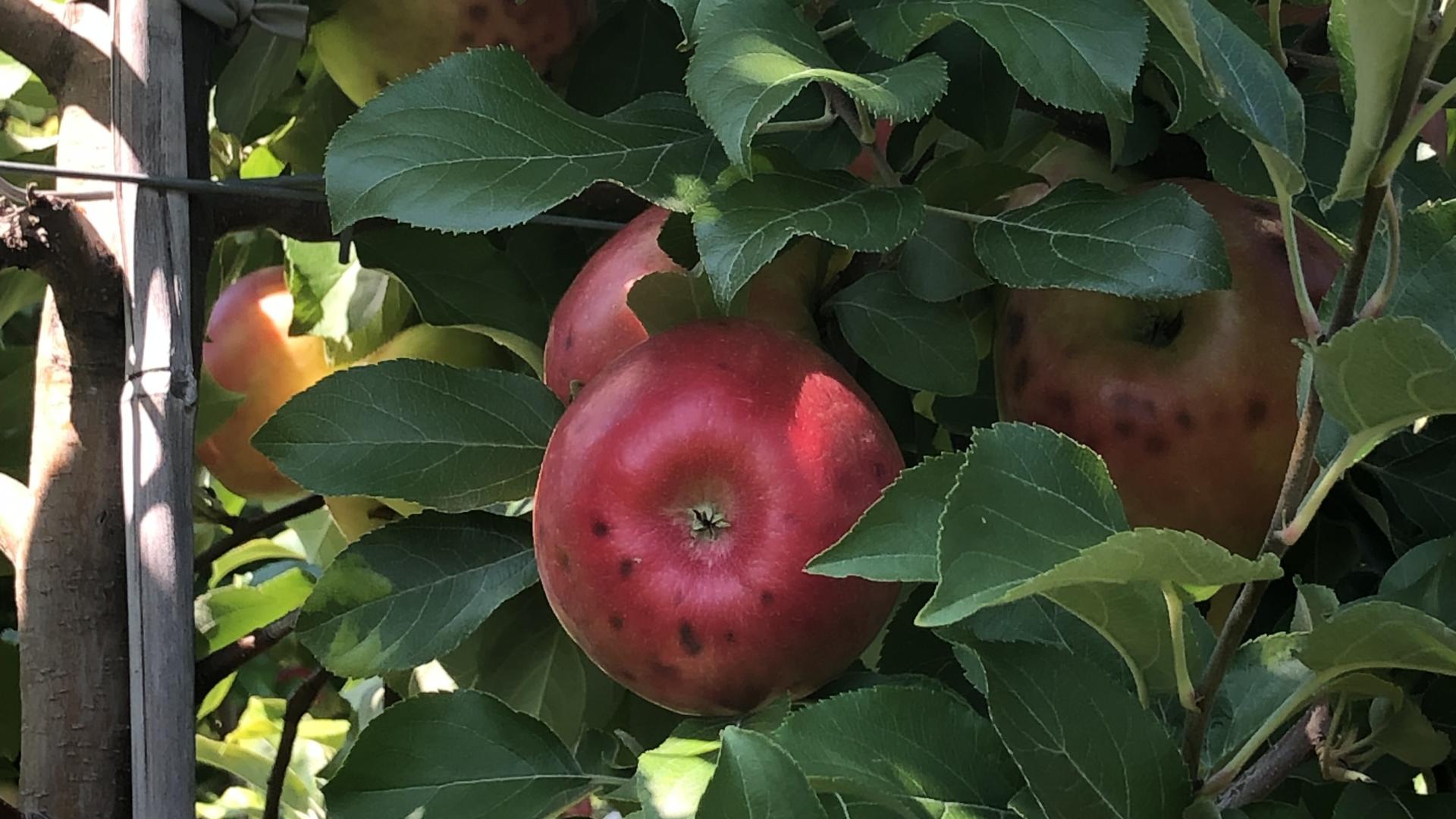
Severe case of bitter pit disorder in ‘Honeycrisp’ apples.
Photo: Todd C. Eihorn
New research reveals that faster growth rates in ‘Honeycrisp’ apples increase both the incidence and severity of bitter pit, which is responsible for large-scale fruit yield losses and avoidable economic impacts for apple producers and storers. This study also reveals these faster growth rates are associated with disruptions to the transport of calcium through the xylem, which the study suggests being a major cause of bitter pit.
Bitter pit is a calcium-deficiency disorder observed in apples. Affected fruits have dark spots of dead tissue that can occur in the skin or the flesh, resulting in an unpleasant appearance and bitter taste that makes the fruit unmarketable. Post-harvest storage can also greatly increase the severity of bitter pit in apples.
“Given the scale of commercial production of ‘Honeycrisp’ in the US, and its relatively high susceptibility to bitter pit, a conservative estimate of annual revenue lost from non-marketable fruit is easily in the tens of millions of dollars,” says study author Dr. Todd C. Einhorn from Michigan State University.
Previous research has shown that larger apples are more susceptible to bitter pit, but the biological mechanisms driving this relationship were unknown until now.
“We wanted to challenge the dogma that mature fruit size was somehow ‘responsible’ for bitter pit,” says Einhorn. “This perception did not provide insight or direction as to when or how growth affects bitter pit incidence.”
These findings, presented in the Journal of Experimental Botany, demonstrate how it is actually the growth rate of apples that drives bitter bit development, rather than size, with faster growth disrupting the transport of calcium through apple tissue toward the peel.
To investigate this relationship, the research team created three growth conditions for ‘Honeycrisp’ apples by altering the number of apples growing on each tree and manipulating the relative resources available to each apple. This resulted in low, medium and high sink:source resource ratios, where low-ratio apples were able to grow faster and larger due to an abundance of resources, while high-ratio apples grew slower and smaller.
They found the highest incidence and severity of bitter pit among low-ratio apples that exhibited the fastest growth rates.
They also found xylem transport in the low-ratio apples dropped by 50% almost two weeks earlier than the high-ratio apples, resulting in a similar decrease in peel calcium content and development of bitter pit.
For more information, CLICK HERE to view the study.
Author Note: The Journal of Experimental Botany is a partially open access journal published on behalf of the Society for Experimental Biology by Oxford University Press. The aim of the Journal of Experimental Botany is to publish papers that advance our understanding of plant biology.
Subscribe Today For
