



Improving Soil With By-Products
 March 8, 2012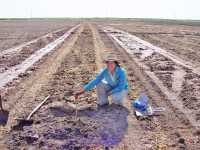
A four-year research study led by soil scientists from Fresno State and California State University (CSU)-Stanislaus has resulted in a new set of protocols to guide the application of food processing by-products on agricultural land.
The principle author of the best management practices manual is Sajeemas “Mint” Pasakdee, from Fresno State’s California Agricultural Technology Institute (CATI).
“The application of by-products to farmlands has become increasingly widespread,” Pasakdee said. “Well-regulated practices are important not only for properly recycling nutrients back into the soil, but also for managing elements of concern — such as sodium — that would otherwise be concentrated elsewhere.”
“The major goal of the manual is to enable growers to effectively use by-products as a soil amendment, causing the least detrimental impacts to soil and groundwater quality,” she added.
Most of the soil sampling work for the study was done in Stanislaus County, located in California’s northern San Joaquin Valley. The county is home to several corporations that process peaches, grapes, pears, and other fruits, as well as vegetables. In processing fruits for canning or freezing, common treatments include a lye bath to remove the skin. Leftover material from the bath, mixed with culls and other unusable fruit parts, comprise the by-product that companies must dispose of.
Because the amount of by-product is too great for landfills, Stanislaus County established a program in 1978 allowing farmers and ranchers to have truckloads of by-products applied to their fields to serve as an organic soil amendment.
The material is typically loaded into trailers at the processing plant and then hauled to participating agricultural sites around the county. It is unloaded onto fields, spread out by a grader and allowed to dry, and within a few days disked into the soil. Geologist Horacio Ferriz from CSU-Stanislaus oversaw measurements of irrigation water infiltration through different types of soils, as well as the movement of salts.
“Water and salts carried by the by-products do move through the soil,” Ferriz observed, “but the impact can be minimized by careful selection of sites where the by-products are applied, and by efficient irrigation management.”
While all participants agree that by-product application enhances soil quality, county and state water quality officials wanted to ensure that salts or metals contained in the by-products do not reach high levels, where they could eventually leach into groundwater aquifers.
“The bottom line is, we are treating by-product application as part of a grower’s soil fertility program,” Pasakdee said. “The manual outlines practices that must be followed to ensure that a nuisance is not created and that there are adequate protections of both surface and ground water as well as soil quality.”
The publication discusses the permitting process required to apply by-products in Stanislaus County, site preparation, soil and plant sampling, record keeping, methods to minimize challenges associated with by-product application, and other issues.
It is titled “Manual of Best Practices for Application of Food Processing By-products on Farmlands” and is available free of charge to growers, food processors, and other interested persons. The practices outlined in the manual are applicable beyond the Stanislaus County geographic area, Pasakdee said. For more information or to obtain a copy, contact Pasakdee at [email protected] or call CATI at 559-278-2361.
Other partners in the study were Dellavalle Laboratory, where soil samples were analyzed, and the Stanislaus County Department of Environmental Resources. Industry partners included Mape’s Ranches & Lyons’ Investments, and Del Monte Foods. Partial project funding was provided by the California State University Agricultural Research Institute (ARI).
Subscribe Today For
