



Lunar Farm Market
 August 29, 2011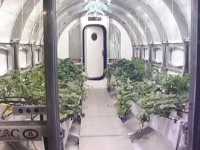
Seeing an astronaut biting into a crisp, recently harvested pepper while breathing in fresh, humid air on the moon could become a normal occurence in the next few decades. Dr. Gene Giacomelli and his team of researchers in the Department of Agricultural and Biosystems Engineering at the Controlled Environment Agriculture Center (CEAC) at the University of Arizona have developed a prototype for a hydroponic lunar greenhouse, where astronauts could grow peppers, tomatoes, potatoes, and other produce on the moon.
Astronomical Beginnings
The idea to develop a lunar greenhouse began after the first journeys to the moon in the 1960s. After it had been proven that space travel was, indeed, possible, the idea of journeying to distant places such as Mars became a topic of debate. It was determined that astronauts would need to have a way to produce their own food in order to survive — hence the lunar greenhouse.
The CEAC received a grant from the Ralph Steckler Space Grant Colonization Research and Technology Development Opportunity two years ago that enabled it to begin developing the lunar greenhouse project. The Center took on the project armed with the results of a successful experimental hydroponic greenhouse project, the South Pole Food Growth Chamber (SPFGC), that it developed for a scientific base in Antarctica. The SPFGC has been operational and has provided researchers who spend long months in the extreme climate with fresh produce and clean, humid air for the last six years.
Phil Sadler of Sadler Machine Co. designed and built the Antarctic greenhouse, and is continuing to work with the CEAC on the lunar greenhouse project. The Thales Alenia Space Italia SpA, an aerospace company in Italy, is contributing to the lunar greenhouse project with technical support, and Aero-Sekur, a specialist supplier of safety systems and advanced flexible materials to the global aerospace and defense markets, is supporting component designs and hardware materials.
The lunar greenhouse prototype functions much in the same way as the SPGC, and both greenhouses share the common goal of growing fresh produce without soil and using the least amount of water and electric lamps instead of sunlight.
All of the elements needed to operate the hydroponic lunar greenhouse can be compressed into a disk 7 feet in diameter and 5 feet wide. This includes the 18-foot long cylindrical frame that makes up the external structure of the greenhouse, as well as all of the organic material necessary to begin production.
How Does It Work?
This hydroponic greenhouse has three main functions: revitalize the air, recycle water and, most important, produce fresh produce for human consumption. It is not yet self-sufficient, since astronauts still need to carry out certain tasks, like transplanting and harvesting ripe fruits.
Even so, some of the tasks are as simple as entering the greenhouse and breathing. Plants need carbon dioxide to survive, just as humans would die without oxygen. As the astronauts exhale carbon dioxide, they are providing the plants with this vital gas. After using the carbon dioxide, the plants give off oxygen.
The astronauts also contribute to the greenhouse with their wastewater. This wastewater, or “grey water,” is filtered through a water recycling system in the greenhouse. With the help of the plants, the grey water is purified; about 50 liters of potable water can be produced every day from the grey water.
The technology used in the lunar greenhouse prototype is so advanced that it warns astronauts if the conditions in the greenhouse are not ideal. If the temperature rises or drops above or below a certain level, the system warns the astronauts. The greenhouse could also be monitored from Earth, where scientists could remotely control certain aspects of greenhouse operations.
The Future Of Lunar Greenhouses
The CEAC has received a second grant from the Ralph Steckler Space Grant Colonization Research and Technology Development Opportunity which will allow it to continue its research over the next two years. The final goal of the project, according to Giacomelli, is to produce plants and produce efficiently, using the least amount of natural resources and funds possible, in order to give a better quality of life to people living in extreme conditions, be it on Earth or on the moon.
To watch an informative video about the lunar greenhouse project, tune into the Events channel on GrowingProduce TV.