



Living The Dream
 July 1, 2007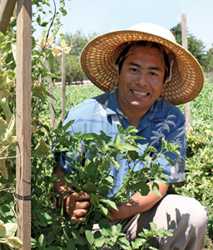
Vegetable growers are known for working hard. But Tchieng Fong’s schedule borders on the ridiculous. Fong, who farms in Fresno County, CA, sells a lot of his produce at farmers’ markets on weekends. Because of that, his weekend schedules get pretty crazy. For example, on Friday nights he’s
up packing vegetables past midnight, usually until about 1 a.m. or so. Then he gets all of about two to three hours of sleep, because he has to be up by 4 a.m. to make the drive to the farmers’ market near San Jose in Silicon Valley.
“When was the last time you took a day off?” a visitor inquires. Fong, a native of Laos in Southeast Asia, shrugs, and then through an interpreter he explains that it was several months earlier. The occasion? With a shy grin the Hmong farmer says that he last missed a day of work so he could go pick up an award from the University of California Small Farm Program as the 2007 Outstanding Farmer of the Year. “Very busy,” says Fong with a shrug.
You get the feeling Fong wouldn’t have it any other way. He came to the U.S. as a Vietnam War refugee with next to nothing, and today is a successful specialty crop grower. Fong farms numerous specialty crops on 20 acres, selling his produce at farmers’ markets, a couple of packinghouses, and a roadside stand his wife Xiong runs during strawberry season each spring from about mid-April to mid-June.
Amazing Diversity
Fong was nominated for the award by Richard Molinar, a University of California Cooperative Extension Farm Adviser in Fresno County. Molinar says Fong has shown a keen interest in improving his production practices by attending grower education courses offered by Cooperative Extension. Fong consults frequently with Molinar, and is also generous about sharing his own experiences with other growers.
“Tchieng is a progressive Hmong farmer,” says Molinar. “He isn’t just sticking with traditional Southeast Asian crops. He’s diversified his crops to cater to the tastes of a diversity of customers.”
The diversity of Fong’s crop mix truly is outstanding. He has a lot of Asian customers, so he does grow a wide variety of Asian vegetables, such as gailon, bittermelon, sinqua, moqua, lemongrass, mustards, water spinach, yam leaves, snow peas, and bok choy. But as Molinar says, he also grows many traditional American vegetables, such as artichokes, carrots, onions, asparagus, and broccoli, as well as fruits such as blackberries, blueberries, and strawberries.
But there are many, many more. They can vary all the way from bamboo shoots to a vegetable that most Americans think of as a sponge, luffa. In fact, when you ask Fong exactly how many crops he does grow, and he shrugs and replies “40 or 50,” you get the feeling that even he really isn’t sure. That’s partly because though he grows a lot of certain crops, such as sweet peas, he has very small amounts of others. For instance, he grows just a few trees called “yuj” in Hmong, and Fong sells four small stalks from the tree for a dollar, which the Hmong will use to make tea.
Mostly Organic
Fong’s farm looks very different from the average American operation. The vast variety of crops in such a relatively small area is immediately apparent. In addition, there are more weeds here and there, though that is, strangely enough, mostly by design. (Yes, some weeds are desirable on a Hmong farm. See sidebar, “That’s No Weed.”)
But weeds are also Fong’s biggest headache, which is not really a surprise as he farms as much organically as possible. Fong has no employees
per se, but gets a great deal of help from his extended family. They do battle with the weeds with a Hmong hoe, which is like an American hoe, but larger.
And while family members do help out a lot on the farm, his own kids have become quite Americanized. (He and his wife have four children, ages 16 to 27.) In fact, their reaction to their parents’ move to the U.S. and subsequent successful foray into farming has been something less than overjoyed. Asked if his children show any interest in taking over the family farm, Fong looks at his visitor in feigned wonder. Then he lets out a big laugh, shakes his head, and says simply, “No.”
Subscribe Today For
