



How To Manage Early Blight in Your Potato Crops
 April 30, 2025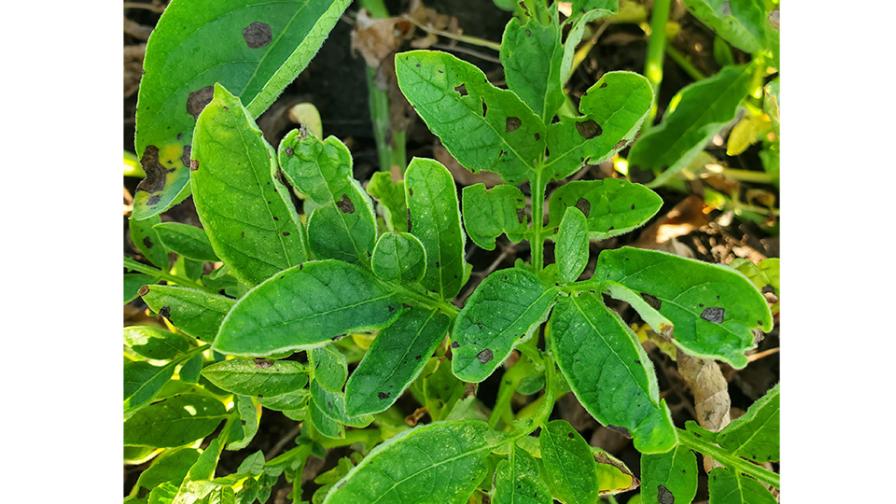
Early blight symptoms on potato.
Photo by Carrie H. Wohleb
Early blight, caused by Alternaria solani, reduces potato yield and quality and is best managed with cultural practices and fungicides.
Symptoms
Leaf symptoms appear as dark brown lesions in circular to angular shapes with concentric rings of dead tissue. Leaf veins restrict lesion expansion, limiting their overall size. As the disease advances, additional spots form, and the surrounding leaf tissue becomes yellow. Small, fleck-like lesions can also develop on the petioles and stems. Over time and in severe cases, the affected leaves curl and die, although they usually remain attached to the plant. Tuber lesions are dark, sunken, and irregular, often surrounded by a raised margin. The decayed tissue is leathery or corky.
Cultural Management
Cultural practices that reduce early blight pressure include planting resistant varieties and rotating with non-host crops like grains or legumes. Balanced nitrogen fertilization is key — excessive nitrogen produces dense canopies that stay wet longer, while nitrogen deficiency stresses the plant. Both conditions increase disease susceptibility. Avoid excessive irrigation to limit prolonged leaf wetness, which favors spore development. Harvest tubers when fully mature with good skin set, wound-heal tubers in storage, and destroy or speed the breakdown of infected plant residues after harvest.
Fungicide Use
Fungicide timing should be based on disease risk. Early blight is more aggressive in regions with moderate temperatures, high humidity, and frequent rain. In these high-risk regions, fungicides should be applied earlier and more often.
In regions with a high risk for early blight, the optimal time to begin fungicide applications is when airborne spores are first detected. Disease forecasting models can help growers time sprays more accurately. Where disease pressure remains high, follow-up applications are made every 5 to 7 days. In lower-risk areas, the first application is often made at or just before row closure, with follow-up sprays at 14-day intervals or ahead of forecasted humidity or rain.
Regular scouting and weather monitoring are essential. If symptoms worsen or environmental conditions suddenly favor disease development, shortening the spray interval can help to minimize early blight spread.
Fungicide Types
Two types of fungicides are used: protectants and systemics.
Protectant fungicides prevent pathogens from growing and penetrating plant tissues. They must be applied before the pathogen arrives, as they do not cure existing infections. These broad-spectrum products remain on the surface and do not move within the plant. Leaves produced after the application will not be protected. Common examples include chlorothalonil (e.g., Bravo), metiram (e.g., Polyram), mancozeb (e.g., Dithane), and copper-based products (e.g., Badge). Protectants are the foundation for managing early blight and other foliar diseases, such as brown spot and late blight.
Organic potato growers are limited to protectant fungicides, including copper-based fungicides and Bacillus subtilis biofungicides, for early blight management. When these are the only options, starting early and repeating at shorter intervals is generally advised.
Systemic fungicides are absorbed into plant tissues and can inhibit pathogen growth after infection. They are most effective when applied within hours or a few days of infection. Depending on the product, the systemics used for early blight management will either move across the leaf (translaminar movement) or upward in the plant’s vascular system (xylem-mobile). Only the more mobile products will protect new growth after the application.
Systemic fungicides are more selective than protectants and target specific groups of pathogens. Systemic early blight products include triazoles (FRAC group 3, e.g., Provysol, Quash), carboxamides (FRAC group 7, e.g., Endura, Priaxor), pyrimethanils (FRAC group 9, e.g., Scala), QoI fungicides (FRAC group 11, e.g., Quadris, Tanos), and organo tins (FRAC group 30, e.g., Super Tin).
Tank Mixes and Resistance Management
A common strategy is to tank mix systemic fungicides with a protectant. One broad-spectrum protectant is sufficient, while one or more systemic products may be added to target additional diseases. Some products are pre-mixed formulations with multiple active ingredients and modes of action for broader control.
To manage fungicide resistance, rotate products with different modes of action, especially when using selective systemic fungicides. A good rule is to avoid more than two consecutive applications from the same FRAC group. Resistance to QoI fungicides (FRAC Group 11) and many carboxamides (Group 7) has already been observed in Alternaria solani populations.
Subscribe Today For
