



Is There a Steamy Solution for Strawberry Pollution?
 July 6, 2026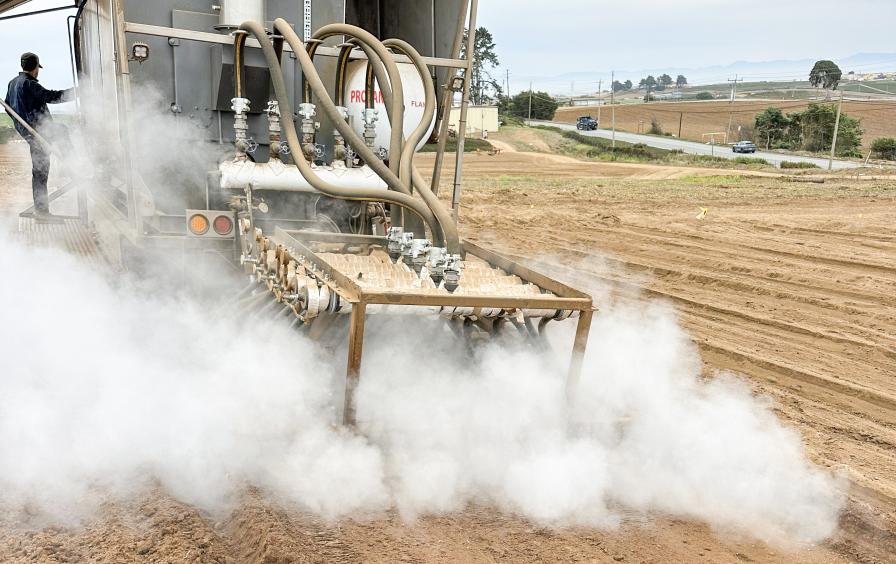
A steam treatment machine operates in a Central Coast strawberry field, where researchers are testing steam as a potential alternative to toxic fumigants used near schools and residential areas.
Photo: Bob Johnson
Steam may provide an answer for California Central Coast strawberry growers facing growing opposition to the use of toxic fumigants near schools, daycare centers, and residential neighborhoods.
Strawberry growers typically rely on fumigants to control persistent soil-borne diseases that can destroy crops and survive in fields for years. Researchers say steam can be just as effective — if it can be made economically viable.
“I’ve been working on steam with strawberries for 15 years,” says Steven Fennimore, University of California Cooperative Extension Weed Specialist Emeritus. “If you get the soil warm enough for 40 minutes, it’s the same as fumigation.”
Fennimore is part of a team studying steam as an alternative treatment for strawberry fields located near sensitive sites.
A Multi-Year Research Effort
“The grant is for a multi-year study and it’s a good amount of money,” says Jenny Broome, a University of California, Santa Cruz Plant Pathologist and Principal Investigator on the project.
California produces about 90% of U.S. strawberries, much of it in Santa Cruz, Monterey, and Ventura counties, where farms often border residential communities. Use of fumigants near schools has been controversial for decades; in 2025, a Watsonville resident staged a hunger strike protesting pesticide use near local schools.
“In Santa Cruz County we have an agriculture-urban interface around Watsonville,” says David Sanford, the county’s Agricultural Commissioner. “We have strawberry fields close to schools and neighborhoods. I think steam shows a lot of promise.”
Early Adoption by Growers
Some organic growers have already experimented with steam to control persistent soil pathogens.
“Two years ago, I had a fusarium problem in the organic fields,” says Ron Koda of Shinta and Kawahara Farms outside Watsonville. “Steam has been used in the greenhouse for decades and we’ve been able to build a machine that works in the field.”
Koda, who represents generations of strawberry farming in the Watsonville area, steam-treated infested beds this year as part of trials comparing steam, fumigation, and untreated ground at four sites in the Watsonville and Salinas regions.
The Economics Challenge
Researchers say the effectiveness of steam is largely established; the main hurdle is cost.
“The cost depends on how much volume of soil you treat,” Fennimore says. “With strawberries you have to treat the bed, but we’re working on a machine that will treat spots through the tarp.”
An autonomous rig capable of treating strawberry beds without a driver is already being tested in the trials.
“It’s still not commercially scaled, so there are problems with the economics,” says Hillary Thomas, Research and Technical Director at Naturipe Berry Growers Inc. in Salinas. “But it looks like a short-term answer for organic farms or fields in buffer zones.”
Industry leaders say the research may provide growers with an option in sensitive locations.
“Steam kills pathogens,” says Bill Turecheck, Vice President of Research at the Watsonville-based California Strawberry Commission. “We need to make sure steam is a viable alternative to fumigation.”
Improving Efficiency Through Technology
During the four-year study, researchers hope to reduce costs by designing equipment that injects steam through holes in plastic mulch, treating only the soil where strawberry seedlings are planted rather than entire beds.
The project also examines broader biological strategies, including studying pathogen history, testing disease-tolerant strawberry varieties, and evaluating rotation crops such as broccoli that can help reduce fungal disease pressure.
Early Results Show Promise
It will be several months before researchers can fully evaluate disease control and yield impacts, but preliminary findings are encouraging, particularly for weed suppression.
“We need to get the steam a little deeper, but it worked,” Fennimore says.
Koda says early results on his farm have been positive. “It seemed to reduce the weed population,” he says. “What’s so encouraging to me is that we’ve been able to build a steam machine that works in the field.”
Policy Pressure May Accelerate Change
The transition toward steam treatment near schools and daycare centers could ultimately be driven by regulation. The California Department of Pesticide Regulation’s Sustainable Pest Management Roadmap aims to reduce the most toxic agricultural chemical uses by 2050.
For growers facing increasing restrictions, steam may represent one of the few workable paths forward.
Subscribe Today For
