



Targeted Weed Control Using AI Can Save Tomato Growers Big
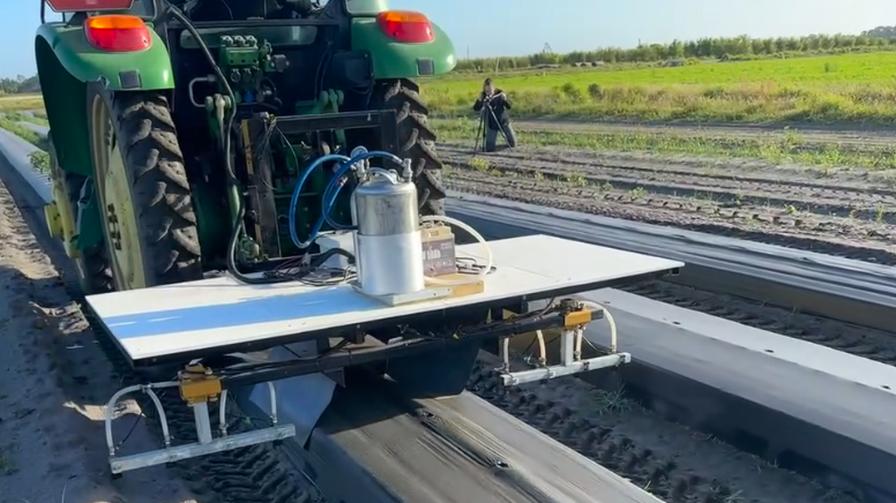
Targeted weed control could help growers save time and money. Machines like this one use AI to detect weeds so that scientists and eventually growers can vanquish only weeds – and avoid the crops near the weeds.
Photo courtesy of UF/IFAS
DYK? Targeted weed-spraying can save tomato farmers 71% of the herbicide they use. This according to new University of Florida research. It also cuts input costs related to weed management for growers by 75%. The results mean that targeted spray technology lowers the amount of herbicides in the environment, says Nathan Boyd, a UF/IFAS Professor of horticultural sciences.
Findings from the study that was reported on earlier this year are crucial to the Florida tomato industry. Most Florida tomatoes are grown in open fields, using plasticulture.
“With the standard method, we would have applied herbicides over an entire area,” Boyd says. “Targeted spray technology that uses artificial intelligence (AI) to detect weeds allows you to apply herbicides only where the weeds grow.”
The new study is the first to show that combining several targeted spray methods into one weed-control program can work effectively for vegetable crops like tomatoes — offering significant economic benefits.
Thanks in part to funding from the USDA, Boyd and his team used AI technology to spray weeds in three distinct locations in tomato fields at the UF/IFAS Gulf Coast Research and Education Center in Balm, FL.
Scientists sprayed three ways:
• They aimed at weeds growing in the bare soil between the raised plastic-covered beds, rather than spraying the entire area.
• They sprayed into transplant holes on top of plastic beds. Weeds can emerge in this area and compete directly with the crop. Boyd’s technology uses machine vision to locate each hole in the plastic and apply herbicide only in those transplant holes, which drastically lowers overall herbicide use.
• They targeted nutsedge. This is a weed that punctures the plastic on the bed. Boyd’s team uses machine vision to locate the nutsedge and only applies herbicides where the weeds grow.
Targeted spraying worked just as well as traditional spraying to control weeds, Boyd confirms.
In the future, Boyd says he hopes to commercialize these technologies to growers.
Read more at blogs.ifas.ufl.edu.
Subscribe Today For
