



New Innovations on the Grow for Muscadine Grapes
 February 15, 2025
 I have been writing a berry column for a number of years and have refrained from many mentions of other fruits I worked with during my fruit breeding career at the University of Arkansas. However, there are exciting advances going on muscadine grapes that I want to share. And the fruit of grapes are botanically a berry, so I think I am safe venturing into this discussion.
Muscadines are a disease-resistant grape relative native to the southern U.S. They boast incredible flavor and aromatics. One of the more famous varieties called ‘Scuppernong’ was selected from the wild. Breeding of muscadines has been going on for more than 100 years, with several breeding programs advancing the crop substantially.
North Carolina State University introduced the first perfect-flowered varieties, eliminating the need for pollinators in commercial plantings, and ‘Carlos’ from NC State is the most important processing variety for wine or juice. The University of Georgia introduced many fresh-market varieties that increased berry size and quality, with ‘Fry’ being the most important. More recently Patrick Conner at Georgia has released some innovative new varieties with large berries, improved texture, and perfect flowers. A private program at Ison’s Nursery in Georgia released a wide range of varieties, including ‘Supreme’, which offers improved texture and skin properties.
I began a muscadine breeding program in 2006 at Arkansas, and my goal was to improve texture and skin characteristics further. Muscadines have traditionally been challenging to eat due to thick skins and pulp, plus large and bitter seeds. As accomplished Arkansas muscadine breeder Margaret Worthington often states, muscadine flesh has been compared to “eyeballs,” “oysters,” and “snot”! Or one might say muscadines were not that appealing to a broad market. I believed there was some quality potential to be uncovered in continued breeding, particularly with parents such as ‘Supreme’ and ‘Tara’.
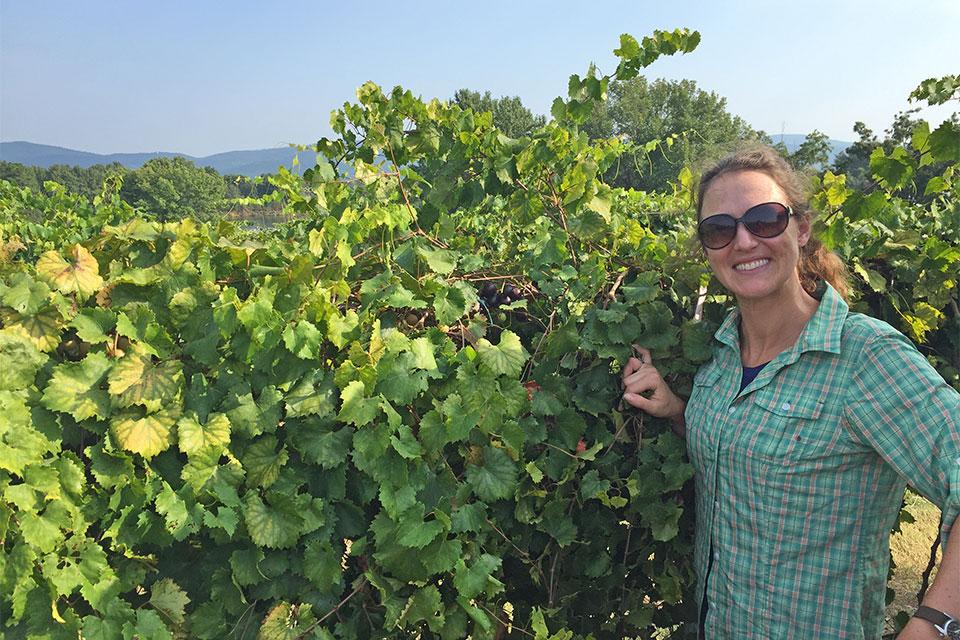
John Clark on University of Arkansas Assistant Professor Margaret Worthington: “The most inspired muscadine breeder I have ever met.” Photo by John R. Clark
I focused on improved crispness and thinner, more edible skins along with larger berry size, perfect flowers, and healthy, productive vines. I remember the day in 2014, on row 44 of the research vineyard at the University of Arkansas Fruit Research Station, when I was evaluating seedlings from a cross of the best-textured selections in the program. I found in the seedlings what I felt was the advance I had envisioned back in 2006. However, with the crisp texture, the seeds were much more noticeable. I thought one more step must be made here to combine this texture with seedlessness.
Jeff Bloodworth, a private breeder in North Carolina, is the genius that combined seedlessness from bunch grapes with muscadines. The challenge in this process is that muscadines have 40 chromosomes, and bunch grapes have 38. This difference in chromosome number usually resulted in poor success in breeding. Bloodworth persevered for years and finally was able to bridge this genetic gap and achieve the first seedless muscadines. His variety, ‘Oh My!®’, is a bronze-colored, seedless variety, quite a breeding achievement. Bloodworth developed a relationship with Gardens Alive!, and they patented the process of seedless muscadine breeding. This prevented others, including the Arkansas program, from using the same breeding approach Bloodworth had used to breed seedless muscadines. Fortunately, Worthington, who began leading the Arkansas breeding effort in 2016, was able to make an agreement with Gardens Alive! that allowed use of germplasm that Bloodworth developed.
Worthington is the most inspired muscadine breeder I have ever met. A native of North Carolina, she grew up with an appreciation of muscadines. When the opportunity came along for her to lead the Arkansas breeding program, including using the improved-textured muscadine selections and then adding seedless parents to the mix, her excitement increased to even higher levels. She intends to change the fruit category with improved muscadines. Her advances, plus continued releases from Gardens Alive! and Bloodworth’s efforts, have the potential to change this fruit from a limited market in the South to a much wider consumer audience.
There are a few challenges beyond genetics to fulfill this potential. One challenge is to expand the marketing season from approximately two months to a much longer period. This can likely be achieved by expanding growing regions for earlier and later harvesting. Improved postharvest storage potential will allow fruit to be stored for extended marketing season. And who knows, maybe muscadine production can be established in other regions of the world as done with other grapes and berries and lead to year-around marketing! The pieces of the puzzle are coming together genetically, and the potential for industry expansion is very promising. I suggest we all pay close attention as this story develops further.
Let the muscadine and berry good times roll!
Subscribe Today For
