



Preventing Noise-Induced Hearing Loss
 November 1, 2008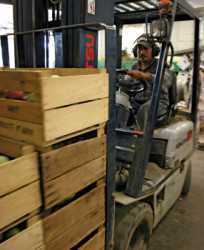
Young orchardists and other fruit growers are often unaware that noise-induced hearing loss may already be occurring. They sometimes think it’s a problem for “older” growers or that it won’t affect them at all.
Yet research has shown that young agricultural workers often do have hearing damage. One study in Wisconsin found that approximately 25% of the male farmers surveyed reported hearing-related communication problems by the time they had reached the age of 30. Other research has shown that hearing loss can increase the chances of serious injury, including when working on or around hazardous equipment.
While a hearing aid can amplify sounds, it will not restore lost hearing. Once your hearing is gone, it is gone. There are, however, ways to reduce the risk of noise-induced hearing loss.
Understanding The Risks
Understanding how noise-induced hearing loss can occur is a good first step in preventing it. If you need to raise your voice to be heard an arm’s length away, the noise could be loud enough to damage your hearing.
Among the ways exposure to noise above 85 decibels can occur are these:
• Listening to loud music through the headphones of personal music players.
• Attending a loud concert.
• Operating a tractor without an enclosed cab or with the cab doors or windows open.
• Operating a forklift or other noisy equipment inside a packinghouse.
• Using a chain saw, circular saw, table saw, or hand drill.
One sign that hearing damage has probably occurred is when you have trouble understanding what a co-worker, family member, or friend is saying, particularly when using a cell phone. Another sign of hearing damage is a “ringing” in the ears. This is called tinnitus. Instead of ringing, some people hear hissing, roaring, whistling, chirping, or clicking sounds. Tinnitus can show up and become permanent before you even notice hearing loss.
Tips For Fruit Growers
• Identify noisy tasks on your farm, in your packinghouse, and in your shop that could be harmful to your hearing or to the hearing of your employees.
• Stay away from noisy equipment when you don’t need to be near it.
• When operating a tractor with a cab, keep doors and windows shut.
• Wear hearing protection whenever you are exposed to loud noise. Know that hearing protectors are available in hundreds of different styles.
• Keep hearing protection in a convenient location so it is available when you need it. Put earplugs in your pockets every morning when you grab your cell phone and your keys. Hang earmuffs or canal caps (earplugs attached to a band) on your tractor’s steering wheel.
• Reduce equipment noise in your packinghouse and on your farm. Replace worn, loose, or unbalanced machine parts. Make sure all equipment is well lubricated and maintained.
• Make use of the many good free resources available to learn more about noise-induced hearing loss. Among these are two new brochures from the National Institute for Occupational Safety and Health (NIOSH), Centers for Disease Control and Prevention that are specifically aimed at young growers, “They’re Your Ears: Protect Them – Hearing Loss Caused by Farm Noise is Preventable” and “Have You Heard? Hearing Loss Caused by Farm Noise is Preventable: Young Farmers’ Guide for Selecting and Using Hearing Protection.” Both can be accessed online at www.cdc.gov/niosh/topics/noise/pubs/no_pubs.html. Printed and bulk copies are also available at no cost by eMailing [email protected]. Other resources include the NIOSH Noise and Hearing Loss Prevention Web page, www.cdc.gov/niosh/topics/noise; Dangerous Decibels, www.dangerousdecibels.org; the American Tinnitus Association, www.ata.org; the National Hearing Conservation Association, www.hearingconservation.org; and Hearing Education and Awareness for Rockers (a non-profit group that educates young people about the dangers of exposure to loud music),
www.hearnet.com.
• Train your employees in how they, too, can reduce the risk of noise-induced hearing loss.
Subscribe Today For
