



Just Peachy: Why Clean Plants Lead To More Productive Orchards
 October 31, 2025
 Have you purchased fruit trees from a reputable nursery and noticed a charge item in the invoice stated as “virus testing” and/or “clean budwood program?” Although you might wonder what this additional charge is, we need to be thankful for such programs.
In South Carolina and Georgia, peach is a major specialty crop, generating approximately $244 million for the local economy (USDA-NASS, 2024). Georgia and South Carolina rank second and third, respectively, in peach production across the U.S. Bearing acreage in South Carolina is up to 15,800 acres, with Georgia following at 7,600 acres.
During my tenure at UGA working with peach growers, I noticed growers replaced about 10% of their acreage every year, corresponding to ~2,500 acres of new trees every year. An orchard will stay in the ground approximately 10 years until being removed and replanted.
Imagine that all those trees replanted every year came from irreputable nurseries and that a plan/structure was missing to make sure that such plant materials are kept clean of major pathogens. The trees planted every year could become the source of inoculum that could easily decimate an industry and destroy the livelihood of different communities.
For peaches in the southeastern U.S., the clean budwood program is in Clemson under the direction of Dr. Elizabeth Cieniewicz. The program helps growers and nurseries to test peach blocks every year that will serve as budwood source for nurseries. Nurseries receive updated maps of the blocks for easy collection of clean budwood.
The budwood program has resulted in lower virus incidence in South Carolina and Georgia over the last two decades based on testing data (Source: Southeastern Fruit and Vegetable Conference, Cieniewicz, 2022). Similarly, its test protocols are improved and updated frequently to allow a more diverse panel of pathogens to be detected if they were to be present in the orchards.
In the last few years, three different pathogens have been detected in different locations: PNRSV (prunus necrotic ringspot virus), PDV (prune dwarf virus), and PLMVd (peach latent mosaic viroid). PLMVd and PNRSV are most widespread across the Southeast, and PDV is more rare but still detected every year. Estimates from the virus testing program suggest that PLMVd incidence across the Southeast is ~20%, PNRSV approximately 5%, and PDV less than 1%.
Although PDV is relatively rare, we have encountered orchards that are 100% infected with PDV, likely because the trees were derived from virus-infected mother stocks. There are reports of all three pathogens across different regions of the world as well, and all three are graft and pollen transmitted. Only PLMVd is transmitted mechanically on contaminated tools.
In the case of PNRSV, leaf shot holing is observed in the early stages of infection, which can be easily misidentified as copper burning. PDV infection may be asymptomatic or associated with stunting of the trees.
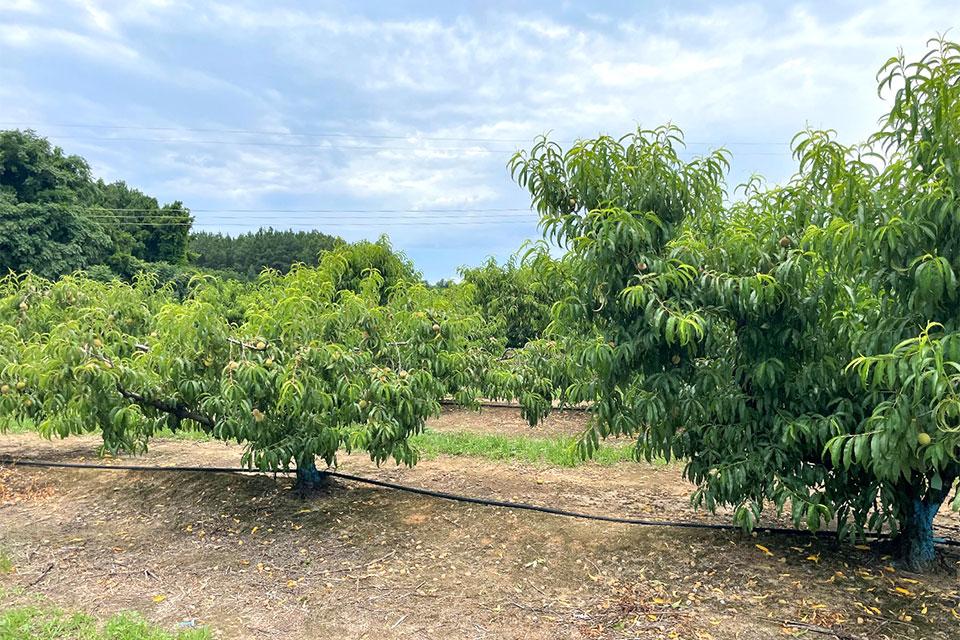
PDV (prune dwarf virus) associated with stunting in peach trees.
Photo by Dr. Elizabeth Cieniewicz
PLMVd infection can often be latent or non-symptomatic, depending on the strain or strains that are infecting the plant. Among the symptoms that some strains causes are leaf mosaics, in extreme cases albinism (peach calico), flower streaking, leaf bud break delay, delay in flowering and ripening, decoloration and fruit deformation, bud necrosis, stem pitting, and premature aging of trees. Symptoms can be variable with one or more present depending on the strain. In the Southeast we mostly have observed fruit deformation and delays in foliation and flowering with PLMVd infection.
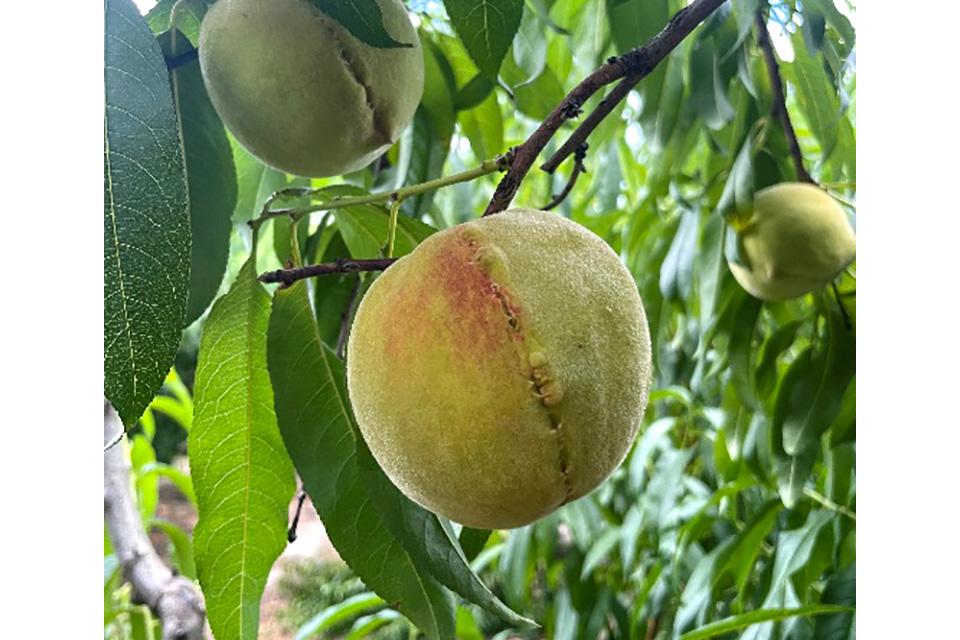
PLMVd (each latent mosaic viroid) showing fruit warts.
Photo by Dr. Elizabeth Cieniewicz
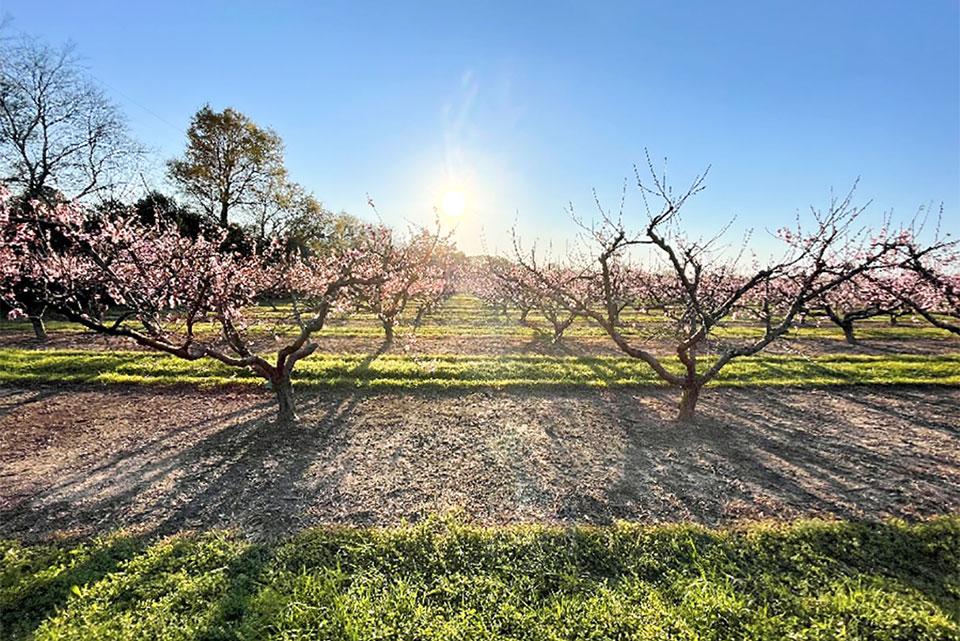
PLMVd and delayed flowering.
Photo by Dr. Elizabeth Cieniewicz.
What are the implications of having high virus incidence in a region? First, we need to identify the problematic viruses and determine their impacts on our production. We also need to understand how these viruses might affect tree physiology and susceptibility to other stresses.
RELATED CONTENT: What the Future Holds for Southeast Peach Production
Perhaps even the “asymptomatic” infections are increasing susceptibility to other pathogens and environmental stresses. There is also some uncertainty on how these viruses are transmitted in the orchards. For example, one question has come up by growers in Georgia. What would be the situation if we had some of these pathogens in our orchards; could they affect bloom in our trees? What would be the situation in infected trees if we had issues with chill accumulation during a specific year at your location? Can we functionally have more of a lack of chill issues happening in infected trees in places with reduced chill accumulation? How about issues with fruit?
All of these can be difficult situations to handle for an industry in a region such as the southeastern U.S. Many questions about the virus biology and ecology in the orchard remain. One thing is certain: The most effective way to prevent viruses from affecting orchards is to ensure that trees start clean at planting. If you are a grower or a researcher, it is important to stay informed and keep supporting programs such as this.
Subscribe Today For
