


Why the Tale of Twin Peaks Orchards Is One of Growing Optimism
 April 4, 2026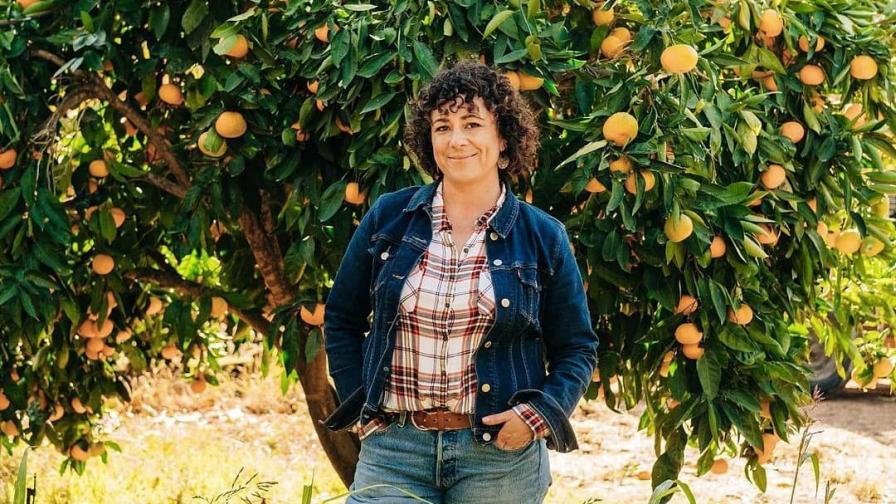
Camelia Enriquez Miller, co-owner of Twin Peaks Orchards in Newcastle, CA.
Photo: Twin Peaks Orchards
Twin Peaks Orchards is a mid-scale farm — and never more proud of it after 114 years. Co-owners Camelia Enriquez Miller and husband Justin Miller spend their days not only trying to grow the best stone fruit, citrus, and Amagaki persimmons from their Newcastle, CA, fields, but also spreading positivity on behalf of the industry.
“There’s nothing more American than farming,” Justin says. “That’s what the country was built on, and we are big advocates of the small- and mid-scale family farm operations. Where that goes is where farming goes. In California specifically, the longest tenured farms and the farms that control the most acreage are mid-scale farms.”
Camelia, the fourth-generation successor to great-grandparents Yoshichika and Tomeo Nakae, who founded Twin Peaks in 1912, finds inspiration in what she calls “positive movements and changes” and the “feel-good stories” they trade. Two such examples are agritourism and Slow Food USA, whose mission is to unite the joy of food with the pursuit of justice.
“I was just at the Visit California ag tourism convention, and I was really excited to see the interest in small- and medium-scale farming from people who aren’t involved with farming — tourism groups that were interested in telling our story,” Camelia says. “When we hear that positive reinforcement, it just motivates us.
“We have great relationships with small grocery stores all the way up to Whole Foods Market. We have great relationships with a lot of buyers and customers, restaurants and chefs in the area. They do a fantastic job telling our story. More people want to know who we are, and we have a good platform to talk about what mid-scale farming is like, from the challenging to the rewarding.”
RISE TO THE OCCASION
Most of the recent challenges — at least since a 2020 fire destroyed the farm’s historic packing shed — have involved extreme or inconsistent weather. “Just a bunch of funky stuff,” Justin says, noting not enough chill hours followed by freezes, hail, rain late, and rain all summer long. “You know, 112 degrees in October,” he adds.
Still, the Millers remain positive. Their story revolves around 102 acres, all of which are 100% certified organic. They grow 50 varieties of peaches and 40 varieties of nectarine as well as persimmons, apples, Asian pears, jujube, and citrus, all of which is picked tree ripe. In February 2025, Twin Peaks was recognized as a Slow Food Farm, one of the first to comprise what the organization anticipates will become the “largest network of farms dedicated to producing good, clean and fair food in a way that is rooted in agroecological principles.”
“No one wants to hear a bunch of negative stuff all the time; the sky is falling, you know,” Justin says. “It’s what are you going to do with it? How are you going to meet those challenges? We all know farming’s one of the most difficult jobs in existence, so we can’t just lament constantly on how tough it is. How are we going to meet those challenges? How are we going to rise to the occasion? That’s critical.”
Adds Camelia: “It’s exciting that we’re able, in our position, to influence and encourage new farmers. We’re showing that you can do it, and you can enjoy it, and it can be successful.”
Subscribe Today For
