


Smart Tech
Unique Almond Variety Generates Exciting Times for Plant Genetics
 January 9, 2026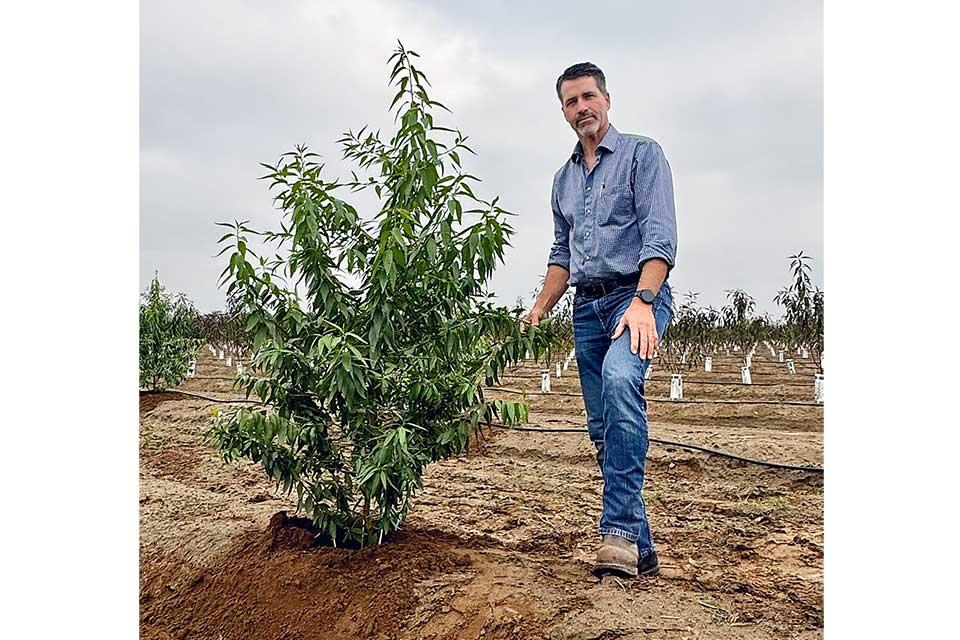
Burchell Nursery owner Tom Burchell presents one of the young self-compatible Nonpareil+ almond trees planted at his test orchard in Fowler, CA. “We’ve come a long way in one year,” he says.
Photo: Burchell Nursery
With 3,000 miles between them — and not much precedent behind the wheel — Stephen Dellaporta, in New Haven, CT, and Tom Burchell, in Oakdale, CA, began a gene-editing partnership in 2019. Their destination: creation of the first Nonpareil almond that is self-compatible and pollen cross compatible with any other almond variety.

“When Tom and I got started on this project, even though there had been enormous activity and investment by a number of people, nobody had regenerated Nonpareil in tissue culture. It hadn’t been done,” Dellaporta, the founder of agricultural genomics company Verinomics, says. “We had our hands full, Tom and I.”
Which says a lot about the task at hand.
Verinomics, since 2016, has been integrating genomics, computational biology, and gene editing into breeding programs to accelerate crop innovation. Dellaporta doubles as a Professor of Molecular, Cellular, and Developmental Biology at Yale University.
“I still have a university appointment, and I teach genetics at Yale, but I would say much of my time these days is spent at Verinomics, applying a lot of the technology we have developed to commercial objectives,” he says.
Meanwhile, Tom Burchell, the third-generation owner of Burchell Nursery, is no stranger to breeding himself. His company, largely through classical breeding, has developed and introduced numerous nut and fruit varieties since its inception in the 1940s, culminating in the incorporation of Burchell Breeding in 2020.
PRECISION BREEDING
What Burchell had not yet developed before collaborating with Verinomics was a self-compatible version of Nonpareil, the most prominent almond variety in California, one that commands a premium price due to consumer demand.
“We’re sort of molecular experts (at Verinomics),” Dellaporta says, “but the (almond) crop itself we knew very little about until we met Tom. He explained the crop, how it was grown, and what problems might be addressable using the technology that we had available.”
Self-compatibility was the primary concern, considering the trait has already been bred out of most crops. “Peaches, you don’t think of self-incompatibility because now modern peach varieties are self-compatible,” Dellaporta says. “But almonds sort of lagged behind, and the benefits from self-compatibility were obvious.”
The ensuing project required developing an entire tissue culture platform of being able to take the plant, put it into tissue culture, edit it, and regenerate the edited products.
“So, it was a long, difficult road the first few years, but once we broke that barrier, the floodgates opened,” Dellaporta says. “In our pipeline we can produce new products with Tom in four to six months. That’s how fast the turnaround time is. And this is a tree crop. Just doing a standard cross can take years to see the results.”
Best of all, the technology behind Nonpareil+ allows Burchell to keep the variety’s identity. “Don’t change a bit about Nonpareil, but just remove self-incompatibility,” Dellaporta says. “That has tremendous value to growers.”
THE NEXT STEP: IN-FIELD TESTING
Many such growers are “really curious and interested” to test Nonpareil+ in real-world situations alongside their current crops, according to Burchell.
“That’s our next phase in 2026. We’ve been propagating the trees in our nursery this past summer, all summer long, so that we can have trees available for distributing this spring,” Burchell says. “We’ve multiplied, and we’ve micro-grafted and grafted trees, and we’ve got trees in the greenhouse, in pots, over 6 feet tall, ready to go out this spring into these test orchards. We have thousands of plants.”
Of significance, Nonpareil+ is not a genetically modified organism (GMO).
“This is not a GMO,” Dellaporta says. “There’s no labeling required by the federal government or by the USDA. Nothing’s changed to this Nonpareil. That’s the beauty of gene editing. You can take a variety that’s in high demand and correct a problem. In this case, we corrected self-incompatibility. But there are other problems you might want to correct, and that’s where I get excited about working with trees and other vegetatively propagated crops, because it will never substitute for breeding new varieties. What this is is a technique that can enhance breeding.”
Having taught genetics at Yale since 1986, Dellaporta calls this perhaps the most challenging and fulfilling phase of his career.
“You see the impact this is going to have,” he says. “Growers are going to be able to produce more Nonpareil nuts per acre. It’s going to cut down on a lot of the inputs, the harvesting, and so forth. Bees aren’t going to be as necessary. It has such a beneficial impact for the industry and for the environment. This is an exciting time to be working in plant genetics.”

For more Smart Tech topics, click here.
Subscribe Today For
