



Important Factors Driving the Next Wave of Vegetable Planting Equipment
Mechanical transplanters have long relied on the same basic seedling delivery principles. Today, they generally fall into four categories — manual, semiautomatic, automatic, and autonomous — distinguished by how much human involvement is required to feed, operate, or support the planting process.
“There is new semiautomatic, automatic, and autonomous technologies on the market that could potentially benefit vegetable growers for transplanting bare ground or plastic fields,” Dr. Luan Oliveira from the University of Georgia says.
Learn more at the University of Georgia’s in-depth Extension publication: https://fieldreport.caes.uga.edu/publications/B1576/mechanical-transplanters-for-tree-fruit-and-vegetable-seedlings/
Though researchers at University of Georgia haven’t been able to test these, Dr. Oliveira shares that there is a new transplanter on the market that can transplant into plastic. Two examples are the Model 912 from the Mechanical Transplanter Co. and the Wolf Pro from the Checchi&Magli.
“There is a semiautomatic model (Kubota KP-4T or KP-4S) for transplanting bare-root seedlings on plastic or bare ground,” he says. “On the automatic side, there are some new transplanters (Minoru OPD-4) for onions that only require the trays to be placed on the machine, and those will be automatically separated and transplanted. I haven’t seen those in the U.S. yet.”
Autonomous planting has traditionally relied on large machines. But advances in AI and robotics are driving the emergence of smaller robots capable of seeding and transplanting. Some systems offer interchangeable tools for tasks like spraying and weeding.
At the same time, planting technology is expanding with more air seeders entering the market, and new planters are designed to place seed beneath plastic mulch.
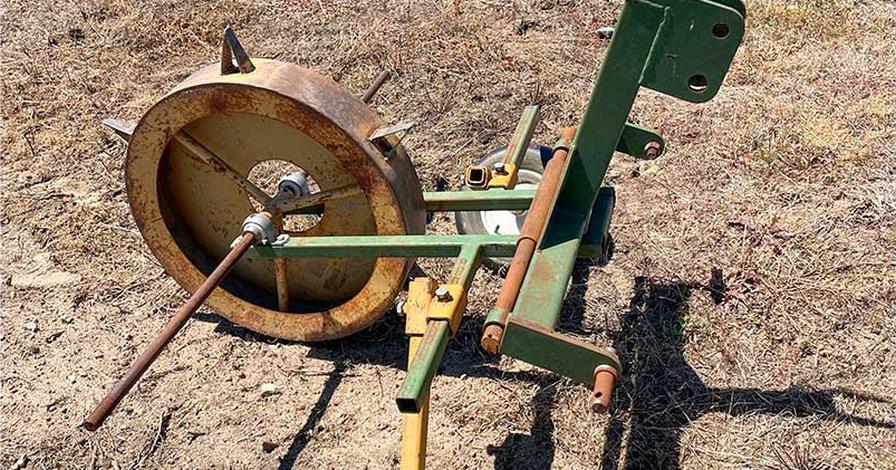
“A single-row hole puncher creates planting holes in plastic mulch for crops like tomatoes, peppers, and watermelon and represents standard, small-scale technology commonly used in research plots,” says Dr. Ted McAvoy, Vegetable Extension Specialist at the University of Georgia.
Photo: Ted McAvoy
Limits of Current Equipment
Planters and transplanters present different challenges for vegetable growers.
With planters, the small size and irregular shape of many vegetable seeds can make accurate metering difficult and affect stand uniformity, even though planters typically operate faster than mechanical transplanters. One way to improve seed placement, especially crops like onions, is with pelleted seed, which is more uniform in shape and allows planter seed plates to meter more consistently.
RELATED CONTENT: The Latest Innovations in Vegetable Planters and Transplanters
Semiautomatic transplanters tend to be slower than planters because seedlings must be manually separated and fed into the delivery system. In addition, many of these machines require tractors outfitted with specialized gear kits, such as creeper gears, to operate at very low speeds — often starting around 0.2 miles per hour.
“Looking forward, we are currently looking into the development of an automatic dosing and metering system for semiautomatic transplanters and a new delivery system,” Dr. Oliveira says.
Subscribe Today For
