


Bee vectoring produces higher profits & better crops
Revolutionizing precision ag:
How sustainable stewardship through biologicals levels up any IPM program
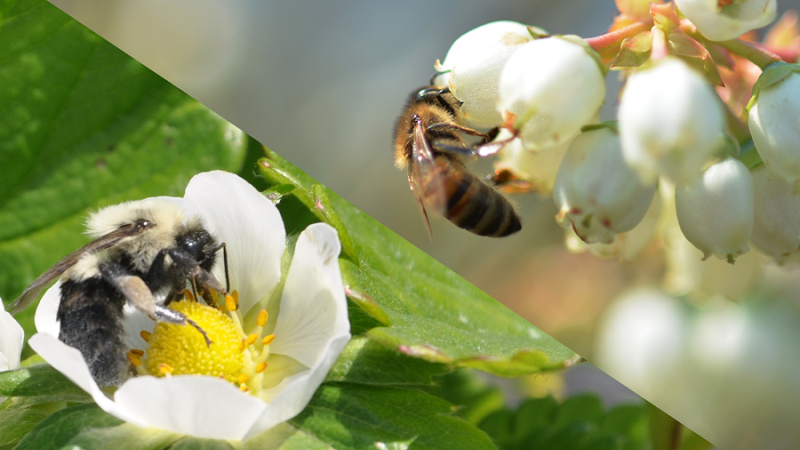
Imagine increasing your yield production and quality using less chemicals, less machinery and no water. Imagine increasing your bottom line an extra 20% while decreasing your impact on planet Earth, leaving only tiny carbon footprints along the food production line. Research, development and field trials have been conducted for the past twenty years on a unique, all-natural solution that controls disease, and improves crop yields through the bee-application (or “bee vectoring”) of a biological fungicide. It uses commercially managed bees as an efficient and targeted way of accessing each plant’s flowers. Bee Vectoring Technology (BVT) has engineered this innovative solution that is both safe for the bee and the environment, and it is now gaining widespread adoption across many growing regions across America.
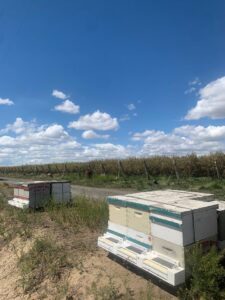
A blueberry field in the US Pacific Northwest at the start of the blueberry bloom period in spring 2021 with BVT’s VectorHive honeybee dispensers.
Committed to sustainable agriculture, BVT created a natural way of distributing a readily available unique strain of the endophytic fungus called Clonostachys rosea CR-7, protecting and supporting the crop during the blooming period.
What makes C.rosea so remarkable is that it has shown to out-compete other diseases and funguses in almonds, blackberries, blueberries, raspberries, strawberries and sunflowers. Since EPA approval in August 2019, it has quickly gained a following of loyal customers across America. Growers in the country’s Southeast and Northeast, Midwest, Pacific Northwest and most recently, California — with state DPR approval — have adopted BVT’s precise, natural approach to crop protection. In the near future, the company is expanding application to include canola, tree fruits and vegetables.
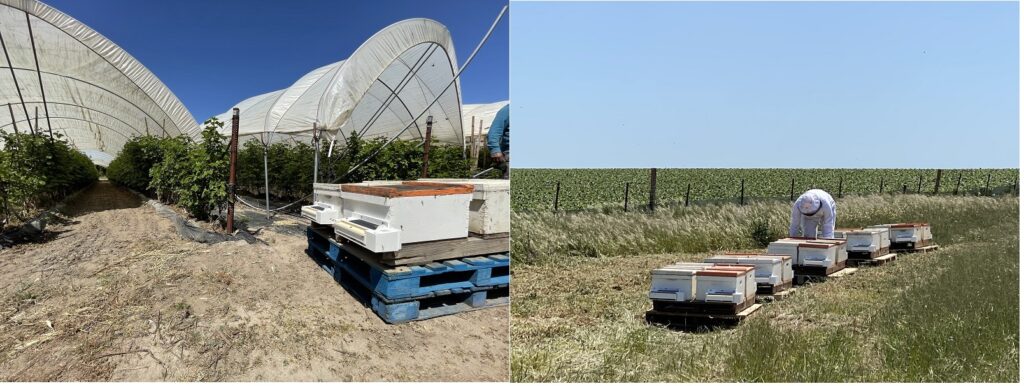
Set up of BVT VectorHive honeybee dispensers on caneberry (left) and strawberry (right) crop fields in California, spring 2021.
How it works
We all know bee pollination is the gateway to our food supply. Bees have access to flowers, which is the main portal of entry for many crop diseases. Using nature’s pollination process, BVT’s vectoring system allows the bee to transfer biocontrols from the beehive into each flower in the field.
What makes BVT’s bee vectoring system so unique is that it allows growers to use commercially reared bees to deliver C.rosea and other active ingredients through the natural processes of pollination. C.rosea is placed on the pathway leading out of the commercial beehive, alongside other potential biocontrols at the same time. As the bee exits the beehive, the powder product sticks to their lower body and legs. The bee carries biocontrol powder to each flower they pollinate, allowing the grower to deliver highly targeted crop protection to where it’s needed most. BVT’s system is called VectorHive, and the biological fungicide is called Vectorite with CR-7.
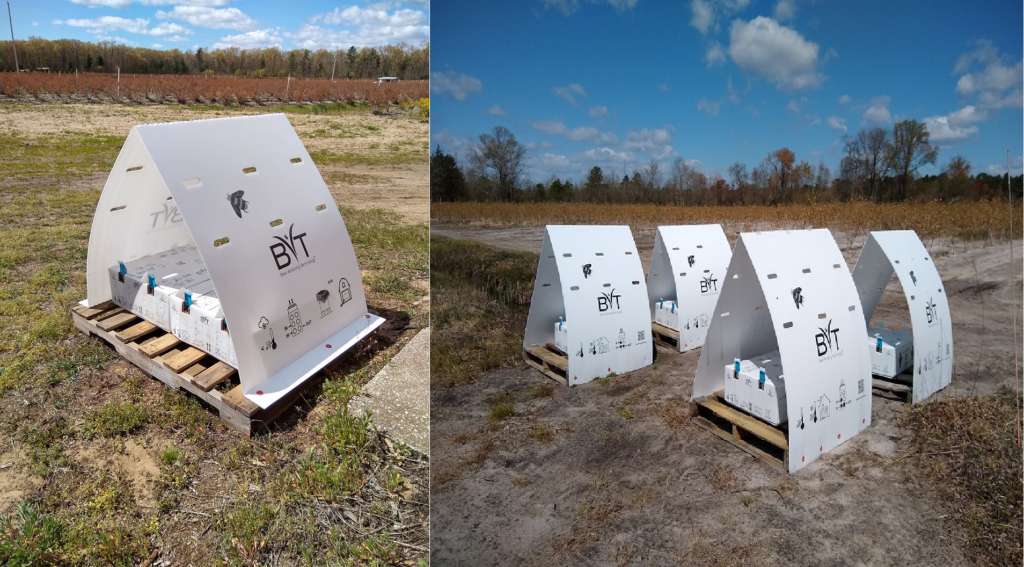
Blueberry fields in Michigan (left) and New Jersey (right) with BVT’s VectorHive bumblebee system at the start of the bloom period in spring 2021.
BVT allows growers to save water, cut back on the use of machinery (and fossil fuels) and reduce the use of synthetic pesticides, while increasing the efficiency of delivery through highly targeted application carried out by honeybees and bumblebees — making it an incredible companion to any grower’s IPM foundation program.
Field performance
Winn Morgan, Co-Founder of Major League Blueberries, an organic farm in the state of Georgia saw an increase of 28% in yields with minimal occurrence of Monilinia (Mummy berry) and Botrytis. Trials conducted by the University of Florida in strawberry fields saw a three-year average reduction of 35% in incidence of Botrytis with the use of Vectorite with CR-7 together with fungicide. More trial results in almonds, blueberries, blackberries, raspberries, strawberries and sunflowers are expected from key growing states, including Michigan, New Jersey, California and the Pacific Northwest, after this year’s growing season concludes.
“There’s technologies that we’ve used that are good and there’s technologies that completely changed the way we farm, and this technology, using bees as a vector to create a positive outcome not just for pollination but for the health of the plant and the health of the fruit, it’s changed the way we farm here,” states Morgan who started using BVT in 2018. “What we believe here is that Clonostachys is the game changer. It protects us against a lot of diseases that we could potentially have during the most crucial time of our year, which is during fruit set and harvest. So, we believe that it keeps us almost safe really until early May before we could have issues.”
Other growers agree. Jim Roofener, of Oak Acres Nursery in Oregon, says they saw larger fruit sizes after using BVT, “the first pick, the fruit size was really, I call it, enormous compared to the past.” That observation held true when looking at the weight of his harvested crop.
“Normal weight is approximately a 1,000 pounds and I got a call from the processor letting us know that they were weighing in excess of 1,100 pounds and his initial reaction was that we were overloading the flats and was worried that the berries were going to be smashed. And we looked, that wasn’t the case at all,” Roofener states. “We didn’t have any of that going on. So just the pure weight, sugar content of the product, was higher and just a lot more weight.”
Solid return on your investment
Morgan has seen a ROI close to 20x over the cost of the system. “Ultimately, you have an average rate of 50% pollination success rate. We are having a pollination success rate of 65-68% in most of our varieties, so it’s throwing out a bigger crop,” he adds. “It really is phenomenal technology.”
Increased plant vigor, healthier plants, healthier fruits and higher yields are some of the benefits and rewards BVT’s bee vectoring system offers. In compliance with US EPA and California DPR approvals, the company has conducted multiple bee safety and health studies that show that bees, larvae and honey are not affected by this crop protection technology. It is safe for bees, and field workers who can work safely alongside the product.
Diskin Morgan, of Morgan Blueberry Farms in Georgia, says he’s pleased with the return on his investment as well. “The peace of mind that the active ingredients being delivered on each bee to each trip to a flower, I’m not sure that you can really put a price tag on that,” he shared. “In terms of the ROI, I would say that if you look at eliminating a couple of sprays, you’ve essentially paid for the product.”
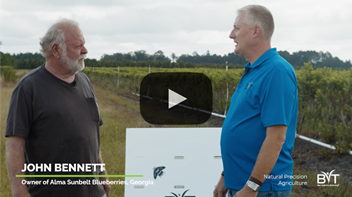
Another grower in Georgia, John Bennett of Alma Sunbelt Blueberries, says “One of the things that bombards us – especially in the years where we have excessive rain or if you get behind on picking and have overripe fruit – is anthracnose. And we just haven’t had it since we’ve started bee vectoring, and to me, that’s the reason I’ll do it again. BVT is money well spent.”
Growers lose money when indiscriminately spraying entire fields. Doing so does not guarantee precise application while many chemical products end up in the waterways or in areas between the crops. BVT’s natural precision agriculture system is an alternative to wasteful practices that affect everyone’s bottom line, from growers to the final consumer. For approximately the same price as a traditional fungicide system, BVT’s Vectorite with CR-7 enables you to take advantage of nature’s finest grower while increasing your stewardship of our environment.
To learn more about what growers have to say about using bee vectoring, make sure to check out these online videos:
Winn Morgan of Major League Blueberries:
Jim Roofener of Oak Acres Nursery:
Diskin Morgan of Morgan Blueberry Farms:
John Bennett of Alma Sunbelt Blueberries: