




How to Create a Habitat for Healthy Roots
Soil is more than the ground we walk on — it’s the foundation of everything we grow. Maintaining healthy soils is the first step toward maximizing yield and ensuring your land remains productive for generations.
One underground organism potentially robbing you of yield is the nematode, which can disrupt root development and nutrient uptake.
“Species such as reniform nematode can dive deep into the soil profile in the off-season winter months or when there’s a non-host crop being grown within that field,” says Tom Allen, Mississippi State University plant pathologist.
When testing for nematodes, Allen recommends focusing on the first 6 inches of the soil’s profile.
“A nematode in general is basically a nearly microscopic worm,” he says. “Some nematodes are large enough to see with the naked eye. The bulk of them are small enough that you need good magnification through a higher-end microscope to see.”
Allen recommends relying on economic thresholds when deciding whether to treat for nematodes.
“Your economic threshold is essentially the numbers of nematodes, per pint of soil, that would cause a yield reduction or would adversely affect the crop,” he says.
That economic threshold level varies during the growing season. For example, the economic threshold for reniform nematode numbers during early spring would likely be around 1,000 nematodes per pint of soil. At harvest, that number would increase to about 2,500 or more nematodes per pint of soil.
Because nematode feeding takes place below-ground where it can’t easily be seen, Allen recommends checking areas in fields where plants look unhealthy. “Plants that look stunted in growth or look to be thirsty in the heat of the afternoon, even a day after you’ve irrigated, those are places where you could have high populations of nematodes feeding.”
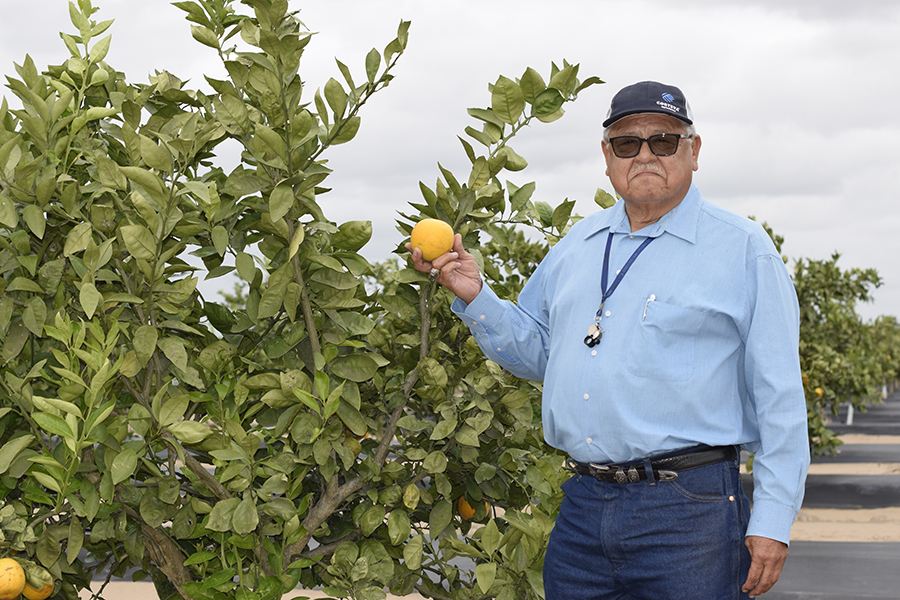
Nematode populations above threshold levels can even kill fruit trees, says Jose Silva, Edinburg Citrus Grove Care manager. “Nematode feeding really affects the roots, especially here in South Texas, where the temperatures are above 100 degrees,” he says. “It doesn’t take very much to have a tree wilt because the roots are affected and they’re not taking water up to the tree.”
Once you gauge your field’s suspected problem areas, the next step is identifying which nematode species are feeding on your crop’s roots. Sometimes that can be determined visibly, but sometimes it requires lab testing.
Various species of root-knot nematode produce visible galls on roots. However, galls can resemble nitrogen-fixing nodules in young legume plants.
“Nodules will be pink inside, whereas the gall that is produced from root-knot nematode feeding will not have that same coloration and will be firmer,” Allen says.
Other nematode species, such as reniform nematode, are trickier to identify because they do not leave visible feeding scars or produce an outward gall on the root and require magnification to observe the females feeding on the roots .
“You won’t see any outward symptoms or signs of that feeding on the outside of the root. You really have to take a soil sample at that point to determine your nematode population numbers,” he says.
Routine nematode testing ensures populations are monitored year in and year out, which helps determine what nematode control program you need long-term. “Growers should test for nematodes for the sake of root health, plant health and ultimately productivity and profitability,” says Zach Lopez, Corteva Agriscience territory manager.
Knowing which nematode species are invading can help determine whether a rotational host plant or cover crop could aid control. A better understanding of which nematodes are living in your soils also helps you estimate potential yield losses for subsequent crops if they are not resistant.
Planting cover crops also can improve soil structure, especially if the cover crop mix includes plants that reach deep into the soil, such as tillage radishes.
“Cover crops can get down into the soil’s B horizon and help with water infiltration, while also minimizing soil compaction,” says Darrin Malone, Mid-South district sales leader for Corteva Agriscience. “You want soil to drain well and you want water to be able to penetrate that soil. Good soil moisture will help produce healthy roots, which produces a great above-ground crop.”
Want to learn more about how you can improve your farm’s soil health? Sign up for the Corteva Agriscience Soil for Tomorrow email series and join us as we explore the stories and science behind nematode management and healthy soil.
™Trademarks of Corteva Agriscience and its affiliated companies. © 2021 Corteva. CA14-449-021 (04/21) BR CAAG1SBRO052