




The Good, the Bad, the Nematodes
Controlling nematodes can be like playing hide-and-seek in a forest with an ant, but a unified program approach that includes Salibro® nematicide with Reklemel™ active and Vydate® L insecticide/nematicide can help level the playing field through selective control.
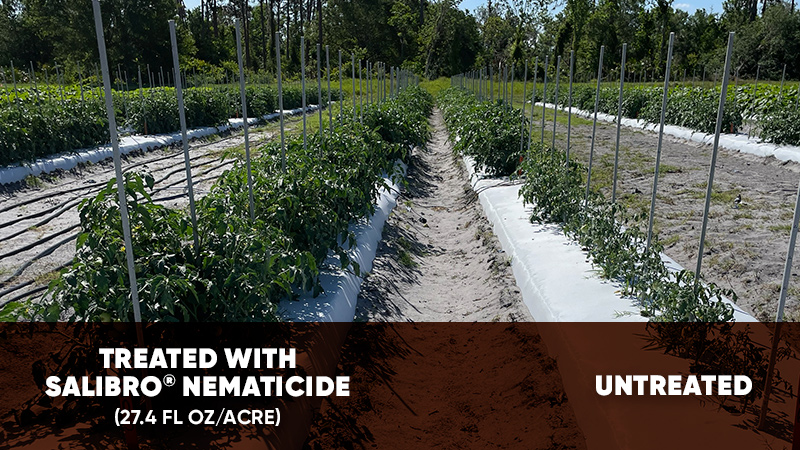
Tomato plants on the left treated with Salibro® nematicide with Reklemel™ active and an untreated check on the right illustrates the efficacy of Salibro nematicide by Corteva Agriscience.
Producers are faced with seemingly innumerable responsibilities and countless business decisions each growing season. Some they can anticipate or expect. Others often blindside them like a deer crossing the road after dusk.
An increasing number of successful fruiting vegetable and cucurbit producers are addressing those tasks, whether anticipated or unexpected, with an all-encompassing program approach, and finding it returns dividends far beyond just their year-end ROI.
When it comes to parasitic nematodes, like the root-knot species, this method of addressing pest control is not only practical but economically and environmentally beneficial, especially when they rely on Salibro® nematicide with Reklemel™ active and Vydate® L insecticide/nematicide as part of their integrated pest management program.
When plants start exhibiting visual signs of stress like stunting, wilting, chlorosis or necrosis, and above-ground scouting reveals little or no pest population, attention should turn to factors below the soil’s surface. A plant’s root system damaged from plant-parasitic root-knot nematodes will exhibit visible galling. Galls restrict the affected plant’s ability to take up water and nutrients. To pinpoint which specific species of nematode is causing the damage, a soil test taken from around the affected plant’s root system is always recommended.
Similar to the influence of underlying conditions in humans, damage from nematodes increases the likelihood of the plant’s susceptibility to other diseases, so a timely control application of Salibro nematicide should be the next move.
“Salibro nematicide is a true nematicide, only targeting plant-parasitic nematodes,” says Sunil Tewari North American biology leader for insecticides, nematicides and bionematicides for Corteva Agriscience. “It causes rapid total paralysis for excellent control of targeted nematodes. With lower use rates than older nematicides, Salibro nematicide also is in a unique chemical group that makes it a great product to assist in resistance management efforts.”
Because good soil health is a precursor to both improved crop quality and higher yields, a nematicide should not impact beneficial organisms in the soil or nontarget pests. Salibro® nematicide fits well into a program where soil health and beneficial organisms such as bacteria, fungi and free-living nematodes play a crucial role in plant development and its resiliency from stress. It also provides residual protection by remaining in the root zone for an extended period − all positive attributes in an overall program approach to pest control.
“Salibro nematicide and Vydate L insecticide/nematicide work well in a program approach for fruiting vegetables and cucurbits for nematode and insect control. Apply Salibro nematicide at plant for immediate nematode control and then come back with Vydate L nematicide/insecticide two or three weeks later for additional nematode control, as well as broad-spectrum insect control,” says Jared Walls, market development specialist, Corteva Agriscience. “Vydate L insecticide/nematicide is a carbamate, which brings additional health benefits to plants. Plants tend to be greener, stronger, healthier and more resilient after any stress event.”
To protect crop roots all season and harvest more marketable fruiting vegetables and cucurbits, depend on Salibro nematicide at plant and Vydate® L insecticide/nematicide during the growing season.
For more information on how to control plant-parasitic nematodes with Salibro nematicide, visit Corteva.us/salibro.
™ ® Trademarks of Corteva Agriscience and its affiliated companies. Vydate® L is a Restricted Use Pesticide. Vydate L and Salibro™ are not registered for sale or use in all states. Contact your state pesticide regulatory agency to determine if a product is registered for sale or use in your state. Reklemel™ is a registered active ingredient. Always read and follow label directions. © 2024 Corteva. 019145 BR (02/24) CAAG4SBRO057