



2011 Seed Trials: The Latest Offerings
 October 28, 2011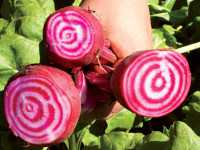
Every year, editors David Eddy and Rosemary Gordon hit the road to learn more about the latest offerings from seed companies. American Vegetable Grower wants to find out about varieties that not only provide good disease reisistance packages and other qualities critical for growers, but offer qualities consumers desire, as well.
This year we visited five companies, crossing the country from California to New York. What follows are some of the varieties that breeders think will really pack a punch with growers and consumers.
Alf Christianson Seed Co./Chriseed
Beet // Chioggia Guardsmark
Chioggia is an old open-pollinated Italian heirloom beet variety that matures to 2 inches in diameter in 55 to 60 days. It has a few traits that make it truly distinctive, says Delita Pardue, Alf Christianson Seed product development coordinator. First, and most noticeably, is the color.
“What we’ve done is improve upon those traditional characteristics to make the red and white interior zoning color more vivid,” she says. “The interior colors make it an eye-catching beet variety.”
Besides making the colors pop, Chriseed has also made it more uniform in beet-shape, as the roots are a flattened globe shape.
Second, Chioggia is known for a mild flavor. “The taste really appeals to people who don’t like the traditional, earthy flavor of many beet varieties,” she says.
Chioggia is well-known throughout the U.S. and Canada and is starting to sell well in Mexico. “In Mexico they are asking for more unique varieties, which was not the case just a few years ago,” Pardue says. “Growers are looking for more refined characteristics that would appeal to U.S. buyers.”
Chioggia Guardsmark is available commercially. The seed is offered as organic and conventional.
Swiss Chard // Peppermint
Another eye-popping variety from Chriseed, Peppermint is a new variety of Swiss chard. “Unique” is a word often used when talking about Peppermint. “It is the first two-toned petiole Swiss chard,” says Pardue. “Its white petiole with pink fading strips from bottom to top creates a visual pop that will catch any eye.”
It has uniform, glossy, dark-green savoy leaves that make for a nice contrast against the two-toned petiole color. “Due to its unique colors it’s going to stand out at any farmer’s market or any display, such as a grocery store,” she says. “It’s going to grab people’s attention.”
In addition, Peppermint is very easy to grow, says Pardue. In particular, it is a slow-bolting variety, which is very appealing to commercial growers who take multiple harvests off of one planting.
“We’re getting a lot of interest across the board from seed dealers in the U.S. and Canada,” says Pardue.
But of course the main appeal is the look, though it may be more than just a pretty vegetable. “Maybe it will cause more children to eat vegetables,” she says. “We’ve had customers who’ve said they’ve used it to entice their own kids to eat more vegetables, and it has shown a lot of interest as an ornamental vegetable for landscaping.”
Peppermint will be commercially available in 2012. Plant Variety Protection is currently in application with USDA.
Bejo Seeds
Leek // Jumper
The latest leek offering from Bejo is Jumper. Maturing in 84 days, this variety is easy to clean and is preferred by the European market as it is longer and more slender than other leeks.
According to Jan Van der Heide, Northeast sales and product development manager at Bejo Seeds, its slender habit gives it a young, more appealing look. “Jumper is productive, has good weight, holds up well in summer heat, and has a nice, clean, fresh look, says, Van der Heide.
As Jumper is a good variety for summer production, he adds that there are other leek varieties available to round out the season. Runner, he says, holds up well in the fall and Surfer, a hybrid leek, is good for late fall and early winter production.
Celery // Samba
Disease resistance is a critical component to variety selection for growers, and celery varieties are no exception. To help growers in this area, Bejo offers a Fusarium resistant celery, Samba.
“This dark-green variety not only has good Fusarium resistance, it features a dark-green, smooth stalk,” says Van der Heide. Maturing in 80 days, this variety is produced on compact plants for ease when packing.
Carrot // Naval
“This continental-type carrot is getting rave reviews,” say Van der Heide. “It is excellent for slicing, cello, and is widely adapted.”
Naval has a strong top and boasts good resistance to heat stress and leaf diseases. It is also suitable for machineharvest, adds Van der Heide.
This bright orange carrot features 1 by 8 inch roots. With 72 days to maturity, this variety is good for fresh market sales or processing.
Sakata Seed America
Broccoli // Emerald Crown
Emerald Crown could be considered an MVB, “Most Valuable Broccoli,” because it functions well in so many environments. Grower demand is starting to get very strong because the variety is extraordinarily adaptable, says Matt Linder, Sakata’s broccoli product manager.
“It grows in many regions of the U.S., from California to Florida and from Washington to Maine – it’s a four corners’ variety,” he says. “It’s somewhat unusual in its adaptability, making it a real nice addition to Sakata’s product line.”
A crown cut and Asian cut (short trim) variety, Emerald Crown is an early- to mid-maturing variety, and for its maturity class has good brown bead tolerance.
One important asset of Emerald Crown, says Linder, is that the variety can extend the slot of another Sakata variety, Green Magic, because of its resistance to purpling. “It simply won’t purple under stessful conditions, which is very important,” he says. “When other varieties will purple, this is genetically predisposed to stay green.”
A heavy-headed, domed variety, Emerald Crown has small beads that are blue-green in color on a small framed plant. Its (direct-seeded) maturity is 93 days.
Broccoli // Emerald Jewel
A fairly recent addition to the Sakata line, Emerald Jewel, formerly SBC7540, has a couple of attributes that will be of keen interest to growers, says Linder.
First, it is well-suited for crown cut and short trim, but it can be used as a multi-use variety, depending on the region in which it’s grown. You can bunch it in the deserts of the Southwest U.S. on second or third cuts. “Growers like that flexibility because you’re seeing more and more crown cut,” he says. “But there is still a substantial market for bunch and, of course, fresh processing.
Second, Emerald Jewel is highly tolerant to some races of clubroot.
Linder says that’s important because in some regions of the U.S. Pacific Northwest and Canada, there are high levels of clubroot in soils. Most growers add lime to their soils because lime can suppress club root. “But that gets expensive,” he says. “If you don’t have the resources, or in some areas where lime is not readily available, you need resistance.”
A small-beaded, smooth-headed, clean-stemmed variety, Emerald Jewel doesn’t favor cold temperatures, and late spring/early summer and late fall harvests are suggested in coastal California. Linder says it works well in the desert Southwest in the Triathlon slot (late February to March harvest.)
Emerald Jewel has a relative maturity of 100 days.
Cabbage // Primo Vantage
This is a very new cabbage variety, so new it was just named. During the summer seed trial it was known as SCB7206. Primo Vantage has two important characteristics, one obvious and one not so obvious, says Linder.
First, it has a very short core as compared to other varieties, says Linder. “A long core makes it tough to de-core and process,” he says. “This variety has a short core in many seasons and environments and holds very well in the field for the maturity class.”
Second, all the focus in recent years is how acceptable a given variety is to buyers, whether retailers, processors, or foodservice. That makes perfect sense, as pleasing the customer is job #1, but in developing Primo Vantage, breeders have also shown they haven’t forgotten the grower, says Linder.
“This is a very grower-friendly cabbage,” he says, “and that’s very important.”
Other advantages to Primo Vantage are that the proportion of green to yellow is quite high, and it’s very sweet tasting for a cabbage. Heads are very solid, dense, and heavy, averaging 4 to 4.5 pounds. Primo Vantage has resistance to Fusarium yellows race 1, and reaches relative maturity in 70 days from transplanting.
US Agriseeds
Cucumber // Cobra
An early gynoecious American slicer cucumber, Cobra has an excellent disease resistance/tolerance package and great fruit quality. The plant produces attractive dark green colored fruit on both plastic and open ground cultures, says Salvador Hurtado, Central/South America sales executive for US Agriseeds.
This variety is very high yielding and thanks to its multi-virus disease package, Cobra holds its length well when other varieties begin to shorten from stress, he says. Here is the disease resistance/tolerance: PRSV, Sc, WMV, ZYMV, ALS, A, CMV, PM, DM.
“Long established as a leading variety in the U.S.,” says Hurtado, “Cobra is fast becoming the variety of choice for cucumber growers in central South America.”
Caribe-type Pepper // Rio Tesoro
US Agriseeds is introducing a new hybrid Caribe-type pepper, Rio Tesoro, that is so new it was still known as USAPR 122 at the summer seed trial.
Roger Thulin, VP of sales/NAFTA, who introduced the variety at the field day, said it produces attractive, high-quality, yellow fruit that are characterized by broad shoulders, thick walls, and a tapered, blunt end. The conical-shaped fruit measure 3.5 by 2 inches and turn a brilliant orange/red at full maturity.
Rio Tesoro has a strong, prolific plant with an outstanding fruit set and is widely adapted for a range of growing regions. “This is the first Caribe type added to US Agriseeds’ product line; we could not have a stronger contender,” said Thulin.
“It really is as good as it looks.”
Fresh Market Tomato // USATR 0111
“It’s all about fruit quality, flavor and yield,” remarked US Agriseeds’ Megan Rietkerk in describing this new semi-determinate, round, fresh market tomato.
This variety is characterized by main to late season maturity, 90 -95 days. The seed produces a very strong plant with a continuous fruit set, large vine size, and excellent fruit cover. Fruits weigh between 250-300 grams, have a uniform bright red color, and smooth shoulders.
USATR 0111 is equipped with a strong disease package, said Rietkerk, having resistance/tolerance to bacterial speck, Fusarium wilt, and Verticillium wilt.
Subscribe Today For
