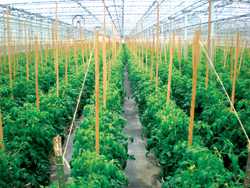
Hot, dry conditions typical of a La Niña year hold the possibility of increased tomato yields and may be a welcome change for Florida growers still reeling after last year’s devastating freeze. But it’s not all good news. Unfortunately, those conditions also can trigger increased insect pressure and the spread of insect-vectored viruses for the spring crop.
Dr. Phil Stansly, UF/IFAS professor of entomology, says tomato yellow leaf curl virus (TYLCV), transmitted by the silverleaf whitefly, is the primary threat for the spring crop in his region, and a concern for South Florida growers who have seen a spike in the magnitude of whitefly outbreaks in recent years. “Increased disease pressure, especially if it comes early, can ruin a crop,” says Stansly. “If viruses appear within a month of transplant, growers could lose as much as 50% of the crop.” To help growers protect spring tomato crops and produce high-quality, marketable fruit, Stansly highlights five key elements of an integrated pest management (IPM) plan.
1. Consider Using Disease-Resistant Varieties
TYLCV causes stunted growth and poor fruit set. In the southern growing region of Florida, whitefly populations may explode as early as February. To be safe, Stansly recommends area growers select TYLCV-tolerant tomato cultivars for the spring crop. Recent evaluations of TYLCV-tolerant varieties in South Florida can be found by searching “TYLCV” at the UF/IFAS Southwest Florida Research and Education Center website (
www.imok.ufl.edu).
2. Separate Crops In Space And Time
Stansly recommends allowing a four- to six-week resting period between harvesting the fall crop and planting the spring crop. At planting, avoid placing plants into or adjacent to fields previously planted with whitefly host crops. “If you have an older crop, such as tomato, pepper, or cucurbit still in the ground, you want to plant the spring crop as far away as possible,” advises Stansly. “Otherwise whiteflies could easily move from the old into the new crop.”
3. Practice Good Field Hygiene
Field sanitation is a critical component of a pest-management strategy. Stansly recommends completely destroying crop residue within five days of harvest. For a thorough job, consider applying an insecticide directed at adults, such as a pyrethroid, organophosphate, or endosulfan to suppress existing whitefly populations, followed by a burndown herbicide application to remove the host crop. Finish by turning under residue.
Stansly acknowledges that growers who plant into plastic mulch are likely to double crop, increasing the importance of using an insecticide when they burn down the first crop. “Many growers will go from tomatoes to a cucurbit crop to utilize the mulch, drip, and stakes already in place,” he says. “Field sanitation is critical to preventing whiteflies from transferring between these crops.”
4. Give Plants The Best Start
To get plants off to a good start in the field, treat with pymetrozine while in the transplant house, followed by a neonicotinoid application just before transplant to protect crops as they enter the field. A follow-up neonicotinoid drench immediately after planting will provide whitefly protection for up to eight weeks.
5. Protect Crops In The Field
After planting, inspect plants for insects and make an insecticide application when action thresholds are reached. After the initial neonicotinoid drench, Stansly cautions growers to switch to a non-neonicotinoid insecticide for the remainder of the cropping period to slow pest selection for resistance. A selective insect control solution, such as Coragen (rynaxypyr, DuPont Crop Protection) insect control, provides long-lasting protection against damaging worms and leafminer larvae and suppression of silverleaf whitefly nymphs says Dan Sherrod, product development manager for insecticides, DuPont Crop Protection. It also has minimal impact on beneficials, to conserve natural enemies and enhance biological controls.
“The beauty of Coragen is that it has a very favorable environmental profile along with powerful systemic activity,” says Sherrod. “An application of Coragen at the root zone allows the active ingredient to be easily taken up by plant roots and delivered to the foliage.”
Coragen also is the only product on the market that controls worms through drip chemigation, an important feature, according to Henry Yonce, a researcher with KAC Agricultural Research Inc. in DeLand. “Currently, there are no insecticides that you can inject through a drip-irrigation system and get the same level of control you can with Coragen. We obtained long residual worm and leafminer control and extended the nymph suppression on whiteflies for almost four weeks.”
0
1
5
5 Tips To Protect Spring Tomato Crops
Bussan is an associate professor in the Department of Horticulture at the University of Wisconsin-Madison.
See all author stories here.




 November 18, 2011