



AVG’s Top 100 Operation Reveals Production Perfectionist
 October 1, 2009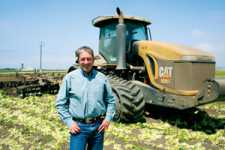
You first clue to how much the folks at Ocean Mist Farms pay attention to detail is in driving around one of their numerous ranches in California’s Salinas Valley. Weeds are so scarce that when you finally do notice one, near an irrigation filtering unit, it comes as a surprise. But since the weed’s not in the field, it’s no big deal, right? Wrong.
“I hate weeds,” says the company’s vice president of production, Troy Boutonnet.
While this one weed isn’t in the field, it can be a host to insects or a harbor for diseases, Boutonnet explains. But it’s not so much the problems the weed can cause, it’s what it represents. “When I bring customers to our ranches, if they see a dirty ranch, it’s going to reflect on the entire operation and they’re not going to buy from Ocean Mist Farms. How you’re perceived by your customers is very important,” he says. “It’s not just our ranches, you can go into our coolers — anywhere — and it’s going to be perfectly clean.”
“Perfect” is a word they use a lot at Ocean Mist, an American Vegetable Grower Top 100 Grower and a 2009 finalist for the Grower Achievement Award. First of all, it’s an easy concept to get across, no matter what language the employee speaks. “There are many ways to define ‘good,'” says Boutonnet, “but there is only one way to define ‘perfection.'”
one way to take care of employees is to provide tractors with
air-conditioned cabs and stereo systems to increase driver
comfort, and global positioning systems to reduce driver fatigue.
This unit is towing a Rome 23-foot disc through a Salinas field.
Second, an employee who understands perfection is the goal will never rest on his laurels. “It’s unattainable, if you always try for it you’ll never be satisfied,” Boutonnet says. “You always need to look for that next level and never be satisfied with where you’re at.”
In Pursuit Of Excellence
Of course you can preach the pursuit of the perfection, or excellence, all you want, but it won’t matter unless you give your employees the tools they need. At Ocean Mist, with the ranches spread out in the valley, one obvious barrier is communication.
So a few years ago, they purchased cell phones for all the tractor driversand irrigators, and instructed them to call a supervisor if they encountered any problems.
For example, if there were a huge leak in an irrigation system and a field was soaked, a tractor driver assigned to cultivate the field wouldn’t just drive the rig into the field. He would stop and call a supervisor for advice.
“We tell them to never be upset about taking extra time for ‘trabajo excelente’ (excellent work),” says the bilingual Boutonnet, who learned Spanish while working in the fields as a youngster, and says a day doesn’t go by that he doesn’t speak the language. “They always know they should take the extra step, go to the next level.”
Employees also know precisely what’s expected of them. For each of the 25 crops Ocean Mist grows, there is literally a book on it that includes such details as the size of the harvested product, its construction, and how the crop should be packed. In all, there are 558 measurements, or quantifiable quality standards. To make sure the standards are met, work crews are graded on a daily basis. Then each quarter, the crews with the best grades — the
ones who best pay attention to detail — get prizes such as gift certificates or Ocean Mist Farms apparel.
Boutonnet says it’s important to take care of those employees, whether it be through good pay and medical insurance to starting the day with 10 minutes of calisthenics. Ocean Mist also provides tractor cabs with air conditioning, a stereo, and global positioning systems to reduce driver fatigue, because they’re the ones who take care of the details.
“It’s not Troy Boutonnet who makes this organization,” he says. “I just provide support for the individuals who make it happen.”
Fresh Perspective
Like a lot of growers, Boutonnet and his colleagues at Ocean Mist Farms love farming. What they don’t like so much is marketing. They identified this as a weakness and decided to do something about it. So a couple of years ago they brought in someone with a fresh perspective, an expert on marketing, especially on a global level. The world, after all, is shrinking.
They asked Roberta Cook, a University of California Cooperative Extension marketing economist, to join their board of directors. It turned out to be a very wise move, says Boutonnet. “She brings a real fresh perspective, always showing us the customer’s standpoint,” he says. “Sometimes we don’t want to hear that, but it’s good for us.”
Cook, who has served on the boards of other large farming operations such as Naturipe Farms, says bringing in experts from academia is unusual and still a relatively new phenomenon in agriculture, but she expects it will gain popularity. “Many firms are beginning to appreciate how rapidly the supply chain is changing,” she says.
Traditionally, the sales tracking data available to food manufacturers wasn’t as available to produce grower/shippers because of the lack of UPC bar codes. But it is today, and producers who don’t take advantage of it are going to fall behind.
“It’s all part of the increasing use of information technology,” says Cook. “If I’m a grower/shipper, I can now better manage what’s happening in my business all the way through the supply chain. I can really understand exactly what’s happening.”
Subscribe Today For
