



Greenhouse Growing Gets Boost From Locavores
 April 1, 2009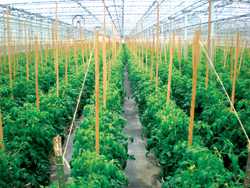
Coming out of a NIFF (Northeast Iowa Food & Fitness initiative) meeting in January 2008, Mike and Rachel Gooder felt excited, energized, and ready to tackle the opportunity and challenge in front of them to become a provider of fresh, locally grown fruit and vegetables. The couple, who owns Plantpeddler, a greenhouse operation that produces ornamental bedding plants and potted flowering plants, were looking for other crops to fill their greenhouses and keep their staff employed year-round. Having recently bought the family farm, where they were enjoying fresh vegetables out of the garden and noticing the marked improvement on their health and lifestyle as a result of eating better, the Gooders felt that entering the produce market was a natural fit.
“We saw this movement toward local interests, and all of these ideas that made local residents question where their food comes from,” Gooder says. “We walked out of that meeting and were convinced of the value of locally grown produce, and we decided then and there to get involved.”
Located in the cash-poor, Driftless Area of Northeast Iowa, a five-county area where shallow soils prohibit locals from joining the rest of the Breadbasket state, the average food item is imported from more than 1,500 miles away and only 1% of the food consumed is grown locally.
As part of a national effort to improve consumer health, lifestyle, and availability of food, the W.K. Kellogg Foundation started the Food & Fitness Initiative. In 2007, the foundation identified nine communities to become models of change, including the five-county region of Northeast Iowa. These communities were required to outline a community action plan for how they will improve the policies, practices, and systems that prevent local citizens from being healthy.
The Northeast Iowa Food & Fitness (NIFF) effort took off and as a component of NIFF, local farmers worked together to form the Northeast Iowa Food and Farm Coalition. Its mission is to support the development and marketing of locally grown agriculture products to enhance the lives of local citizens while building a stronger local food and farm economy in Northeast Iowa. Enter the Gooders and Plantpeddler.
Diversifying For Sustainability
With the general economic condition of the ornamental greenhouse business continuing to rely upon the four-month spring season, it was getting harder for Plantpeddler to make ends meet, so the Gooders were searching for a more balanced income for the company, says Mike Gooder.
“We have to have 90 employees in the spring. I have to cut back to 15 in the offseason and that’s not long-term sustainable for our company,” he says. “A good portion of the floriculture industry is probably making 60% of income in a six- to eight-week period. If we dilute our spring like we did the Christmas season and that happens across the market, the industry is cooked. If a portion of greenhouse growers switch to veggies in the offseason, they can produce 52 weeks of income.”
In addition, the conventional and often wasteful production methods used to produce ornamental plants were becoming bothersome to Gooder, who wanted to change practices to become more environmentally sustainable.
“One of the things that bother us is that we pull greenhouse plastic after one pass of crops and use containers for one pass. A plant in a plastic pot goes to consumers to enjoy for one season and then the pot goes to landfill,” Gooder says. “Plus, we use a lot of chemicals and plant growth regulators, which are very unsustainable, and we wanted to be able to use greenhouse plastic for two passes. We began to ask ourselves how can we make changes to impact our business for the next 20 years?”
So Plantpeddler began its first year growing produce with two questions in mind: “Can we produce; is there a return? And can we sell it; is there a market?”
Last August, the 8-acre operation replaced 30,000 poinsettia plants with a trial of three acres of vegetable crops. Poring over a catalog from Johnny’s Select Seeds, Plantpeddler’s managers handpicked 25 vegetables and fruits to produce, from arugula to zucchini, with only one objective: “Can we produce it, flower it, fruit it, and reach quality standards?” Gooder says. As a trials-based company, Plantpeddler naturally chose a number of different varieties of each crop to determine the few best suited for greenhouse production, including 25 different lettuces.
Now, at the end of its first rotation, Gooder says Plantpeddler accomplished what it set out to do. “We identified that we can produce products that taste
better, with better nutritional value, and we identified five areas of demand opportunities and we’re scaling up.”
Renewed Excitement
Plantpeddler’s customers include its own retail market; several institutions, including three colleges and universities such as Iowa State, which mandates for a certain percentage of the food it buys to be from local supply; a number of Hispanic and other restaurants, including Long John Silver, which is differentiating itself by serving fresh, locally grown tomatoes on its burgers; five food cooperatives; and grocery store chains.
The operation, which markets its produce under the name Stone Creek Farms, currently has no competition locally for its winter produce harvest. Other tomatoes consumed in the area come from Mexico and its competition in strawberries is from China. Gooder says Plantpeddler will continue to grow produce in the spring, although the operation has to continue to prove that produce will generate income.
“We consider ourselves to be a skilled greenhouse operation and have proved that on the ornamental side, but we are the new kids on the block at best on the produce side,” Gooder says. “We have established a customer base that we don’t want to lose. Our goal is to be a 52-week market in fresh produce and possibly for other locally produced products.”
Though he says the operation went into this venture with the objective not of what could be made the first time through, but of determining the economics, the comparisons speak for themselves: The return on two greenhouse tomatoes were the equivalent of a poinsettia plant.
“There is opportunity in the greenhouse sector to produce vegetables in one season, ornamentals in another,” he says. “It’s done that way in Europe but here we grow by emotion — we grow what we love. I love growing poinsettias but they are not driving the deepest bottom line.”
Meanwhile, the produce business is helping Gooder renew his enjoyment of growing and selling plants, he says. “It’s been fun selling again. I used to go in to see a guy and say, ‘Hey, how about running a promotion on poinsettias, fall mums, or begonias’ and he would decline, telling me he was barely in the black as it was,” Gooder says. “Now I go in to see the same guy and tell him I can give him locally grown produce and help him market it, and he’s my best friend because I’m providing him with something people are asking him for anyway and that he can’t find.”
Subscribe Today For
