



Greenhouse Heating And Other Fuels
 August 1, 2007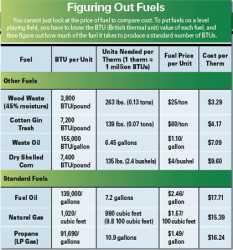
I don’t really like the word “alternative” — it is way overused these days. It refers to doing things differently from how things are usually done, whether it be alternative fertilizers (a.k.a. organic), alternative pest management (a.k.a. IPM), or alternative lifestyles (fill in this blank yourself). Therefore, the term “other fuels” will be used.
Standard Fuels
Starting from the beginning, the fuels that are not “other” would be the ones that are most commonly used. In greenhouses, I believe these are propane (also called LP gas), diesel heating oil, and natural gas. People often talk about butane, but I believe that butane for heating has been entirely replaced by propane.
For small growers, natural gas is generally preferred (cost and efficiency) over propane. However, due to its limited distribution lines in many rural areas, propane and its storage tanks are often required for growers who want to heat with gas burners.
Costs of various fuels are constantly changing, so it is wise to compare natural gas and propane costs to heating oil costs and change when necessary. To change, a grower will need to purchase a conversion kit for the burner from the heater manufacturer.
Despite the ups and downs of fuel prices over time, it is no surprise that the general trend is upward. This is due to the increase in global demand for fuel, as well as the finite supply of fuel sources.
And, as you know, as fuel prices go up, your profit margin shrinks. That is, unless you can charge enough more per unit for your product to take up the slack. If your customers give you a hard time about the price increase, you’ll just have to explain to them about the fuel prices.
Comparing Fuel Costs
There is really only one fair way to compare the cost of fuels. You cannot just look at the price. That is because some fuels are sold by the gallon (fuel oil, waste oils, etc.), some by the cubic foot (natural gas, propane, butane, etc., as well as saw dust, wood chips, bark, wood pellets, etc.), some by the cord (wood), some by the pound (coal, corn, etc.), and some by other units.
To put fuels on a level playing field, you have to know the BTU (British thermal unit) value of each fuel, and then figure out how much of the fuel it takes to produce a standard number of BTUs. The standard used in the industry is 1,000,000 BTUs, which is also known as a “therm.” Then you multiply the amount of fuel needed per therm times the price of that much fuel to determine the cost per therm for the fuels you want to compare.
A comparison of some of the standard fuels, and just a few of the possible “other fuels,” is shown in the table. There are many other possible fuels not mentioned in the table, including coal, poultry waste, peanut hulls, wheat and other grains, corn stover, and other agricultural residue.
Another factor is burner efficiency. No burner is 100% efficient. Electricity is 100% efficient, but is too expensive for large greenhouses. In the table, 84% burner efficiency is assumed for all fuel types.
In the chart, look at the column indicating the actual cost of each fuel to produce one therm. Once your jaw drops, you will see why so many greenhouse growers are looking at the other fuels.
The fuel values in the table are guidelines, so plus or minus 15% is probably reasonable.
There is a lot more information online. One starting point would be the Agricultural Utilization Research Institute’s Web site, www.auri.org.
Subscribe Today For
