



Making Sprayer Applications More Precise
 February 7, 2012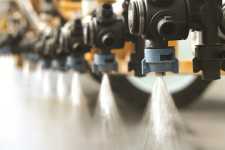
In sprayer technology, the latest improvements are not in the sprayers themselves, but instead in controls and technology to improve targeting and precision of spray applications. These provide growers with ways to ensure they hit the intended target with a crop protectant and help reduce waste.
According to Dr. Richard Derksen, Research Agricultural Engineer with the USDA Agricultural Research Service, in addition to precision application tools, some of the latest technology, such as GPS and sprayer controllers, will be useful to help growers with record keeping as well as applying material accurately. He cites as an example recently developed valves that allow growers to more rapidly shut off flow along the boom line of ground sprayers.
“These valves are relatively new, and reduce waste as the nozzles are turned off and then back on,” he says. “The valve relieves the pressure in the line very quickly by opening a path between the spray lines and the liquid return line and it also traps enough fluid in the spray line to help bring the pressure back up quickly when you are ready to start spraying again. So, that dripping that you hate to see when you shut off the nozzles can be further eliminated with this device.”
Nozzles And Applications
Derksen also encourages growers to check label instructions for the types of nozzles to use for specific applications. Many crop protectant manufacturers now provide suggestions on the droplet size or spray quality that they recommend.
For example, he says there may be a recommendation to use a medium-quality droplet size or a coarse droplet size, depending on the product. “All nozzle manufacturers now provide this sort of classification,” explains Derksen. “When they talk about the size of nozzles they have, they also provide information about the spray quality to help growers more easily select nozzles.”
In addition to selecting the best nozzles, growers need to choose the ones that will apply the product with the least amount of spray drift. Specifically, he says that large orifice and air induction nozzles produce a coarser droplet spectrum, and they also help reduce drift.
A Precise Future
Down the line, Derksen says there will be a greater emphasis on precision applications. These new techniques will require growers to use GPS systems and controllers that put the material down in just the quantity that is needed in a particular portion of the field.
Technology farther in the future will enable growers to access weather conditions on the go, allowing them to adjust sprayer operating parameters, he adds. “For example, researchers are working on systems to adjust the sprayer output or the droplet size based on changes in wind conditions. We are adding these controls to traditional sprayers, so the equipment may not look too different.”
Making Sprayer Applications More Precise ctd.
Prepare For Spring
Assuming your machine is properly winterized for freezing conditions, to prepare it for use in the spring, Derksen offers growers the following pointers.
• Be sure to look over the machine for leaks and make sure hoses and connections are all in good shape. Replace/repair as needed.
• Prepare to change nozzles if they have been used for a long time and there are visible signs of wear. “A small amount of nozzle wear will change the flow characteristics and the droplet size characteristics from the nozzles,” says Derksen.
• Check the pressure gauges or other sensors used to help monitor the conditions of the spray system. “The pressure gauges are usually the ones that most people depend on to monitor sprayer operation,” he explains. “Sometimes they don’t realize the gauge is no longer ‘zeroing’ when there is no pressure, or maybe it is stuck in another position.”
• Test the gauge before using the sprayer. If it fails, replace the gauge with a new oil-filled gauge that will provide a reading within a reasonable range.
• Check other sensors, such as the speed and flow rate sensors, to make sure all are in good operating condition. Calibrate as needed.
• Clean out the sprayer, including strainers and sensors. “Sometimes growers can run into problems with the sensors in the sprayer not working properly because the system hasn’t been cleaned out well,” he explains.
• Assess sensitive areas to be sprayed before the start of the season. Derksen tells growers to think about this in terms of planning the spray program for the year and the impact the program may have on adjacent areas.
“If growers think about this ahead of time, they can work with neighbors regarding these sensitive areas to plan a spray program that will have the least amount of impact on non-target areas,” he explains. “This will also help in planning the equipment they will use such as nozzles, the time of day they are going to be spraying, and the actual materials they are going to use to do a better job spraying.”
Subscribe Today For
