



Melon Grafting: Hole Insertion
 June 1, 2009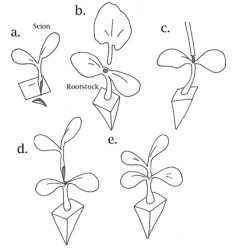
Hole Insertion Graft
The grafting method called “hole insertion graft” would be convenient for watermelons because of their small seedling size compared to the size of the rootstock seedling. This method, however, only works with the gourd rootstock. As you can see from the diagram, the rootstock leaf along with the growing point is removed and the scion is inserted into the stem of the rootstock. Following the five-step process, using a sharp utensil, such as a knife or razor blade, the scion is cut an then inserted into the upper portion of the rootstock.
Rootstock seedlings should have one small true leaf and scion seedlings should have one or two true leaves (Fig. a).
With a pointed probe, remove from the rootstock the true leaf along with the growing point (Fig. b). It is important to remove all of the growing point to prevent future shoot growth of the rootstock. This is one of the advantages of this type of graft.
Use the probe to open a slit along one side on the upper portion of the rootstock’s stem, where the stem connects to the cotyledons. Cut the scion and insert into the rootstock (Fig c). Hold in place with a grafting clip (Fig. d). Place the grafted seedling in a chamber with high humidity at about 77°F and discard the unused parts.
Advantages:
1) The only task after grafting is to remove the clip. There is no trimming of unwanted plant parts after healing of the graft union.
Disadvantages:
1) Requires slightly more skill than most other grafting techniques.
2) Requires careful control of humidity, light, and temperature after grafting. Can experience high losses due to poor environmental control and possible disease under high humidity conditions.
Subscribe Today For
