



Pest Of The Month: Wireworm and White Grub
 April 27, 2011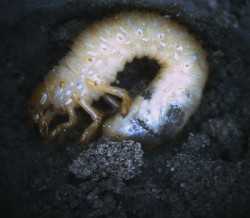
North Carolina is the nation’s leading producer of sweet potatoes. In that state, wireworms are enemy Number 1, with eight species attacking the crop. The most common is the tobacco wireworm. White grubs also are a major pest of sweet potatoes. A new “exotic” grub surfaced in the area a few years ago and is wreaking havoc on some growers’ crops.
According to Mark Abney, an Extension specialist in the Department of Entomology at North Carolina State University, it is important for growers to first understand the life cycles of these pests. Tobacco wireworm, which makes up about 80% of the wireworm population, has a one-year life cycle, with adults emerging from the ground in June or July. They lay eggs in the soil and in about one week, the eggs will hatch and the worms move down into the soil. Once there, they feed on roots.
In the white grub arena, Abney says there are two main groups: Phyllophaga and the new exotic Plectris aliena. Native to South America, the Plectris species was identified in 2006.
Because it is new to the U.S., there is not much known about its biology. It does, however, have some similarities to tobacco wireworm, as it has a one-year life cycle with adults emerging at the end of May and egg laying taking place in June. It is the third larval stage where grubs do the most damage, feeding on the surface of the roots.
“It is a very curious insect in that the adult beetle doesn’t feed at all,” explains Abney. “The adults emerge about 20 minutes before dark, flying about 3 feet above the ground. They emerge solely for the purpose of finding a mate. After mating, they immediately return to the ground.”
What makes this pest more challenging, he says, is that it can lay its eggs as deep as 11 inches in the soil. This creates a control problem as it is difficult to get a chemical down that deep or even to try a cultural practice, such as tillage.
Unlike the Phyllophaga grub, which tended to be sporadic inflicting damage, Plectris aliena has decimated nearly entire fields of sweet potatoes. From studying this pest, Abney says researchers have determined that adults simply do not feed and because they are only out of the ground a short period of time, it is difficult to target them with insect controls.
The Challenge
Abney says the Plectris grub is most susceptible to insecticides when the larvae hatch. The challenge is to get the insect control to the larvae.
Currently, the best control for grubs has been the neonicotinoid Belay (clothianidin, Valent U.S.A. Corp.) Abney says the product has been trialed as a pre-plant application and at cultivation. “We have had good results using it both ways,” he says. “Right now, we are telling growers to apply it pre-plant.”
Wireworm Worries
They may have a similar life cycle, but wireworms require a different treatment plan. Abney recommends that growers apply an effective insecticide such as Belay or chlorpyrifos to the soil pre-plant to kill wireworms that overwintered. Based on trials conducted in the state, Abney says an application of bifenthrin at cultivation improved control, acting as a soil barrier treatment.
The importance of putting the insecticide in the top layer of the soil is to stop the immature wireworms from moving into the soil. “They hatch in treated soil and never make it down to where the roots are developing.”
Subscribe Today For
