



What Potato Growers Need To Know About Bacterial Blackleg
 January 2, 2026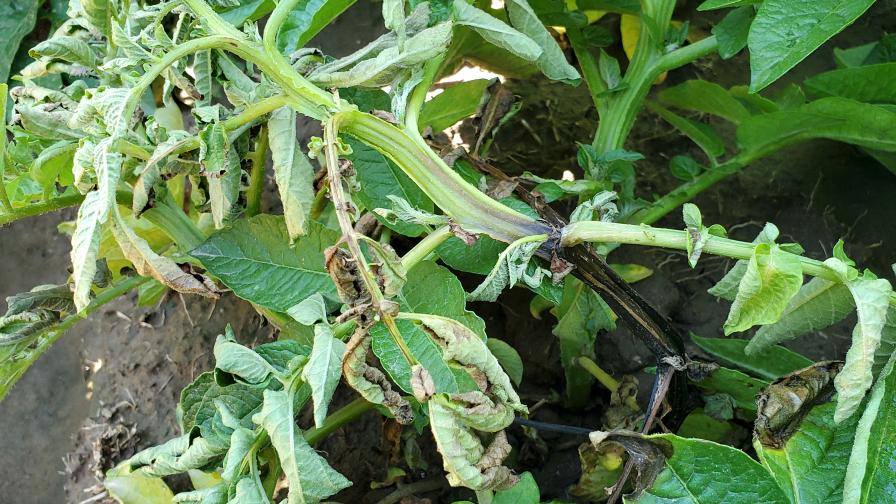
The most characteristic symptom of bacterial blackleg is a water-soaked, blackened decay at the base of the underground stem that extends into the canopy as symptoms progress — this is the “black leg” for which the disease is named.
Photo by Carrie Huffman Wohleb
Bacterial blackleg remains a significant early-season challenge in potato production. Although blackleg has long been a problem in North America, shifts in pathogen species (particularly the increasing role of Dickeya spp.) have renewed interest in understanding how this disease develops and how growers can limit its impact.
Symptoms
Blackleg symptoms can appear at any stage of early plant development. Infected seed pieces may rot or fail to sprout, or plants may emerge weak, stunted, and chlorotic. Often infected plants emerge normally and then weaken as the causal bacteria multiply.
Affected tissues exhibit a watery, soft, foul-smelling, or earthy-smelling rot. The rot often advances from the infected seed and up through the vascular tissues of the developing plant. As water uptake is impaired, leaves may roll up and wilt, and the entire plant can collapse. Later in the season, blackleg can lead to tuber soft rot.
Casual Agents
Blackleg is caused by pectolytic (soft rot) bacteria, including several species of Pectobacterium and Dickeya. These pathogens were formerly grouped within Erwinia, but they were reassigned to distinct genera about 20 years ago.
What’s the Difference?
Over the past decade, Dickeya dianthicola has emerged as an important pathogen in many North American potato-producing regions. Although Dickeya and Pectobacterium species produce similar symptoms, they differ in ecology, aggressiveness, and temperature preferences:
Dickeya spp. are most aggressive under warm conditions, whereas Pectobacterium spp. cause more damage under cool conditions. Pectobacterium spp. are more likely to cause tuber rot in storage and seed piece rot in the soil.
Dickeya spp. can progress rapidly through stem tissues, leading to sudden wilt and plant death. Pectobacterium spp. tend to move more slowly through the plant and cause only mild symptoms in emerged plants.
Even low or nondetectable levels of Dickeya spp. in seed can lead to outbreaks if environmental conditions favor disease development after planting. In contrast, Pectobacterium-related problems tend to correlate more closely with observed blackleg and soft rot in seed lots.
Many commercial laboratories offer PCR-based diagnostics to distinguish among the causal species. Knowing which pathogen is present can help explain why an outbreak happened and guide future seed sourcing decisions.
Pathogen Survival
Pectobacterium spp. can survive several months in water films on soil particles, but Dickeya spp. appear to survive for shorter periods in soil. Both, however, survive much longer inside potato tubers. Infected seed tubers are the primary source of inoculum for blackleg outbreaks.
Reducing Risk Through Seed and Field Management
Because blackleg is predominantly tuber-borne, management focuses on exclusion, minimizing secondary contamination, and avoiding conditions that promote rapid disease progression and spread.
Don’t plant infected seed. Select certified potato seed lots with no detected blackleg. Incidence at summer field inspections is often reported on the North American Certified Seed Potato Health Certificate, but visual inspections can miss low-level or latent infections. Some certification programs do not monitor blackleg. In that case, select seed from farms without a history of blackleg and reject lots showing any visible rot.
RELATED CONTENT: 5 Steps To Distinguish Abiotic vs. Biotic Problems in Potatoes
Limit contamination with careful seed handling. Take particular care during seed cutting. Disinfect knives regularly, and more often if you see any soft rot. Allow seed pieces to suberize by holding them in a well-ventilated area at moderate temperature and humidity until the cut surfaces are dry and corky. Avoid bruising the seed when handling and planting, as wounds provide entry points for bacteria.
Avoid conditions that favor disease development. Cold, saturated soils are a recipe for seed decay. Wait for the soil to warm and dry enough to support vigorous emergence. Avoid overwatering. Light irrigation to maintain moisture is fine, but saturated soil enhances bacterial movement. As plants emerge and root systems develop, irrigation can be gradually ramped up, but soil should never be waterlogged. In wet soil, lenticels on underground stems, stolons, and developing tubers open, becoming entry points for bacteria.
Can Copper Treatments Help?
Copper compounds have long been used as bactericides, but their usefulness for managing blackleg is minimal at best. Copper is not systemic, so it can’t reach bacteria inside the plant. Seed treatments containing copper may temporarily reduce surface contamination, but they do nothing to stop internal inoculum, which is the primary source of blackleg. Foliar copper treatments do not reach tubers in the soil, so they cannot protect underground tissues from blackleg (or soft rot) pathogens.
Subscribe Today For
