



Using the Right Balance of Nutrients To Fight Plant Disease
 October 18, 2025
 Optimizing soil fertility and mineral nutrition is vital to plant health and disease prevention. Too often the focus falls only on crop yield. A grower’s objective should be to create a healthy soil environment with the right balance of nutrients. That balance supports yield and helps suppress disease.
The presence of a pathogen in a conducive environment can lead to infection if the crop is susceptible. Fine tuning plant mineral nutrition is one of the ways growers can protect against disease.
Start With Soil Testing
A recent soil fertility test offers the first guidepost toward soil health and disease protection. The first step is to check soil pH level and determine whether it matches the needs of the crop or requires adjustment.
- Fertility levels for phosphorus and potassium
- The balance of calcium to magnesium
- Micronutrient availability in the context of the soil pH
However, soil testing is just a starting point. Regular fertility soil tests generally do not access nitrogen availability. Even though nitrogen often has more influence on disease susceptibility than any other plant nutrient.
And in the case of nitrogen, it is not just how much nitrogen is provided to the crop, but the form. Nitrate or ammonium affect crops differently.
Some diseases are favored by nitrate nutrition, while others are favored by ammonium. Nitrate uptake increases soil pH in the root environment; ammonium decreases it. Altering the root pH environment can influence disease risk. For example, ammonium nutrition enhances manganese availability, which helps protect wheat and bentgrass from take-all disease.
Beyond Nitrogen: Other Influential Nutrients
After nitrogen, calcium plays a major role in crop disorders. The main challenge with calcium nutrition is its low mobility within the plant. Its uptake competes with potassium and magnesium.
Even if soil tests show adequate calcium supply, crops may still experience deficiencies if environmental conditions are unfavorable for uptake.
Delivering calcium into fruit tissue is essential. Without it, disorders like blossom end rot in tomato or bitter pit in apple may appear. New research suggests that the micronutrient nickel may enhance calcium uptake in developing fruit tissue and help prevent these disorders. However, most soil tests do not currently measure soil nickel status.
Silicon, described as a quasi-essential plant nutrient, can also play a big role in protecting crops against diseases. Numerous studies show that supplying soluble silicon through products such as wollastonite or calcium silicate boosts uptake in cucurbits and delays powdery mildew disease.
While testing soil for silicon is not routine, soil pH measurements can guide application rates for calcium silicate. (For more details, see Silicon Needs of Soils and Crops from Rutgers University.)
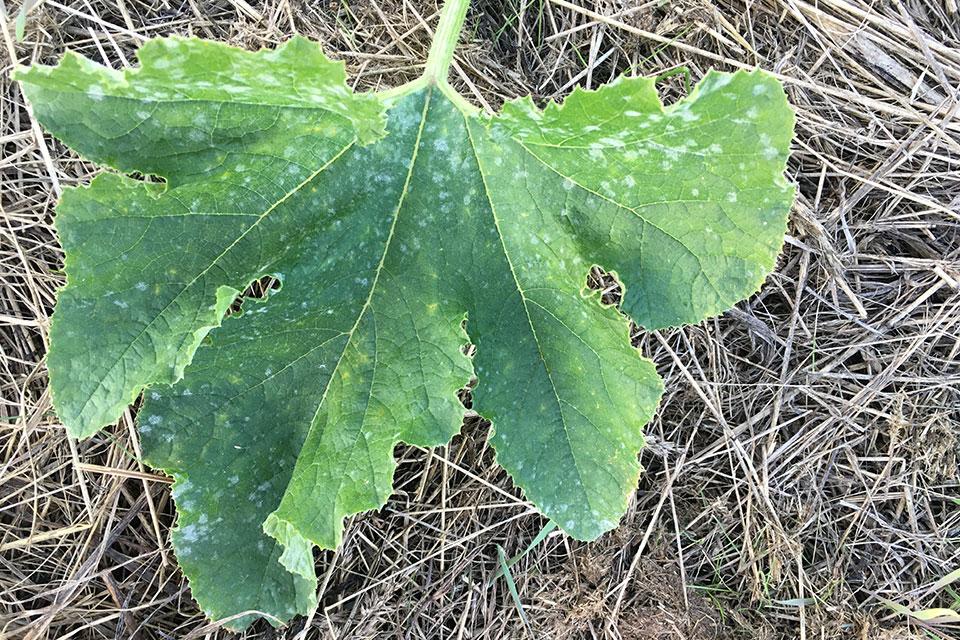
Silicon in the soil strengthens cucurbits against powdery mildew, shown here on pumpkin.
Photo by Joseph Heckman
A Sustainable Tool
These are some of the ways that mineral nutrition can be targeted to protect crop health. The advantage of using a mineral nutrition approach is that the application of this knowledge is low cost compared to the use of pesticides for disease protection.
In the case of fungicides, diseases tend to develop resistance after repeated use of the same product. In contrast, mineral fertilizers are comparatively inexpensive and a sustainable cultural practice.
Still, nutrient management is not a stand-alone solution. It works best as part of an integrated strategy that includes:
Building soil health and organic matter content
- Crop rotation
- Good sanitation
- Integrated pest management
For deeper reference, the American Phytopathology Society recently published the second edition of a best-selling book titled Mineral Nutrition and Plant Disease. This book deserves a place in every county agents’ library as a tool for diagnosing problems and fine-tuning nutrition for crop protection.
Subscribe Today For
