




Better, more berries and almonds for growers to sell – with new bee-centric technology
Disease, harvest and postharvest data supports what early adopter growers are experiencing
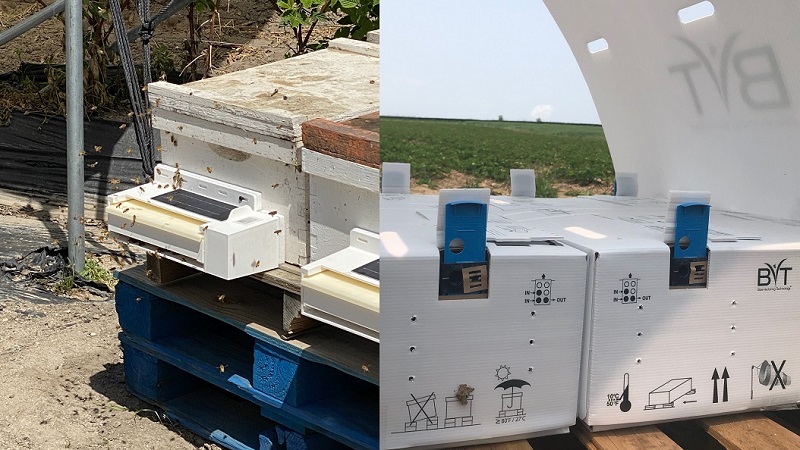
As growers continue to look for ways to improve their profitability while becoming more sustainable, a new bee-centered technology could deliver the answer.
With Bee Vector Technology’s (BVT) VectorHive™ system, bees themselves deliver a biofungicide spore, Vectorite™ with CR-7, from hives to blooms. As bees exit the hive to forage pollen, they travel through the system and pick up minute amounts of the biofungicide, bringing it with them to the blossoms, a common vector point for fungal diseases that affect crops.
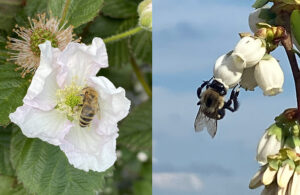
Commercially reared and managed bees busy “bee vectoring” on crop fields with the BVT system in use; Left: a honey bee on a raspberry bloom in California; Right: a bumble bee on a blueberry bloom in Georgia.
The trace amounts of the biofungicide carried by the bees do not harm them but do provide enough spores to allow the biofungicide to colonize on the blossom, becoming bound to it at a cellular level.
Growers of blueberries, blackberries, raspberries, strawberries and almonds agree — the investment in this new technology pays off, and the data supports what’s being seen in the field.
“It’s helped the overall pollination, and it’s helped the size of the berries,” said John Bennett of Alma Sunbelt Blueberries in Georgia.
Disease and yield
Using BVT’s bee vectoring system showed better marketable yield results over crops using traditional chemical treatments/application methods. A 2019 University of Florida trial on strawberries found that using the BVT system and Vectorite with CR-7 along with a fungicide program provided better marketable yield (34% increase) and better Botrytis cineria (gray mold) control (12% reduction) than a fungicide program alone.
In 2021 California strawberry trials with two major growers — one organic and one conventional — BVT was added on top of the grower standard spray program and resulted in 25% and 32% greater yields, as well as 50% and 62% reductions in diseased fruit. The farms also saw 34% and 50% reductions in culled fruit.
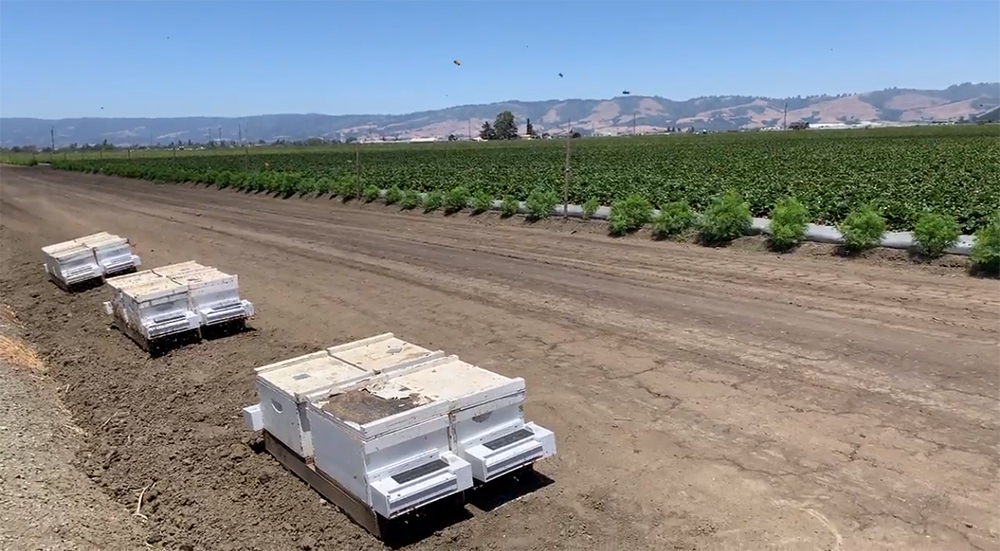
2021: A California strawberry field south of Watsonville with BVT’s VectorHive honey bee dispensers attached to hives – bees carry the biofungicide Vectorite with CR-7 with every visit to blooms.
In postharvest, the berries treated with BVT were healthier, with 13% and 17% lower incidence of Botrytis. And the severity of Botrytis on the berries was decreased by 12% and 45% at the two farms.
The California strawberry grower trials were a proof-of-concept of the BVT system for one of the largest berry companies, in a market where bees are currently not being used for pollination, and demonstrated the economic benefit of the BVT system.
Fruit size
In another grower demo, crops grown utilizing BVT’s system measured bigger fruit. At this conventional blueberry grower demo in the Oregon Columbia River Basin region, they reported bigger berries, higher yield and more profit. Pre-harvest berries were on average 16% bigger in berry size with bee vectoring used over plots not treated with bee vectoring, and there were 43% more larger berries (that were 12 mm in size or greater) with bee vectoring used over plots not treated with bee vectoring.
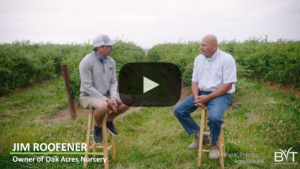
Jim Roofener, owner of Oak Acres Nursery in Oregon, said they saw larger fruit sizes after using BVT. “The first pick, the fruit size was really, I call it, enormous compared to the past.” He went on to say “My granddaughter had found a berry in the field that weighed 7 grams by itself! She’s on a mission to find big berries.”
Field disease and impact on postharvest results
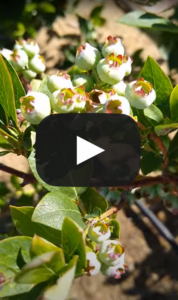 Growers also reported less field disease and postharvest disease. Bennett said in addition to larger fruit sizes in crops utilizing bee vectoring, “I’m very pleased because we don’t have anthracnose and that’s a major, major problem.”
A 2020 blueberry grower demo in Michigan showed Colletotrichum (anthracnose) incidence in dropped berry samples. Using the BVT system with bumble bees, in combination with conventional management, had a 77% and 22% reduction in pathogen incidence in two different cultivars compared to conventional management samples alone.
At a spray trial on conventionally grown almonds in Central Valley, California, University of California researchers found that CR-7 had over 80% efficacy in Monilinia laxa (brown rot blossom blight) disease control — the same level of control as leading chemical standards. In addition, CR-7 outperformed five other biologicals for control of Botrytis cineria (jacket rot).
2021 was a very dry growing season in California’s Central Valley and there was little disease on the almond orchards. The data collected from this 2021 Central Valley trial positively confirmed 2019 collected data: CR-7 sprayed produced the same control of Monilinia incidence as leading chemical standards; and CR-7 outperformed other biologicals for Botrytis control.
More durable berries lead to longer shelf life
Longer shelf life with more durable berries is being seen, as well. In a 2017 Spain trial measuring percent damaged strawberry fruit after two to five days of simulated storage at 41 to 44.6 degrees Fahrenheit, fruit from plots using bee vectoring, along with standard chemical treatments, showed less fruit damage than plots just treated with chemicals only.
In addition, according to Everett Hendrixon, BVT’s Territory Manager for the Eastern U.S.: “We’ve observed shelf life of two weeks above conventional treatment. Two packing houses have told me that the BVT customers have less soft fruit, likely a symptom of anthracnose.”
And, finally, due to quality, size and yield, growers are seeing less rejection at the packing house on crops grown using BVT’s technology.
Growers’ costs for inputs continue to increase, including the cost of many traditional chemical products. Some of these have risen as much as 40% in the last year. With BVT’s technology, growers not only help the environment but their pocketbooks as well. What’s more, the product is readily available for the 2022 growing season.
Want to know more? Learn about how sustainable stewardship through biologicals levels up any IPM program in “Revolutionizing precision ag” and “How to protect your crops on a micro-level while saving on labor and costs.