


One Grower’s Take on the Apple Industry’s Oversupply Issue
 November 29, 2024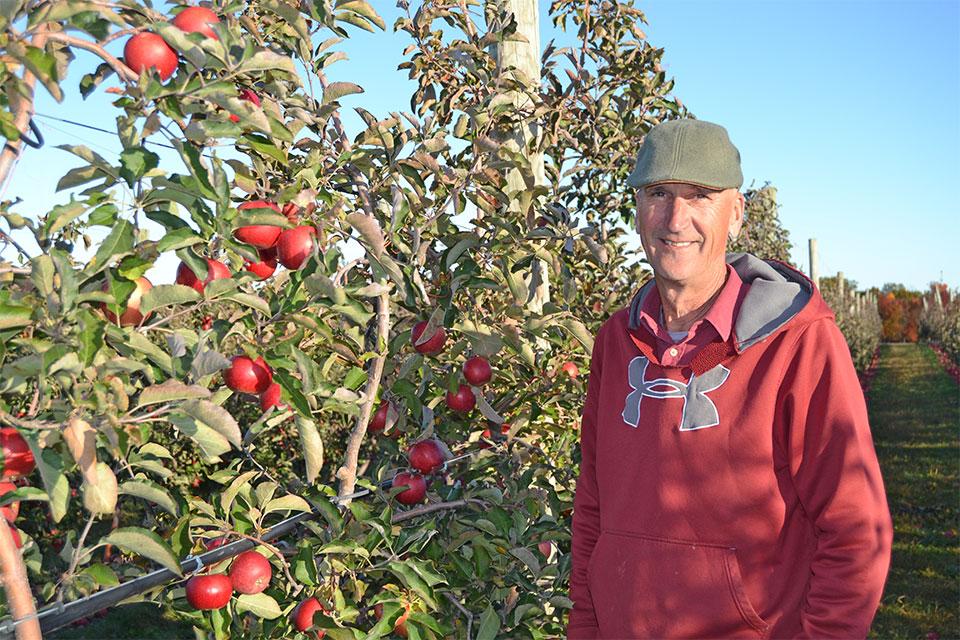
These are turbulent times in the apple industry. Bill Dodd of Hillcrest Orchards in Amherst, OH, weighs in with some thoughts.
Photo by Thomas Skernivitz
The 2024 season for Bill Dodd started on a path of totality that unexpectedly hit a dead end. But all’s well that ended well for the owner of Hillcrest Orchards in Amherst, OH, thanks to 10 consecutive pristine U-pick weekends between September and early November.
“My year depends on the weather on the weekends,” Dodd says. “We do our agritainment just on the weekends, and we had pretty darn good weather through the fall.”
Some years are like that. Some are not.
“There’s been years when some of these hurricanes go up the east coast. I have friends in Boston, and if they get a week of rain or it hits on the weekend, they have no business,” Dodd says. “People aren’t going to come and pick, and you usually don’t make that up. It’s not like you’ll have twice as many people the next weekend.”
Hillcrest Orchards experienced a no-show of different sorts in the spring, when a unique agritainment event went dark — figuratively and literally. In anticipation of the ballyhooed Great North American Eclipse on April 8, Dodd, ever the marketer, promoted a five-day watch camp at his farm. Smack in the middle of the eclipse’s path of totality, paying attendees from across the country would experience complete darkness for 3 minutes 53 seconds, beginning at 3:13 p.m.
Unfortunately, everyone interested in the phenomenon was apparently anywhere else in northeast Ohio that day. While 12 similar events locally would generate $24.6 million in economic impact, according to convention and visitors bureau Destination Cleveland, Dodd wound up enjoying the moment — “Oh, my God, it was incredible,” he says — with only family and friends.
“There were all kind of reports going back to November that this is going to be 3 million people descending on the county, and this is a once-in-a-lifetime event, and the hotels are going to be booked up,” Dodd says. “I’m like, ‘OK, is there an opportunity? We thought, ‘Well, we’ll have some sort of event at the farm.
“I priced it like there was going to be a lot of demand. And we didn’t have any participation because I priced it too high. We were looking at possibly letting RVs stay here. Then I found out that the campground in Lorain County was doing campers for, like, a hundred bucks for the weekend, and I was at $400.”
Six months later, Dodd, smiling, says, “I have a lot of great ideas. Some of them just don’t work.”
Addressing Oversupply
Fortunately, letdowns involving Dodd are about as rare as eclipses. In 2015 he earned American Fruit Grower’s Apple Grower of the Year award. Since 2012 he has served as President of the Midwest Apple Improvement Association (MAIA) — an organization that has now produced nine apple brands, including ‘EverCrisp’ and ‘Ludacrisp’.
When it comes to seizing opportunity, Dodd has excelled on the business end and in the field. As the apple industry deals with what he says is simply “too many apples,” he offers his thoughts on the oversupply dilemma:
For starters, the time is right to sell retail. “I got out of the wholesale business because we weren’t big enough,” Dodd says. “We transitioned over the last 25 years from being 90% wholesale to now being 90% retail. We have a little more control over what the pricing is when there is an oversupply.”
With retail comes agritainment, which only helps. “If you’re in agritainment, the downturn is probably not affecting you as much,” Dodd says. “A lot of people in Ohio are blended. They’ll have a wholesale component where they’re packing, but they also have retail because we have so many people here. Up in western New York, there are not a lot of people, so they’re mainly growing and packing and shipping, so they’re at the mercy of the market.”
Oversupply is not new. In the late 1990s, while there were fewer varieties, there were nonetheless too many ‘Red Delicious’, ‘Golden Delicious’, and ‘Granny Smith’ trees. Now there are too many varieties as well, some of which will need to be removed, Dodd says. In addition, there are 1,250 or more trees per acre today, he says, compared to around 250 trees per acre 30 years ago.
“Economics and supply and demand work their way out. You can’t lose money very long or you’re out of business,” Dodd says. “Growers will adjust, and unfortunately some people will probably go out of business, but the supply has to get more aligned with the demand.”
More consumption, of course, would alleviate the issue. “If we increase per capita consumption by 2 pounds per person, we don’t have a problem,” Dodd says. “But it’s been flat and maybe even declining. Part of that is competition in the produce aisle. Everyone is upping their game. We are trying to as well with all the new varieties, but we’ve kind of done it to the point where we’ve confused the consumer more than we’ve established something.”
With MAIA having introduced nine such brands over the last decade, Dodd says he is frequently asked, “Aren’t you part of the problem?” His standard answer:
“The grapes and the clementines and every other fruit in the produce aisle are looking to improve themselves — better eating experience, easier eating experience, price point that consumers can stomach. We have to increase consumption. If we can increase consumption, that solves most all of our problems. To increase consumption, we have to give the consumer a return on their food investment and a better eating experience.
“All of these new varieties or most of them are better than ‘Red Delicious’ and the old standards. But there’s too many of them. Newer varieties are already failing. Some are going to catch a niche or catch a wave and continue, and there’s others that are going to go away. We can’t, as an industry, hamstring ourselves and not create more better varieties because there are too many varieties. Some of them just need to go away.”
Subscribe Today For
