



Reasons Revealed Why Bacterial Spot of Tomato Spreads So Easily
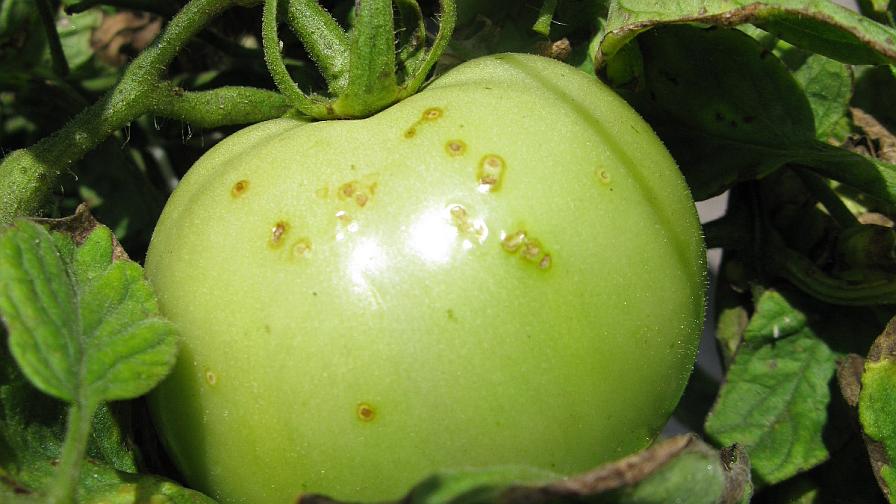
An up-close look at bacterial spot of tomato symptoms.
Photo by Gary Vallad, UF/IFAS
Bacterial spot of tomato is spreading rapidly across continents. Researchers have been on an epic mission to find out why. Thanks to funding from the USDA’s National Institute of Food and Agriculture, a global team of scientists led by plant pathologists from the University of Florida has found the pathogen that causes bacterial spot (Xanthomonas spp.) has multiple genetic variations.
Bacterial spot travels when plants are infected with the pathogen and can survive in tomato seeds shipped anywhere in the world. For the 12-year study, scientists collected the pathogen from tomato plants in 13 nations on six continents and found its genes vary greatly from country to country.
“This is a problem because when new genetic variation arrives in Florida, it may cause new problems, like more severe disease symptoms on tomato or spread to other crops like peppers,” says Erica Goss, a UF/IFAS Plant Pathology Professor and one of the corresponding authors of the study. “We already have a disease that is very hard to control in hot and humid weather around the world. It is a global problem that needs a solution.”
UF/IFAS Professor Gary Vallad says scientists can use the study’s findings to better monitor bacterial spot and develop tomatoes that can thwart the disease. “Past efforts to breed for resistance to bacterial spot were compromised by the introduction of new strains, even before the resistance was commercially deployed. Knowledge of pathogen diversity allows us to refine our breeding efforts to target conserved genetic features within the global pathogen population. This should allow us to deploy resistance that is effective and durable.”
As bad as the news appears to be about how bacterial spot travels, the study’s findings should help plant breeders, Goss adds. “What this study shows is that the pathogen is diversifying – there are lots of different types of the pathogen out there, and it’s evolving quickly to respond to control measures, which means there will not be a simple solution. But having this genetic information is critical to the development of disease-resistant tomato varieties, which would help farmers avert bacterial spot.”
To read the recently published study about the spread of bacterial spot of tomato, click here.
Subscribe Today For
