



Survey Says Berries Are Seriously Booming Right Now
 July 8, 2025
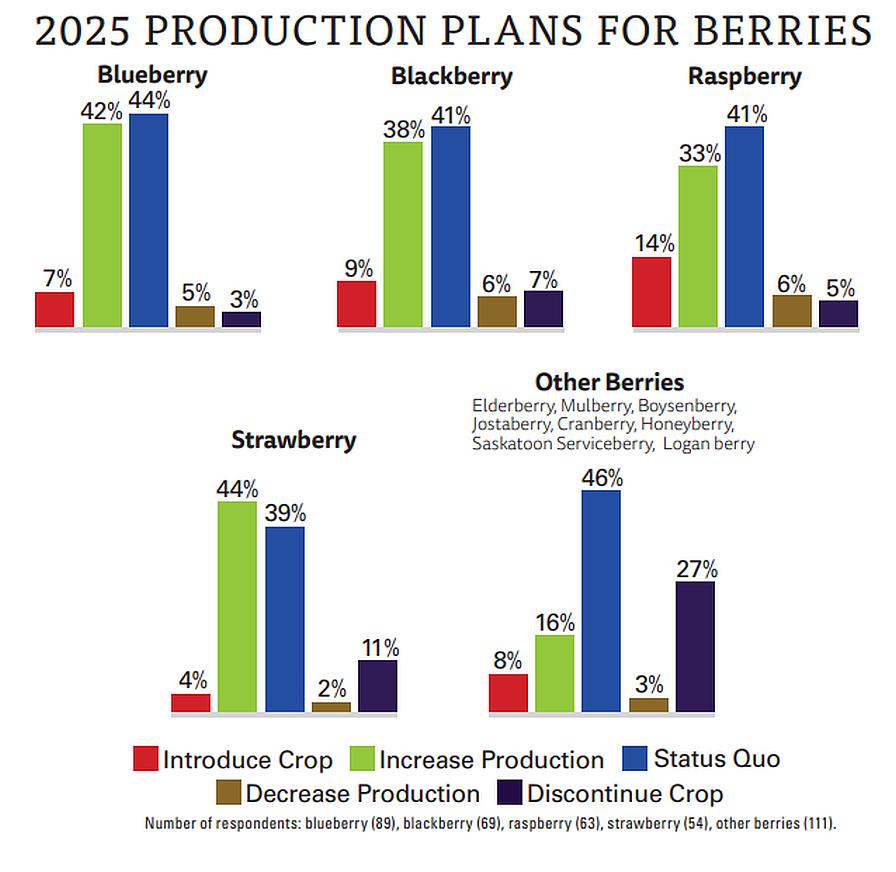
 It’s up, up, and away for growers of the four main types berries: blueberry, blackberry, raspberry, and strawberry. Growers of all four plan on increasing production by at least one-third this year. Only about 5% of these growers are looking to decrease production in 2025.
In fact, more growers are looking at introducing these crops than decreasing production, led by raspberry, as 14% of berry growers are planting raspberries for the first time.
Some growers are planting raspberries because they see an opportunity in other growers’ misfortune: “The red raspberry market has new openings due to many growers discontinuing production due to plant health challenges,” writes one grower.
More typical was this response: “Demand for raspberries,” writes one grower. “Decreased strawberries due to labor costs.” Or this: “Many of our customers have requested raspberries, so some are going in this year.”
Blueberry growers have been riding the wave of demand for so-called “brainberries” for a number of years. If all that planting continues apace, U.S. Highbush Blueberry Council data shows supply will outstrip demand in the next half-dozen years. Growers were asked how they are preparing for, or even preventing, such a scenario.
“The government needs to stop all the imports coming into this country,” writes one grower. “They’re flooding our markets year-round — Peru and Mexico in particular — we cannot compete with them.”
But most growers write that increasing the quality of the fruit they grow is the key to continued success. “Maintain existing plantings so that they are nutritionally complete and healthy,” writes one. “Remove old plantings or varieties that are less productive or less tasty. Harvest fruit at peak maturity so that the flavor profile is optimum.”
Writes another: “Quality is the key. We are small enough that we can be a price setter vs. a price taker in our market. We are also seeing many competitors vacate or downsize the organic portion of their production. That raises the cost of maintaining production but also increases the spread between conventional and organic fruit.”
In general, smaller, direct market growers reported fewer qualms about the future, exemplified by this confident grower. “This (over-supply) is not our situation. We’re a U-pick farm, and we have way more demand than we can supply — by a lot. If you are talking about simply the consumption of the fruit, I would recommend more farms incorporate a U-pick experience if possible. People want experiences! And they like picking blueberries — it’s relatively easy, safe, and kids especially enjoy it.”
One problem some strawberry growers are dealing with is Neo-P (Neopestalotiopsis), a fungal disease that emerged as a significant concern in 2024. Most growers report being unaffected, but for those who were, it is a serious problem. “Neo-P is a royal game changer,” writes one. “We are spraying weekly to attempt to hold off the fungus. Our plants appear to have overwintered well — now to start the spring regimen.”
And a few report such serious problems that they have given up growing them altogether. “That’s why I’ve discontinued growing strawberries after 15 years. (Nurseries) won’t guarantee their plants, as over 50% die when planted, and varieties that sell are not available.”
Looking a little further down the road, growers were asked what the most important trait breeders should focus on. Two words are used repeatedly, showing what is foremost in growers’ minds: “taste” and “flavor.” Typical answers are short and sweet, often including an exclamation point, such as “Flavor! Please.” Another common answer is “Taste over shelf life.”
Shelf life is the second-most sought-after quality for breeding, often grouped together with disease resistance. Several growers indicated in their answers just how difficult that could be while also focusing on taste: “Flavor and shelf life (which are often mutually exclusive),” writes one grower.
Coming in third for desired traits was berry texture, which was also often grouped with pest resistance, as many diseases can make for too-soft fruit. Summing up the direct marketer’s needs was this grower: “Resistance to common diseases (anthracnose, etc.), flavor, and ease of harvest. Thornless varieties are preferred by U-pick customers.”
Stay tuned for more insights from the 2025 State of the Fruit and Nut Industry report in the coming weeks.
Subscribe Today For
