


Crop Nutrition Experts Offer Advice on Bitter Pit
 October 27, 2025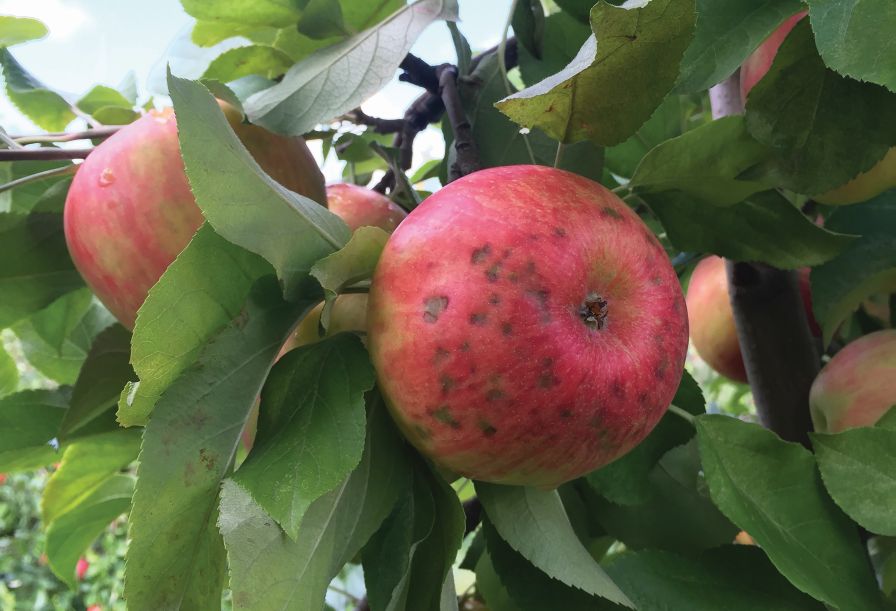
Untreated ‘Honeycrisp’ apples exhibiting bitter pit. (Photo by Poliana Francescatto)
Five specialty agriculture industry leaders representing some of the country’s top crop input suppliers, share their thoughts on the bane of apple growers — bitter pit — and the disorder’s association with calcium (Ca) deficiency. Check out what advice they have in the following Q&A.
Few growers seem to understand bitter pit. Can you relate? What do you tell them?
Danica Kluth (PNW Regional Agronomist, Crop Nutrition, Tessenderlo Kerley Inc.) — “Yes, that is a common and valid frustration. Bitter pit is unpredictable, and even when growers feel like they have done everything correctly, it can still happen. Agronomists and researchers have helped narrow down contributing factors, but it is still somewhat of a mystery. For the most part, we have narrowed it down to variety, Ca uptake, environmental stress, and management.”
Abe Isaak (Field Agronomy Manager, AgroLiquid) — “Many times, out of frustration, we wonder if anyone understands our issue or problem. We know that Ca deficiency, primarily in surface cells, is the most common cause of bitter pit, and we know what should work to prevent or cure the symptoms. What makes it more frustrating is that we often get mixed results from applications, and it can be difficult to repeat the same results in another field. Many factors influence these results. They include soil pH, cation exchange capacity (CEC), sodium levels in the soil, dry or wet soil, and previous farming practices.”
What is so confounding about the disorder?
Greg Clarke (Senior Field Market Development Specialist, Valent U.S.A.) — “I think the confounding issue is that producers are adding more Ca and doing everything correctly in their nutrition and irrigation programs, yet they still end up with high bitter pit some years. Perhaps the new discoveries about maintaining xylem health will be the big game changer.”
Rick de Jong (Canadian Regional Manager, Rovensa Next North America) — “There are many factors that can affect bitter pit severity, creating the need for a holistic approach to managing it. Nutrient levels, nutrient ratios, rootstock selection, crop load, pruning strategy, and stress management can all influence bitter pit.”
Kluth (TKI) — “It is so inconsistent. Neighboring blocks with similar programs can have drastically different levels of bitter pit. It is a system of a physiological imbalance, not just a single deficiency. This makes it harder to treat with a one-size-fits-all approach.”
Why Honeycrisp? Are other varieties particularly susceptible as well?
Randy Ross (Regional Manager, Virginia/Carolinas Region, Timac Agro) — “Honeycrisp gets most of the press by virtue of it being so popular and there being so many acres of it in current production.”
Isaak (AgroLiquid) — “Northern Spy, Gala, and Granny Smith are also susceptible to bitter pit. Genetics and the physiology of Honeycrisp are the biggest reasons for bitter pit in apples.”
Clarke (Valent) — “Honeycrisp is the worst — and currently the most economically significant — but there are other varieties that exhibit the xylem function problem to greater and lesser degrees, including Granny Smith, Golden and Red Delicious, Cortland, Idared, Crispin/Mutsu, Empire, Northern Spy, and others.”
Kluth (TKI) — “Honeycrisp is the poster child for bitter pit susceptibility due to the unique physiology, with factors like thin skin, large cells, and high transpiration rates. Other varieties like Jonagold and Cortland can be affected but usually not as severely or consistently.”
de Jong (Rovensa) — “Other varieties have shown susceptibility to bitter pit but have been largely replaced in orchards over the years.”
Are regions of the U.S. more or less susceptible?
Clarke (Valent) — “In all my travels, I believe bitter pit is mostly universal, but its intensity can vary across different fruit-growing regions due to factors such as water, soil, rootstocks, etc.”
Kluth (TKI) — “Regions with high-vigor growing conditions, like the PNW or Midwest, tend to struggle with bitter pit more in my experience. These areas have more aggressive vegetative growth across all crops, and this can lead to a shortage of available Ca at times it is needed the most.”
de Jong (Rovensa) — “Due to the many factors impacting bitter pit, no one region is immune.”
If Ca deficiency is the root of the problem, is a “more the merrier” treatment approach oversimplifying matters?
Kluth (TKI) — “It can be. Dumping more Ca into the program will not necessarily guarantee that the Ca will make it to the fruit. Translocation depends on tree health, root function, ET, and nutrient balance. It’s a case of ‘just because it is in the soil, doesn’t mean it is getting to the fruit.’”
Isaak (AgroLiquid) — “There are two things growers should keep in mind when addressing bitter pit with Ca applications: timing and solubility. If you apply Ca at the right time but can’t get it into the plant (solubility), the tree will not be able to absorb it either by the roots or leaves if foliar applied. If you apply soluble Ca at the wrong time, the plant won’t need or take it up. Calcium is also immobile in plants. It will not move from one part of the tree where it is adequate to another that is deficient.”
Clarke (Valent) — “Ultimately, bitter pit is a transport issue. If you can’t deliver Ca to the outer areas of an apple, that tissue breaks down and bitter pit happens. That’s where the ‘black hole’ … comes into play: soils, trees, leaves, and even fruit can be tested to have enough overall Ca, but it’s not ultimately getting to where bitter pit is formed.”
de Jong (Rovensa) — “Calcium deficiency is the “effect,” not the “cause”. The cause can be any physical, cultural, or environmental action that disrupts or antagonizes Ca uptake, distribution, or supply.”
Ross (Timac) — “The amount of Ca applied foliar isn’t nearly as important as when it is applied and the source of the Ca applied. The most critical time is early in the fruit’s development during the cell division stage that begins immediately following pollination of the flower and continues for approximately five to six weeks after. This is when cell walls are being built. So, application timing can start at bloom but should be no later than petal fall and through the cover sprays until about 30 days before harvest. Calcium applications should be from a product that uses Ca chloride (CaCl) as its source. CaCl has been found to be the most readily available and usable source of Ca to the apples.”
Are other nutrient imbalances in play?
Kluth (TKI) — “Yes, it isn’t just about Ca. Excessive potassium (K), magnesium (Mg), and even nitrogen (N) can antagonize uptake of Ca. Therefore, flooding the system isn’t always effective. Trying to balance the nutrients can be the more effective approach to support efficient plant uptake and allocation to the fruit to help get Ca into the cell walls to prevent bitter pit.”
Isaak (AgroLiquid) — “Calcium may be the issue, but when boron (B) is low, the plant can’t take up Ca from the soil, no matter what the form of Ca or if it is in excess. Boron helps move Ca to where it is needed in the plant. The takeaway is we must always start with the soil.”
Is there any way for a grower to predict how prevalent bitter pit will or won’t be any given season?
Isaak (AgroLiquid) — “The old saying, “An ounce of prevention is better than a pound of cure,” is appropriate in this situation. It is better to prevent bitter pit through proper nutrient management and cultural practices than to find symptoms and try to treat it. At that point, it’s often too late to do anything more than try to limit the losses of fruit. Calcium applications should be applied early and regularly.”
Clarke (Valent) — “Cornell developed a ‘passive method’ that can be used to predict bitter pit. It involves harvesting fruit three weeks before harvest, keeping them at room temperature, and then assessing incidence and severity three weeks later. There are also some peel sap analysis methods that have shown promise in predicting bitter pit.”
Kluth (TKI) — “Tracking things early and consistent is key — year to year and throughout the season. Predication is tough, but risk assessment is possible. Things like crop load, pruning intensity, and early-season N use can be factors that can give clues to the risk. SAP analysis can be a good tool, and fruitlet testing and past block history can allow growers to be proactive, but there still is a lot of gray area.”
What are your rules of thumb for application timing?
Isaak (AgroLiquid) — “Start early and be consistent with the applications. Start applying right after petal fall when the small fruitlets are starting to form and continue this weekly until two or three weeks before harvest. Remember that Ca does not translocate in plants. When leaves and fruit are small, they move much more easily when sprayed with an air blast sprayer, and coverage is better. If Ca is not applied to the surface of a fruit, it will migrate there. One to 2 pounds of Ca per application per acre is a good rule of thumb.”
de Jong (Rovensa) — “Early-season Ca is critical for bitter pit management. Applications need to start as early as pink stage and continue through to four to six weeks post-petal fall. This approach ensures that Ca is in abundance during the fruit division window of opportunity. Maintenance applications of Ca for the remainder of the growing season ensure that fruit Ca levels are maintained. Avoid early-season K applications, which can inhibit the uptake and flow of Ca to the fruit. If excessive soil K levels are present, one can apply foliar manganese applications, starting at pink stage, to regulate the uptake of soil K during the fruit cell division window. Avoid N applications later in the growing season, which can result in larger fruit and more bitter pit pressures.”
What application methods do you recommend among soil, foliar, and fertigation?
Isaak (AgroLiquid) — “The application method you choose depends on timing and nutrient needs. Soil applications should be based on a soil test, which will determine what, if anything, should be done through the soil. Foliar Ca should be applied at the rate of 1 to 2 pounds per acre. For growers who use irrigation systems, fertigation can be an efficient way to apply nutrients. However, it’s important to apply soluble Ca that can be taken up by the roots. Nitrogen is needed for plant growth, but be careful, as too much can exacerbate bitter pit. Calcium nitrate is a great source of N, and because it contains very soluble Ca, it will work in the soil and be available to the plant.”
de Jong (Rovensa) — “A grower should use all the tools available to them in the management of bitter pit. This holistic approach should include soil management, foliar crop nutrition, and fertigation where possible. Soil management, including fertigation, can address nutritional concerns and optimize soil pH, setting the stage for Ca uptake. The tree’s root system is the primary way to move Ca into the crop. Foliar nutrient applications can then be used to enhance Ca levels during windows of opportunity, improving fruit Ca levels.”
Ross (Timac) — “In-season Ca foliar applications are necessary as a supplemental source of Ca but should only be one part of a Ca management plan. In my experience, foliar applications are not a silver bullet. They can’t fix everything but are just part of the Ca equation.”
Subscribe Today For
