



Can Advances in Genetics Help Apples Outsmart Spring Frost?
 June 26, 2026
 It has become increasingly common to experience extreme weather events, including unusually warm winter temperatures followed by freezing conditions in spring. Late-spring freezes have long been considered a major threat to fruit production because they can severely damage or completely destroy developing flowers. In apple, approximately 90% of flowers at the pink and bloom stages can be killed within a short period when temperatures reach 25˚F.
A recent example occurred on April 21, when a damaging freeze swept across multiple states, including New York, Pennsylvania, Maryland, and others. Reports indicate frost damage to fruit crops was widespread and severe.
In New York alone, estimated crop losses exceeded $30 million. To assist affected growers, New York Governor Kathy Hochul requested a federal disaster declaration.
To mitigate the threat of spring frost, orchard protection measures such as wind machines and heaters have long been recommended. However, these approaches can be costly to implement and may provide limited protection during severe frost events.
Given the increasing frequency of weather extremes, it may be time to explore genetic solutions that could help reduce frost risk. As an initial step, we completed a phenology survey of apple cultivars and wild relatives maintained in the USDA apple germplasm repository in Geneva, NY.
The objective of the survey was to determine whether a viable genetic solution exists to help mitigate frost risk and how such a solution might be developed.
DIVERSITY IN TIMING OF BUDBREAK AND BLOOM
Major observations from the survey include:
1. Most apple cultivars require approximately 30 days to progress from budbreak (green tip) to full bloom.
2. Apple cultivars generally fall into three groups based on budbreak and bloom timing: early, normal, and late.
3. The normal group is the largest, accounting for more than 85% of the cultivars surveyed. Elite cultivars such as Gala, Fuji, Honeycrisp, and Delicious all fall within this group. The early group represents roughly 10% of surveyed cultivars, while the late group accounts for approximately 5%.
4. Average budbreak timing for the early, normal, and late groups occurs in late March (around March 25), early April (around April 5), and late April (around April 25), respectively.
5. Average bloom dates for the early, normal, and late groups occur in late April (around April 25), early May (around May 5), and late May (around May 25), respectively.
These observations indicate that the difference in budbreak timing among apple cultivars can be as much as 30 days. A similar range exists for bloom timing, highlighting substantial genetic variation in apple phenology.
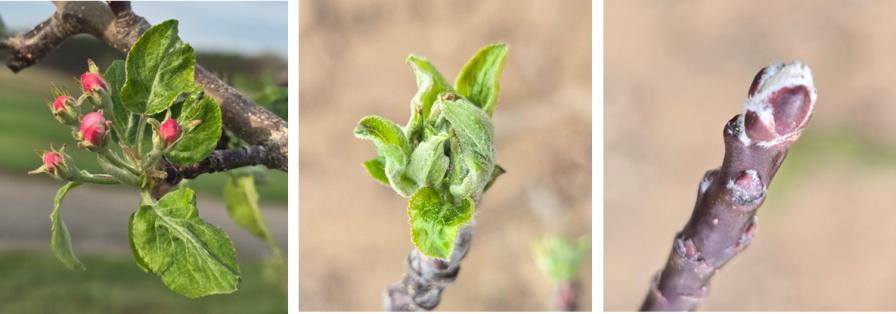
Diversity in apple phenology: A mid-April comparison of fruiting buds from representative early (left), normal (center), and late (right) budbreak apple cultivars.
Images: Kenong Xu
SIGNIFICANCE OF DELAYED BUDBREAK AND BLOOM
The survey also showed that cultivars in the late group lag the normal group by nearly three weeks in both budbreak and bloom timing. Such a delay could have significant implications for reducing frost risk.
There are two primary reasons for this:
First, a three-week delay in budbreak would keep flowers at less advanced developmental stages, such as green tip or half-inch green, during periods when late-spring freezes are most likely to occur. For example, during the April 21 freeze event, flowers at these earlier stages would have been better able to withstand low temperatures. Research has shown that flowers at these stages can tolerate temperatures of approximately 18˚ to 23˚ F without significant crop loss.
Second, a three-week delay in bloom would move highly vulnerable stages, such as pink and bloom, farther into the growing season and potentially beyond the period when damaging spring frosts typically occur.
POTENTIAL GENETIC SOLUTIONS
The approximately 20-day delay in budbreak and bloom observed among late-blooming apple cultivars also provides valuable opportunities for genetic research.
By leveraging the considerable genetic diversity present in apple phenology, researchers hope to identify genes associated with delayed budbreak and bloom.
Advances in CRISPR-based, DNA-free gene-editing technologies may eventually make it possible to modify these traits in elite apple cultivars. If successful, such an approach could provide an effective genetic strategy for mitigating damage from late-spring frosts.
This work is part of the USDA-funded ($6.75 million) multi-institutional project, “Preparing U.S. Pome Fruit Production for Extreme Temperatures in a Changing Climate,” led by Lee Kalcsits of Washington State University.
Subscribe Today For
