



New Study Rates Potential of Coffee as Cash Crop for Florida
 July 10, 2026
 Are you a coffee drinker? If you’re reading this, the odds are highly likely. Statistics indicate American coffee drinkers account for 20% of all global imports. With that, the potential growth of coffee farms on U.S. soil could provide a new outlet for the always thirsty coffee market. A study recently published in the journal Crop Science has found coffee holds promise as a specialty crop in Florida.
Researchers from the University of Florida’s Institute of Food and Agricultural Sciences spent three years examining whether the state’s climate and soil could support the crop. Using four coffee varieties, the team found strong yields, high coffee quality, and profits that could surpass citrus farms.
“This contrast underscores the economic potential of coffee as an alternative high-value crop in regions where citrus profitability has declined,” according to the researchers, led by UF/IFAS Research Assistant Scientist Luis Felipe Ferrão, who also works on breeding blueberries and other fruits.
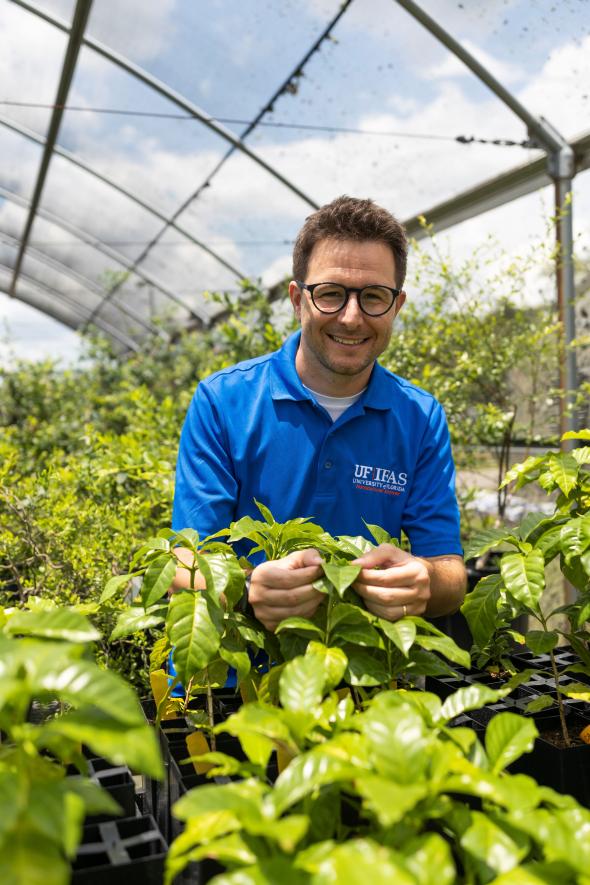
Felipe Ferrāo, a UF/IFAS Assistant Research Scientist, checks out coffee plants growing in a Central Florida greenhouse. Can coffee grow into a cash crop for Florida?
Photo by Cat Wofford, UF/IFAS photography
The search for new places to grow coffee has been an urgent issue for industry. New pests, diseases, price instability and climate change are all driving up costs around the world. These pressures may create an opportunity for domestic production, though perhaps not on a large scale. The researchers highlighted Florida’s network of specialty roasters, coffee shops, and small-scale farm-to-table operations as potential beneficiaries.
The trial also challenged the team’s expectations about the most potent barriers to coffee production. While they originally worried about climate and soil conditions, they found the intense management needs of coffee to be the biggest constraint.
Florida’s climate caused no major losses, and its sandy soils were enriched to support the crop. But finding expertise in fertilization, irrigation, pruning and other techniques was difficult.
“We noticed that the limited availability of local labor with experience in coffee cultivation proved to be a significant constraint,” they wrote.
Substantial work remains to determine coffee’s viability in Florida. Data captured only the very first harvests of young, three-year-old trees. Moreover, exploring additional coffee types could identify the best fit for Florida’s weather extremes.
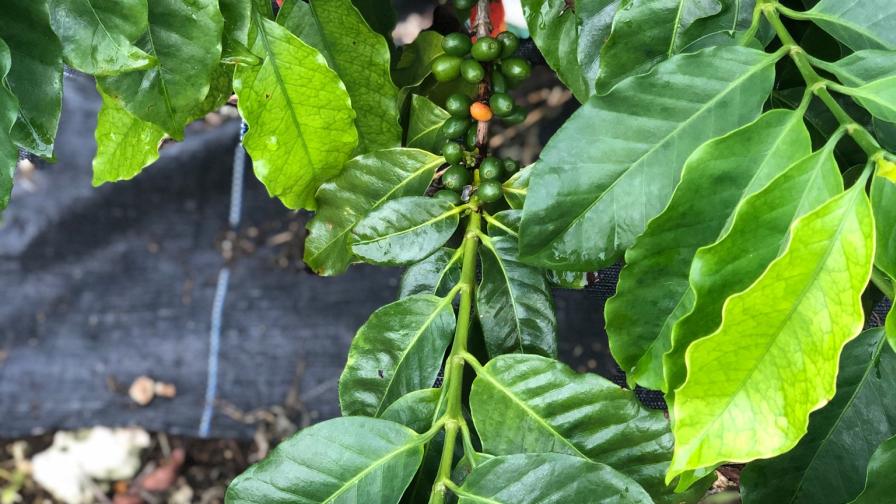
Climate-smart coffee beans being grown in South Florida. Photo by Felipe Ferrāo, UF/IFAS Photography
UF/IFAS researchers state, “one of the biggest challenges is that coffee is not traditionally part of Florida’s crop portfolio. While we can borrow knowledge from established crops such as citrus, many production practices must still be adapted specifically for coffee.”
For example, coffee has its own fertilizer needs, local diseases and stressors, pruning requirements and seed propagation. The crop also requires plenty of specialized equipment to harvest and process.
For more information, visit sciencesocieties.org.
CLICK HERE to read the study in its entirety.
 Loading ...
Subscribe Today For
