



Ways Fruit Growers Can Get the Most Out of New Sprayer Tech
 September 28, 2026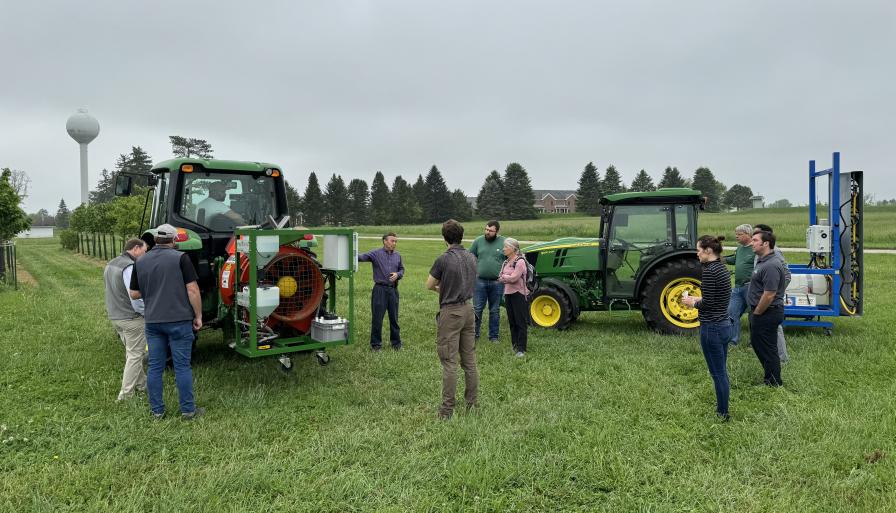
Heping Zhu of USDA highlights several new sprayer prototypes to a group of Ohio State University Extension educators and specialists.
Photo: Gary Gao
Effective pest management continues to rely heavily on conventional sprayers. However, innovative technologies are increasingly being integrated into these sprayers to improve efficiency, precision, and decision-making. I am often asked about selecting the right sprayer and upgrading existing equipment with advanced technologies to enhance performance. Let’s address some of these frequent questions and highlight key steps pesticide applicators can take to ensure compliance with the Endangered Species Act (ESA).
What are the key considerations when selecting the right sprayer?
I reached out to Erdal Ozkan, Ph.D., Professor in the Department of Food, Agricultural and Biological Engineering in the College of Food, Agricultural and Environmental Sciences at The Ohio State University and a fellow of the American Society of Agricultural and Biological Engineers (ASABE). Ozkan said a sprayer should help the operator achieve four major principles: efficiency, effectiveness, economics, and environment.
The right tank size makes spray jobs more efficient because too small a tank requires frequent refills. Ozkan stressed the importance of selecting a sprayer for “effective deposition and coverage on the part of the canopy where we want the pesticides deposited. This may require buying a sprayer with horizontal discharge (tower type) as opposed to the conventional radial discharge sprayer.”
Since money does not grow on trees — even though many fruit growers make money from growing fruit on trees — economics play a vital role. Ozkan wrote that growers should consider buying the sprayer with the most economic size (tank, fan, etc.) and make a return on investment (ROI) considering the size of the area to be sprayed and the size of the sprayer. (The bigger they are the more expensive they get!) Growers may also look into purchasing new sprayers with targeted application capabilities that can reduce the pesticide sprayed up to 80% to 85%, depending on season and canopy conditions.
Last but not least, the sprayer must be environmentally sound and not pollute air and water resources.
What are the latest sprayer technologies other than drone sprayers?
There are many. To narrow the field, I reached out to Heping Zhu, Ph.D., agricultural engineer and lead scientist with the USDA-ARS Application Technology Research Unit in Wooster, OH. Zhu is also an ASABE fellow. He received the 2023 Cyrus Hall McCormick-Jerome Increase Case Gold Medal for inventing and commercializing intelligent precision spray technology resulting in reduced agrochemical use and enhanced protection of crops, workers, and the environment.
Zhu’s intelligent precision spray technology was licensed by a company and later sold to John Deere. It’s marketed as the Smart Apply Intelligent Spray Control System.
When asked about the key features of this highly effective and practical system, Zhu identified three key advances:
The system utilizes the most accurate laser sensor to detect plant presence and plant canopy volume, which allows the system to automatically adjust the spray volume of individual nozzles in real time to match what is detected.
The system is designed as a retrofit kit, so it can be mounted on almost any new, used, or autonomous sprayers used in orchards, vineyards, and nurseries.
It’s not a ‘gamer’ technology. It’s a practical, user-friendly solution that enables growers to reduce the use of pesticides and foliar applied products by more than 50% throughout the growing season.
“Many specialty crop growers in the U.S. and abroad have adopted the Smart Apply Intelligent Spray Control System and have reported the investment payback in just one or two seasons,” Zhu said.
Beyond sprayer selection and modifications, pesticide applicators must also consider the Endangered Species Act (ESA). To learn how applicators can remain compliant with ESA requirements, I spoke with Mary Ann “Mimi” Rose, Ph.D., Director of Ohio State University’s Pesticide Safety Education Program.
Rose reminded that ESA-related label requirements include mandatory spray-drift precautions and runoff mitigation measures. For example, a label may require meeting specific conservation goals, based on a point system, to mitigate the risk of pesticide runoff and erosion. Applicators should refer to EPA’s online Runoff/Erosion Mitigation Calculator to determine if minimum requirements have been met before making applications. There are many options for attaining the required number of mitigation points, such as cover crops, grassed waterways, reduced tillage management, and others.
When instructed to do so by the label, the applicator must check the EPA’s Bulletins Live! Two website for local or regional restrictions within six months of application and comply with any instructions in the bulletin. The bulletin may impose additional requirements for the specified location, such as a downwind buffer or additional mitigation points.
“The bulletins do not provide information about any particular endangered or threatened species,” Rose said. “The bulletins impose additional application restrictions, if they exist for that location.”
The 2026 season is almost over, and may things be great in 2027!
Subscribe Today For
