



Smart Tech
Innovate to Grow: Where Capstones Meet the Real World
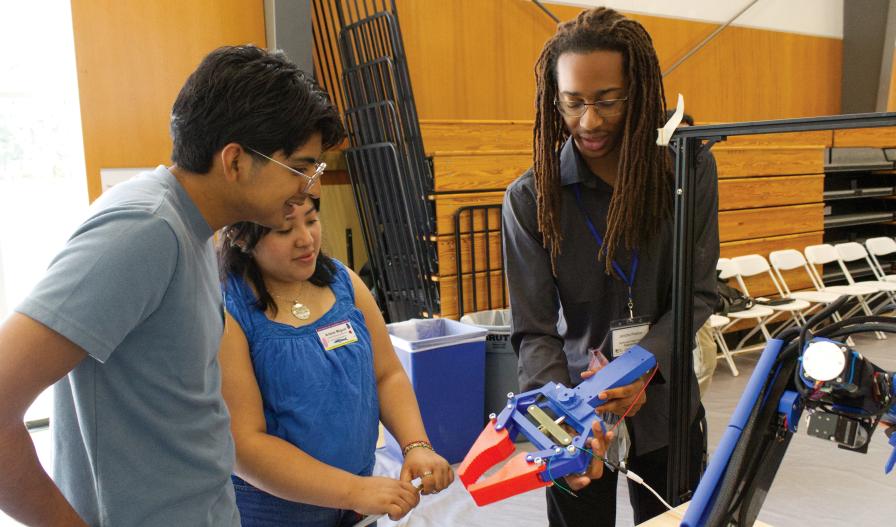
Members from Team Bagception demo a 3-D printed robotic claw prototype.
Photo: Innovate to Grow
The University of California, Merced Innovate to Grow (I2G) program is redefining what a senior capstone experience can be.

Senior engineering and computer science students are getting a taste of the professional world before they graduate by tackling real industry challenges by partnering with some of industry’s most well-known names.
What began in 2012 as a small, startup-style initiative serving a select group of capstone students has evolved into a signature university program that pairs student teams with companies and organizations seeking fresh perspectives of real operational problems.
“Employers want students to learn how to do real projects and communicate and understand the business’s problems, and why those problems exist,” said Director of Innovation Stefano Foresti of I2G’s partners and prospective supporters.
Foresti joined the program in its early days, and roughly five years after taking the helm in 2013 industry-sponsored work had expanded enough that nearly every capstone student was involved in industry projects. Today, I2G works with organizations across a wide range of sectors, including agriculture, food systems, energy, health care, and technology.
At the end of each semester, student teams present their work during the Innovate to Grow Showcase. The event serves as both a public demonstration of the projects and a component of the students’ final exam. In addition to displaying posters and demonstrating prototypes, teams follow a judging track where they make formal presentations before a panel of industry judges.
UC Merced now hosts two I2G showcase events each year: one in December, following the fall semester, and another in May, following the spring semester. These events host about 300 to 500 attendees.
From Capstone to Clients
Each I2G team typically includes 3 to 6 engineering students assigned to a single project. Spring sessions typically involve about 55 to 60 teams, while fall sessions include 40 to 45 teams. While students remain enrolled in a faculty-led capstone course, I2G brings an added layer of professional accountability by connecting them directly with industry clients.
Foresti serves as the bridge between the two, helping students navigate communication, project management, client relationships, and deliverables.
Students participating in the program sign an agreement, including a nondisclosure and intellectual property licensing, to the respective client.
“I always push for the win-win-win,” Foresti said. “A win for the students, for the partners, and for the school and its education program.”
For students, the experience is more akin to an internship, where they can point to real work completed for an industry client rather than a classroom assignment. Participating organizations receive prototypes, tools, applications, or process improvements. It also gives companies an opportunity to observe potential future employees in action. As I2G succeeds, it remains a signature program for UC Merced’s engineering and computing ecosystem, helping the institution stand out to prospective students and partners.
“At this point, things are changing so fast,” Foresti said. “The earlier students are exposed to the real work, the better it is because then they understand how things are changing.”
Projects With Purpose
Innovate to Grow is supported through tiered sponsorships, though sponsorship is not required for an organization to submit a project. There is no fee to propose a challenge, and participating companies are expected to cover the costs of any materials needed to complete the work. This includes both hardware materials and computing costs, particularly for the projects that increasingly use AI tools. Project submissions are solicited at any time at i2g.ucmerced.edu/project-submission.
The priority, Foresti said, is identifying projects that are meaningful, achievable within a semester, and not immediately vital to the company’s operations. The program also works with local municipalities and public and non-profit organizations.
“Everyone has a million problems, and sometimes there are so many that you say, ‘Okay, we’re going to do it next quarter,” Foresti said. “Then next quarter, then the quarter after that, because there’s always something else that’s mission critical.”
For example, students built a machine learning model to forecast soil moisture, complete with a forecasting dashboard and a user-run training pipeline for The Morning Star Company, the largest tomato producer in the United States. Another team built a cloud-connected monitoring and control system for tanks for Agrecom, a chemical solutions provider specializing in pest control, sanitation, and biosecurity.
Within agriculture and outside of it, the assortment of projects is impressive: an autonomous inventory drone and bin tracking system using AI vision technology in extremely cold conditions, a consolidated data model and a suite of dashboards for the U.S. Department of State Budget & Planning Office, a biodegradable thermoplastic screw that expands after it’s been placed in the body for OrthoSpine Advance Health, specializing in neck and back treatments.
The program is always open to additional projects, and the long-term partners who return every year are a testament to its utility.
“Give us those projects that are on your wish list that keep getting postponed,” Foresti said. “Those are the ones we can make progress on for you.”
Organizations interested in participating can learn more at I2G.ucmerced.edu or email [email protected].

For more Smart Tech topics, click here.
Subscribe Today For
