



Learning In The Field
 March 25, 2010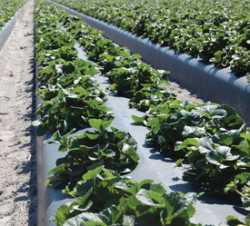
A highlight of the event is a five-stop field tour on the Center’s 400-acre grounds. The soil fumigation and weed management stop, hosted by Joe Noling and Andrew MacRae, drew interest because growers are looking for new alternatives as methyl bromide is phased out. “Replacing the broad spectrum efficacy of methyl bromide will require co-applications of a number of different fumigants and other supplemental herbicides,” Noling noted. “The new pest management strategy will definitely have to be an integrated, programmatic effort, relying on other physical, cultural, and chemical practices. In some instances, changes in irrigation practices, use of two rather than one tape per bed, may be required to successfully implement drip fumigation as an alternative.”
“Strawberry growers should be prepared to start applying herbicides underneath their plastic mulch, added MacRae. “This will require the building of a spray boom that will make the application to the top of the finished bed, just prior to laying of the plastic mulch. If an application is made prior to the pass of the last bed shaping pan, the bed pan has to be adjusted so it does not move any soil form the top of the bed, or it will also remove the herbicide that has been sprayed on top of it.”
New Varieties On Tap
There is a great deal of interest in the new strawberry varieties available to growers, because there is a perception that once a cultivar has been on the market for 10 years or so, it begins to degrade. According to strawberry breeder Vance Whitaker, this is really not the case. The perception is created by the superior performance of newer varieties. “A historical trail of cultivars released from UF/IFAS from 1975 to the present is showing the positive breeding progress that has been made in many aspects, particularly in fruit size, uniformity, firmness, appearance, and yield,” he said. “Our breeding program is currently trialing two advanced selections, with the next variety release slated for late 2011 or early 2012.”
Whitaker also made a special point to the Florida Strawberry Growers’ Association for their support in funding tissue culture and other breeding research programs.
Pesky Pest
According James Price, an entomolgist with UF/IFAS, chili thrips have emerged as a growing threat. “Growers should scout for leaf blades with black streaks and leaves with cinnamon colored leaf petioles that indicate chili thrips that live largely among tissues of the strawberry crown,” says Price. “Radiant (spinetoram, Dow AgroSciences) can be a good choice for chili thrips control, but it must be rotated with other thrips control agents of differing modes-of-action such as neem oil and Agri-Mek (abamectin, Syngenta Crop Protection).”
Subscribe Today For
