



Who Holds the Pricing Power for the Vegetable Market?
Five years of inflation, rising labor costs, and escalating input expenses have created challenges across the specialty crop industry. Yet growers are not experiencing the same outcomes.
While more than 40% of 2026 State of the Vegetable Industry survey respondents report worsening profitability, only 22% say profitability has improved. Another 38% report it has remained stable.
The survey raises an important question: What separates operations that are protecting margins from those that are not?
One possible answer is pricing power — a grower’s ability to influence the price received for a product. As costs continue to rise, understanding what builds pricing power, what weakens it, and how growers can strengthen it may be increasingly important to long-term profitability.
Who’s in Control?
When it comes to pricing power, the central question is simple: Who controls the price?
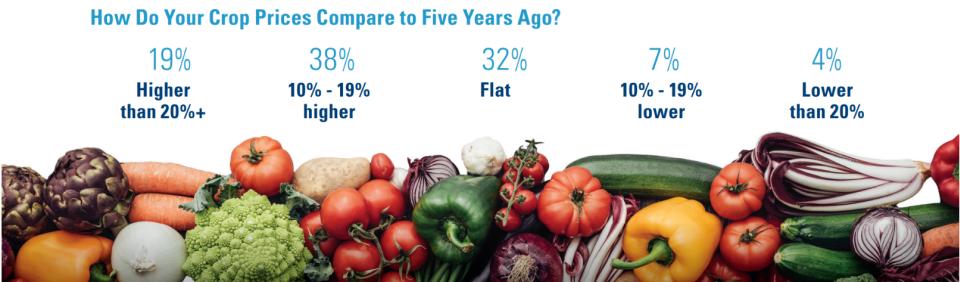
For many growers, rising costs have made that question increasingly important. More than 92% of the American Vegetable Grower 2026 State of Vegetable Industry survey respondents report higher input costs than five years ago, yet only 8% say they can fully pass those increases on to buyers. Another 51% can do so only partially, while 41% can rarely or never pass higher costs through.
Some growers believe the answer is clear: “Growers are not price makers, they are price takers. We [the growers] don’t have any ability to set prices because we have no power over supply or demand,” says Cindy Davis, grower at Tutti Frutti Farms in Lompoc, CA.
While many growers view pricing as largely dictated by market forces, some experts argue growers have more influence than they may realize.
David Zilberman, agricultural economist at the University of California, Berkeley, sees a more nuanced picture.
“The operations most likely to have pricing power look less like commodity sellers and more like product producer-marketers: they control more of the customer relationship, differentiate what they sell, and reliably deliver what the buyer values,” says Zilberman.
One avenue for strengthening pricing power may be direct and local sales channels. Nearly three-quarters of respondents sell directly to consumers, and 36% sell through local outlets, creating opportunities to build customer relationships and differentiate their products.
“Growers who can pack, cool, grade, deliver, meet food-safety expectations, and provide consistent volume are better positioned than growers selling only what is available after harvest,” says Zilberman.
The Pricing Edge
While rising costs have affected nearly every grower, the survey suggests operations are not experiencing the same results.
More than 40% of respondents report profitability is worse or much worse than five years ago, yet nearly 22% say profitability has improved, and another 38% report it has remained about the same. The findings suggest that factors beyond rising costs alone may be influencing profitability.
“From the grower’s perspective, the wholesale price of produce is much less than 15 years ago. Especially organic produce. But, if it takes multiple middlemen — produce brokers — to get it to the grocery store, then the overall wholesale price to the grocery store might have gone up. No one seems to have the visibility of all the middlemen,” says Davis.
Customer relationships, product differentiation, quality, reliability, and market channel all play a role in pricing power, but not in the same way. Product differentiation gives buyers a reason to pay more, whether through freshness, local identity, unique varieties, production practices, or other attributes that set a product apart.
Quality and reliability, meanwhile, are often the cost of entry rather than a premium feature. Buyers expect consistent quality, dependable delivery, and predictable supply. Growers who consistently meet those expectations may be better positioned to strengthen customer relationships and gain leverage in pricing discussions.
“Customer relationships convert differentiation into repeat demand,” says Zilberman. “Relationship-based channels can reduce pure price comparison, but only when the customer experience consistently reinforces the value proposition. This matters because the survey shows many growers already use direct-to-consumer channels, yet few can fully pass on costs; relationships must be managed as commercial assets, not just friendly interactions.”
Building Leverage
Labor costs remain the top challenge facing growers, cited by 52% of respondents. Inflation (43%), input costs (41%), and crop prices (38%) also rank among the industry’s biggest concerns.
With many of these pressures largely outside a grower’s control, the focus increasingly turns to strategies that can improve efficiency, strengthen buyer relationships, and create more leverage in the marketplace.
One area where growers may be able to strengthen their position is through investments that improve consistency and reliability. Irrigation systems, cold storage, packing infrastructure, protected agriculture, and labor-saving technologies can help reduce risk, extend market windows, and improve a grower’s ability to meet buyer expectations.
Zilberman recommends a four-step approach for growers looking to strengthen pricing power.
First, understand the true cost of serving each market channel, as focusing on gross price rather than net margin can lead to costly decisions.
Next, identify the buyer segments where the operation can provide the greatest value, rather than trying to appeal to every customer. He also encourages growers to invest in reliability through improvements such as irrigation, cold storage, packing infrastructure, protected agriculture, and automation, ensuring those investments support specific buyer needs.
Finally, growers should work toward securing longer-term commitments with key buyers, reducing reliance on spot-market sales and minimizing the pressure to move product after harvest.
While many market forces remain outside a grower’s control, building stronger customer relationships and delivering consistent value can make an operation harder to replace and better positioned for long-term success.
Click here for more findings from the 2026 State of the Vegetable Industry survey.
Subscribe Today For
