



Control Codling Moth Through IPM
 September 1, 2011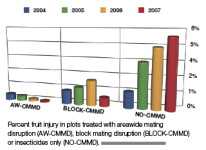
When it comes to battling codling moth, experience shows that growers who band together have better outcomes than those who go it alone. The concept of areawide control has a long history dating back to initial quarantine eradication programs for invasive species, where participation was mandatory for growers in large contiguous areas.
Modern areawide IPM programs are entirely voluntary, and growers typically share pest monitoring data and adopt standard control guidelines. Areawide IPM programs target key pests that can be adequately controlled using softer, less disruptive methods that are more efficacious when used on a larger scale. Pheromone-based mating disruption is such a method, where increased levels of applied pheromone confuse males and prevent them from successfully locating a mate.
Because pheromone concentrations decline at the borders of a treated area, individually treated blocks are more susceptible to damage than contiguous blocks within an areawide program. Immigration of mated females from adjacent untreated orchards also contributes to border infestations, which can be responsible for most of the fruit damage that occurs in an individual pheromone-treated orchard.
Reduce Risk And Cost
The first Codling Moth Areawide Management Program (CAMP) was a five-year program supported by USDA in the early ’90s in parts of California, Oregon, and Washington. This program was successful in not only reducing codling moth trap counts and attendant fruit damage, but also in reducing the use of conventional insecticides and subsequent negative impacts on beneficial insects, which work to prevent secondary pest outbreaks. Finally, in areas with high codling moth populations requiring more than five insecticide applications annually, the use of mating disruption was more cost-effective than conventional insecticides after two years.
In areas of moderate codling moth populations, mating disruption was more cost effective by years three and four. Additional benefits included reduced costs associated with worker protection and decreased potential for the development of insecticide resistance. This program continues today in Washington state on an estimated 147,000 acres of pome fruits or 83% of the state’s acreage.
Michigan Follows Suit
More recently, apple growers have been successfully implementing a similar program in Michigan in spite of challenges like lack of available labor for hanging pheromone dispensers and a farmland topography where orchards are interspersed with other crops, woodlots, and neglected blocks that support populations of pest insects.
Prior to the start of this project, populations of codling moths had developed resistance to azinphos-methyl, the most relied-upon insecticide. In parts of Michigan, growers had whole truckloads of fruit rejected, and statewide worms were detected in more than 300 truckloads of apples delivered to packers and processors. It was in this climate that the project began in 2004 and since then, no participating farm has experienced any rejected loads of fruit.
The Power Of Mating Disruption
Researchers at Michigan State University consider mating disruption a welcome addition to the apple IPM toolbox, because it completes the spectrum of tactics needed to target every stage of the codling moth life stage. Organophosphate insecticides have been used for more than 50 years, and were lethal to every life state of this insect. However, the development of resistance has reduced their effectiveness.
Newly registered insecticides act on either insect eggs or larvae, but have little knockdown capability for adults. A single mated female codling moth can lay more than 100 eggs, putting enormous pressure on these new insecticides to provide control. Pheromones act to reduce pest populations by interfering with the ability of codling moths to reproduce, and work best when used in the same orchard for several consecutive years, thereby reducing the need for companion insecticide applications.
Starting with eight growers on 800 acres in 2004 in two counties, the Michigan areawide project expanded in four years to approximately 3,000 acres on more than 30 farms spread throughout four additional counties. This project served as a catalyst for wider use of mating disruption in the Michigan apple industry, doubling the number of acres where mating disruption is used as a management tactic to more than 8,000 acres. Areawide participants in the original two counties experienced trap counts that were reduced by a stunning 93% at the end of the four-year project.
In the first year alone, captures were reduced by 81% among areawide participants, compared to only a 48% reduction on individual farms employing the same pheromone-based tactics. In orchards not using mating disruption, catch counts increased by 20%. Other success indicators include average insecticide applications dropping from 10.1 to 5.2, for an overall 65% reduction in pounds of organophosphate applied.
In addition, codling moth-related fruit injury in areawide orchards decreased by 93% compared with orchards relying on insecticides alone, and 30% less than in orchards employing mating disruption outside the areawide project. Some growers completely stopped companion insecticide sprays and still did not see infestations develop.
The Facts And Figures
The economics of this areawide project have worked out favorably, as well. The cost of mating disruption deployment and biological monitoring ranged from $125 to $170 per acre, depending on the number and type of pheromone dispensers used. The additional returns associated with reduced insecticide use and increased packout of non-damaged fruit is reflected in a net return of $210 to $305 per acre per year for farms participating in the project for four years. So, the net return significantly exceeded net costs for the 20 farms included in this analysis.
The success of the Michigan project has served as a model for other states to develop areawide projects, including Pennsylvania’s project for managing codling moth and Oriental fruit moth on more than 1,200 acres in 2006-2008. Dr. Larry Hull, of the Fruit Research and Extension Center at Pennsylvania State University, reports that orchards participating in the areawide project experienced a gradual and significant reduction in percentage of injured fruit and lower pest pressure, while reducing insecticide applications for these two pests by up to 50%. Growers who remained in the program from 2009-2010 continued to encounter reduced levels of fruit injury, while in orchards using only conventional insecticides, fruit injury levels increased. In addition, insecticide use increased in the conventional orchards by 18% in 2010 from 2009 levels, and almost 40% more than that used by areawide growers in 2010.
So, for managing codling moth, the areawide approach has been shown to be adaptable to local conditions, and a win/win for both growers and the environment.