



New Scientific Discovery Might Help Bury Root Pests
 June 28, 2012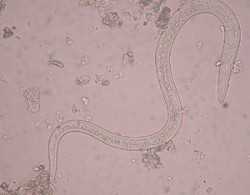
University of Florida researchers have discovered a natural compound to battle insect pests. The compound boosts crops’ resistance to pest attacks on their roots by recruiting microscopic worms that kill the insects by eating them from the inside out.
Researchers, including members of UF’s Institute of Food and Agricultural Sciences (UF/IFAS), made the discovery by studying chemicals released by citrus roots when they are attacked by citrus root weevil larvae. Their results are published in the June 27 online edition of PLoS ONE.
Citrus root weevils are a problem in Central and South Florida, and at one time were estimated to cause $70 million in damage annually. The researchers found that a chemical called pregeijerene, which is released by citrus roots when attacked by citrus root weevil larvae, is an attractant that signals beneficial nematodes to move in and attack the pests.
But not only does pregeijerene protect citrus roots, it also can protect the roots of blueberry plants and possibly other crops, said study author Lukasz Stelinski, an assistant professor of entomology and nematology at UF’s Citrus Research and Education Center (CREC) in Lake Alfred.
In the study, the researchers found that when pregeijerene was applied to soil in citrus groves, larvae control by nematodes was three times greater than when pregeijerene was not used.
And when the researchers applied pregeijerene to a blueberry field in New Jersey, larval control by nematodes was two times greater than when pregeijerene was not used. “The results are important because they occurred in vastly different agricultural habitats,” Stelinski said. “Therefore, they may have broad application in biological control of root pests in agriculture.”
This is the first time pregeijerene has been shown to have an important role in protecting plants, Stelinski said, and he believes the compound could be useful in other production settings where root pests are a problem.
The study was funded by UF and the USDA. Study authors also include Hans Alborn, a research chemist, and Fatma Kaplan, a research molecular biologist, both with the USDA-Agricultural Research Service’s Center for Medical and Veterinary Entomology; Jared Ali, a postdoctoral fellow with the department of ecology and evolutionary biology at Cornell University; Raquel Campos-Herrera, a postdoctoral researcher at the CREC; Cesar Rodriguez-Saona, an assistant extension specialist in entomology, and Albrecht M. Koppenhöfer, an extension specialist in entomology, both with Rutgers University.