



Farm Manager Shortage Hits Growers
 March 1, 2008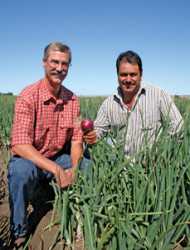
Bill Dean is looking for a few good men. Or women. He’s certainly not picky; he can’t afford to be. Dean is the chief agronomist at River Point Farms in Hermiston, OR, the largest onion producer in the nation. River Point, which grows, packs, and ships yellow, white, red, sweet, and organic onions, produces more than 400 million pounds of onions each year. For much of the past year, Dean’s been looking for people with both the skills and education to become farm managers. “I’d hire an agronomist and a farm manager right now if they walked in that door,” he says, pointing. “But I can’t find them. It’s hard to find someone with a decent academic background and a practical bent.”
Dean is not alone in having a tough time finding farm managers. Jeff Oliver says that not only is there a shortage, but he has seen it worsen over the past several years. In addition, we might not have seen the worst of it, though there is reason for hope if those like Dean who love agriculture are willing to take action. As a consultant for Sherwood Lehman Massucco, the oldest and largest executive search firm in Fresno, CA — the epicenter of U.S. agriculture — Oliver has specialized in agriculture and food processing for the past nine years, working with some of the nation’s largest growers to help them make educated hiring decisions.
For example, a large winegrape grower recently had an opening for a farm manager, and Oliver contacted more than 225 vineyard managers to see if they were interested. The man is nothing if not thorough. But he has to be, because of the way in which society is changing in general, and agriculture specifically.
The shortage is due in part to the fact that baby boomers are beginning to retire, and there are so many of them that there just aren’t enough experienced people to fill their shoes. His firm also handles searches in banking and health care, and he’s heard the same complaints from his colleagues. “I don’t care what industry you’re looking at, there’s a shortage,” says Oliver. “Then when you combine that with the problems unique to farming, you’ve got the perfect storm.”
The problems associated with agriculture include the fact that the hours can be long and hard, it requires an unusual skill set, there is increasing pressure from urban encroachment, the industry is poorly understood, and there is a sea change in industry structure from small family farms to more of a corporate model. These problems are not easy to nail down because they are not necessarily distinct from one another. Keeping in mind that there is some spill-over, here’s Oliver’s take, followed by a potential solution.
Growing vegetables is hard work. You can sugarcoat it all you want, even noting that during the winter months the pace can become downright leisurely, but during harvest and at other times during the growing season(s), the hours are long. Traditionally, growers have followed in the footsteps of their parents, but now they’re having second thoughts, says Oliver. “Generations X and Y have had everything handed to them,” he says. “They’ve seen how dad and grandpa had to work for it, and they don’t want that.”
Oliver is quick to note that while this problem is more acute in agriculture, it’s not limited to it. He grew up in Bakersfield, CA, and when he was in high school, he and most of his classmates spent their summers working in the potato sheds. “How many high school kids do you know that work in agriculture in the summer?” he asks. “This generation doesn’t work at all. A lot of kids’ first jobs will be their first job out of college. They’ve had it too good because mom and dad want them to have it better than they did. It’s too bad, because a little bit of working — even suffering — is good for people.”
There is nothing quite like farming. There simply aren’t many jobs that require the skills that farming does, says Oliver. Just look at an average grower’s day. “He gets in his truck and heads out to solve some problem in the field,” says Oliver. “Then he drives back, goes into a boardroom, and makes a budget presentation. That’s hard to find.”
For example, Oliver was contacted by a large citrus growing operation that was looking for a director of farming. Oliver collected market information, and then spent two months looking. He found some candidates, but they weren’t what the grower was looking for. “Either they didn’t have a university degree or they lacked leadership skills,” he says. “They just weren’t out there, so the client ended up promoting from within.”
 With profit margins getting thinner for many crops, a lot of today’s generation of growers are looking at real estate development. “They’re not necessarily encouraging their kids to go into farming if they’re in the path of urban sprawl,” says Oliver, adding that many growers are lending an ear to real estate developers. “If you’re pocketing $10 million, who needs to farm any more? I see a lot of that.”
A real wild card is urban encroachment. With profit margins getting thinner for many crops, a lot of today’s generation of growers are looking at real estate development. “They’re not necessarily encouraging their kids to go into farming if they’re in the path of urban sprawl,” says Oliver, adding that many growers are lending an ear to real estate developers. “If you’re pocketing $10 million, who needs to farm any more? I see a lot of that.”
Consolidation isn’t limited to retail. To compensate for consolidation at the retail end, there is increasing consolidation on the supply side. The idea of the family farm is still very much alive, but many of today’s family farms are large, privately held companies. These bigger operations often need employees well beyond what the family can provide, says Oliver, not just in terms of numbers, but in specialized expertise, such as accounting or information technology. Along with the change to a more corporate structure comes the lessening of the idea of career inheritance. “When the children go off to college today, a lot of them are going into different areas (of employment),” he says. “They don’t necessarily come back to the farm.”
Farming isn’t modern or cool. At least that’s what a lot of young people think, says Oliver. Actually, that idea isn’t limited to the young. As the disconnect between the farm and the fork grows, so does the ignorance of the nature of farming. Those who shape the minds of the young, such as teachers and the media, have almost no clue as to what’s involved in producing a vegetable crop. For many in that 99% of Americans not involved in agriculture, the stereotype of ‘farmer as hick’ lives. “They truly don’t realize how sophisticated farming is today,” he says. “They don’t appreciate the technology involved, and partly because of that, ag isn’t promoted like other professions.”
Alleviating the gross ignorance of agriculture in today’s society would be a monumental task. That’s why Oliver, who makes no pretense about having the answers, sees no quick fix, and why the shortage of farm management talent may get worse before it gets better. It’s not likely that any headway can be made with the college students of today. He thinks the solution lies in getting to the kids when they’re younger. There needs to be stronger support for such programs as the USDA’s “Agriculture in the Classroom.” High school career counselors need to be educated about the opportunities that are available in agriculture. “Do they realize that, in California alone, agriculture is a $30 billion industry?”
Dean hopes that those who do mold the minds of the nation’s youth do come to realize the opportunities that are available. If people in the industry don’t get more young people involved, the future for agriculture doesn’t look nearly so bright as it could be. So much has been made of the shortage of farm laborers, but Dean thinks a shortage of managers represents a similar threat to U.S. agriculture. He notes that when he posted openings at River Point at Washington State University, the only interest came from foreign students. Those students would take what they learned at a U.S. university and a progressive U.S. farming operation, and then take their enviable knowledge and skill sets back home to put them to use. “It’s scary to me when I look at this from an international perspective,” says Dean. “I’m just trying to raise the flag.”
Subscribe Today For
