



Managing Stink Bugs
 August 6, 2010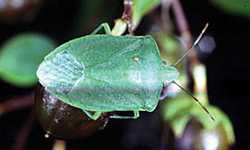
Recently, growers have reported an increase in stink bug related problems in tomato and other crops. They have become more of an issue for growers because of the move away from broad-spectrum insecticides to more pest-specific biorational products. This is coupled with the fact that they are very mobile and can quickly become a problem at anytime during the season. The Florida Tomato Scouting Guide sets the economic threshold for southern green stink bug in tomato as one stink bug per six plants.
Some controls for use on tomato include broad-spectrum insecticides, such as Baythroid (cyfluthrin, Bayer CropScience), Brigade (bifenthrin, FMC Corp.), Danitol (fenpropathrin, Valent U.S.A.), and Voliam Flexi (thiamethoxam, chlorantraniliprole, Syngenta Crop Protection). A parasitic fly, the tachinid fly (Trichopoda pennipes) can provide biological control. This fly parasitizes stink bug adults and nymphs, and a wasp (Trissolcus basalis) parasitizes eggs.