



Covering the Bases To Revive HLB-Infected Citrus Trees

Recent University of Florida research suggests significant potential for young, Huanglongbing (HLB)-infected citrus trees to recover through the combined use of individual protective covers (IPCs) and specific plant growth regulators (PGRs), enabling them to become commercially productive.
A bacterial disease spread by the Asian citrus psyllid and first detected in 2005, HLB — or citrus greening — remains a major crisis for Florida citrus growers, resulting in severe declines in acreage, yield, and fruit quality.
In a recent webinar, Fernando Alferez, Associate Professor of Citrus Horticulture at the Southwest Florida Research and Education Center in North Immokalee, FL, offered a comprehensive summary of seven years of IPC research and introduced several compelling future research directions. Alferez’s findings provide critical context for citrus growers regarding the continued evolution of disease management.
Utilizing visual comparisons, Alferez explained that a tree planted 30 months earlier without protection displayed a sparse, bare canopy. In contrast, a tree planted the same day and covered exhibited a tall structure, denser canopy, and larger leaves, indicating it would bear fruit and produce a sustainable yield.
“We know that (IPCs) are an effective strategy to maintain trees free from HLB, but they do not exclude all the pests,” Alferez says. “So, that means regular scouting is still necessary, and controlling secondary pests remains important. The nice thing is that fruits produced on trees that were protected under IPCs have better internal quality, and also, we have an improvement in yield.”
Drilling down into disease incidence, Alferez says the data show that IPCs also cause a dramatic reduction in citrus canker. Conversely, he adds that the enclosed environment can inadvertently foster the development of other diseases, such as greasy spot or sooty mold, indicating the need for a holistic disease management strategy.
SUSTAINED YIELD AND QUALITY
Alferez presented detailed findings on the performance of Valencia trees protected by IPCs for 30 months, followed by three years of observation after cover removal and the initiation of standard insecticide treatments. The data showed that the previously protected trees consistently produced more fruit than the control trees. The second season’s harvest distinctly showed that protected trees yielded fruit with better color and larger size, both of which are commercially advantageous to growers.
“The bottom line here is that IPCs are giving a kickstart to these trees, so the fruit that we are producing is more abundant and the quality is better,” Alferez says.
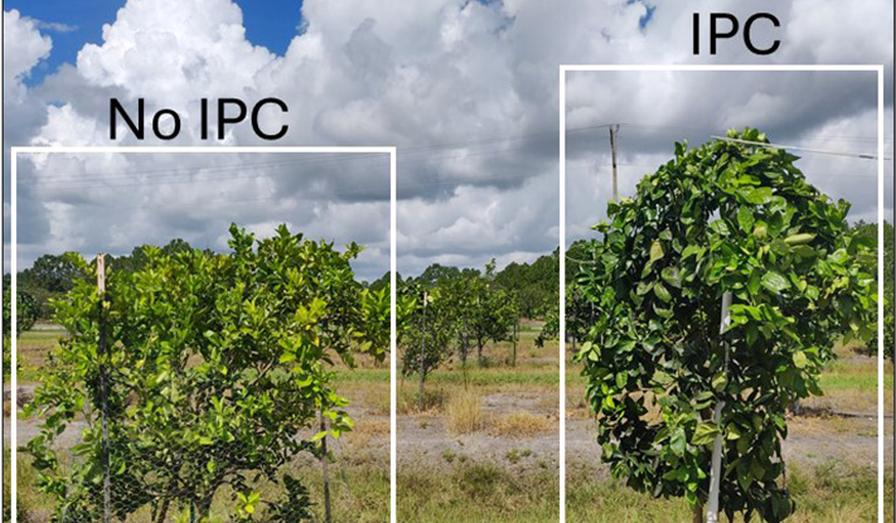
Trees with and without IPCs after IPC removal (30 months after initial planting).
Image: Fernando Alferez, UF/IFAS
Additionally, beyond quantity and size, the fruit’s internal quality also improved during the same three-season post-removal period.
However, not all citrus varieties respond equally well to IPCs. According to Alferez, IPCs are highly effective for varieties like Valencia and Hamlin oranges, Tango mandarins, grapefruit, and pummelos. It is not a suitable tool for ‘Early Pride’, which often declines even when covered for 30 to 32 months. Similarly, the benefit of IPCs for ‘Sugar Belle’ appears to disappear after just one year, he adds.
NEW RESEARCH DIRECTIONS
Based on this foundational work, Alferez outlined two new research directions to optimize IPCs and integrate PGRs for citrus health and productivity.
The first project seeks to identify the optimal time to begin injecting oxytetracycline (OTC) into trees after removing the IPCs. Many growers remove the IPCs and immediately begin OTC trunk injections, a practice whose efficacy is not yet scientifically validated as the best approach.
The second investigates the introduction of brassinosteroids (BRs), a potent plant growth regulator (PGR). BRs are known to stimulate general plant growth and play a role in disease resistance. The objective is to determine if BRs can help new plantings and infected young trees not only survive but thrive to reach commercial bearing age. A 2023 pilot program has produced intriguing and encouraging results, he says.
“Look at the tree that we treated with the IPC, plus (BRs). We have a really dense canopy with larger leaves,” Alferez says, referring to his presentation visuals. “And if you zoom in on this canopy, you can see healthy leaves and even some blooms on that tree. And these trees have sent some fruit this past year, and we are now looking forward to seeing the (fruit) quality.”
Subscribe Today For
