



Dealing With Downy Mildew
 February 7, 2011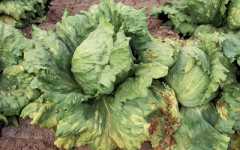
Symptoms
Signs of downy mildew appear initially as chlorotic yellow spots on the upper leaf surface. Under favorable conditions, a white cotton-like fungal growth, indicative of sporulation, may be seen on the lower leaf surface.
During the early stages, leaf spots often are delineated by the veins of the leaf, giving an angular appearance. Lesions become increasingly chlorotic and eventually turn brown. Although downy mildew is most severe on the older outer leaves, the disease may become systemic over time, infecting heads internally. Lesions also may provide entry for secondary fungi like Botrytis.
Spread Of The Disease
Downy mildew is spread by spores called conidia or sporangia. These may be rain-splashed or windblown to uninfected tissue, inciting new infections. Although rain-splash dissemination normally ranges from several inches to several feet, sporangia may be windblown tens to hundreds of miles and still maintain infectivity. Many thousands of sporangia can be formed in each lesion under favorable conditions, allowing downy mildew to spread rapidly over large areas.
Sporulation and infection are favored by relatively cool temperatures and humid conditions. Five to seven hours of high humidity or leaf wetness are required for successful infection and sporulation.
Management Strategies
Cultivar resistance — when available — is the most economically feasible form of downy mildew control. In the event of a regional outbreak, susceptible cultivars should be protected with fungicides to avoid major losses.
The list of fungicides currently labeled for lettuce downy mildew control includes maneb, fosetyl Al, metalaxyl, and several copper compounds. Recently some newer compounds including Presidio (fluopicolide, Valent USA Corp.), Previcur Flex (propamocarb hydrochloride, Bayer CropScience), Reason (fenamidone, Bayer CropScience), Revus (mandipropamid, Syngenta Crop Protection), and Tanos (famoxadone, cymoxanil, DuPont Crop Protection) have been added.
Applications must be made prior to infection if adequate control is to be maintained. If downy mildew is known to be present in the area, growers should launch a fungicide program immediately.
Several cultural practices, such as the establishment of a lettuce-free period, crop rotation, and the destruction of possible weed hosts, also are recommended control measures.