



How to Design an Effective Fungicide Program for Your Vegetable Crops
 January 7, 2025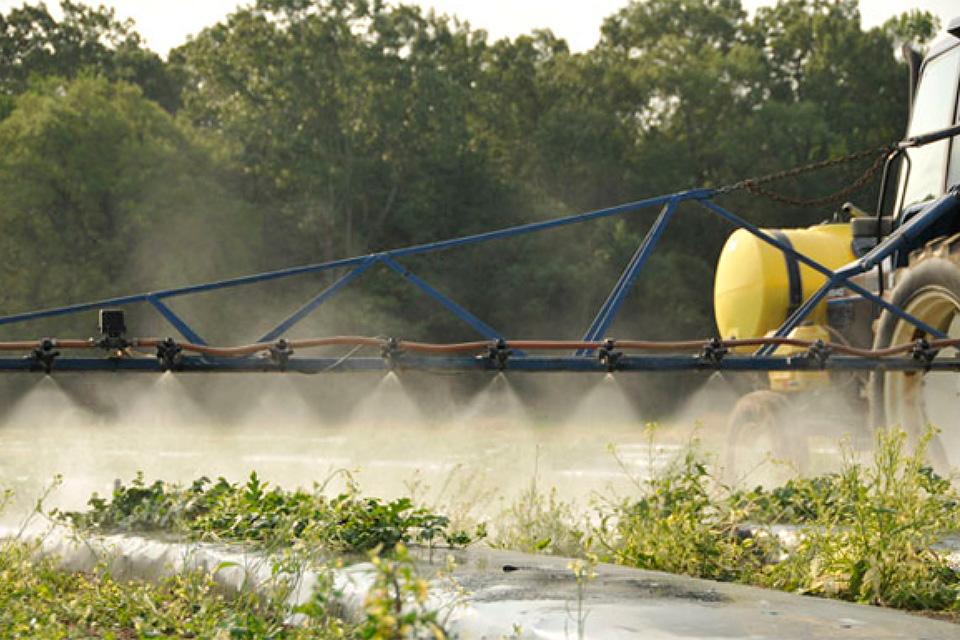
All conventional fungicides have limits on the number of times they may be sprayed on edible crops so fungicide residues on the harvested portion stay below the allowed tolerance.
Photo by Ginny DuBose
I recently sat down with a new watermelon grower to plan a fungicide program for next year. Here’s a condensed version of what we discussed, if a ready-made fungicide schedule isn’t available for your favorite crop from the local Extension Service.
Choose the Right Products
A fungicide program should include products effective against the main diseases expected to occur most years. For southeastern watermelons, these diseases include gummy stem blight, powdery mildew, anthracnose, and downy mildew. No fungicide works against all four diseases, so multiple products are needed.
The grower wondered in what order to spray his preferred products. The sequence depends on when the diseases are most likely to show up during the season. On watermelon, gummy stem blight and anthracnose are threats from the beginning. The mildews start later, so the specific biofungicides or fungicides that target these diseases are added to the weekly rotation mid-season.
Check FRAC Codes
The FRAC Code or codes is on the product label, first page, top right corner. The numbers give the chemical class for the fungicide or biofungicide. Common FRAC Codes for conventional products used on vegetables are 3, 7 and 11. Biologicals are are BM01 to BM03 and P04 to P06.
FRAC Codes help ensure the same chemicals sold by different companies aren’t accidentally used one after another, which would be a serious risk for fungicide resistance. This risk is why many conventional fungicide labels direct applicators to rotate to another product with a different FRAC Code after one or two applications.
On cucurbits, fungicides to manage powdery and downy mildews usually have different FRAC Codes than the fungicides mainly used against gummy stem blight and anthracnose. Changing the target disease can automatically change the chemistry applied.
FRAC Code M is for older contact fungicides, such as coppers (M01), sulfur (M02), mancozeb (M03) and chlorothalonil (M05). Products with Code M and most biologicals do not need to be rotated to prevent fungicide resistance, because the risk is so low.
One important exception is polyoxin D (Oso), FRAC Code 19, which has a medium risk of resistance. Note that bacteria can become resistant to copper, but there’s not much to rotate with copper to manage bacterial diseases.
Premix Fungicides
Some conventional fungicides are sold as premixes of active ingredients with different FRAC Codes, such as 7 + 11. Mixtures of two active ingredients have two ways to kill a pathogen and so lower the risk of fungicide resistance.
Premixes make planning a fungicide program harder. For example, a 7 + 11 fungicide cannot be sprayed after or followed by any fungicides with FRAC Codes 7 or 11. As another example, four effective fungicides against gummy stem blight can be used in only two possible rotations because of common active ingredients: either Miravis Prime (7 + 12) with Inspire Super (3 + 9) or Aprovia Top (7 + 3) with Switch (9 + 12).
Maximum Amounts
Essentially all conventional fungicides have limits on the number of times they may be sprayed on edible crops so fungicide residues on the harvested portion stay below the allowed tolerance. The maximum number of sprays can be as few as three, another reason why rotating fungicides is so common in modern agriculture, especially for crops harvested a long time, like pepper.
Assumptions
I always use the highest recommended rate of any product. If the label gives a wide range, the lower rate can be used before symptoms appear, early in the season or when weather isn’t favorable for disease.
On most vegetable crops, weekly applications are the norm, unless a weather-based spray advisory system is available. Fungicides should be applied until one week before the last harvest. Biofungicides should be sprayed until harvest is finished.
Costs
The watermelon growers I’ve worked with for the past 30 years don’t like big spray bills. I try to keep costs per application under $35/acre. Older contact fungicides, chlorothalonil or mancozeb (conventional) and sulfur (organic), and generics reduce the total cost. Use contact products early in the season and in rotation with more expensive, but more effective, systemic fungicides. In calculations I’ve done, if a watermelon spray program increases yield, it pays for itself.
Subscribe Today For
