



Research Finding Better Ways To Deal With Basil Downy Mildew
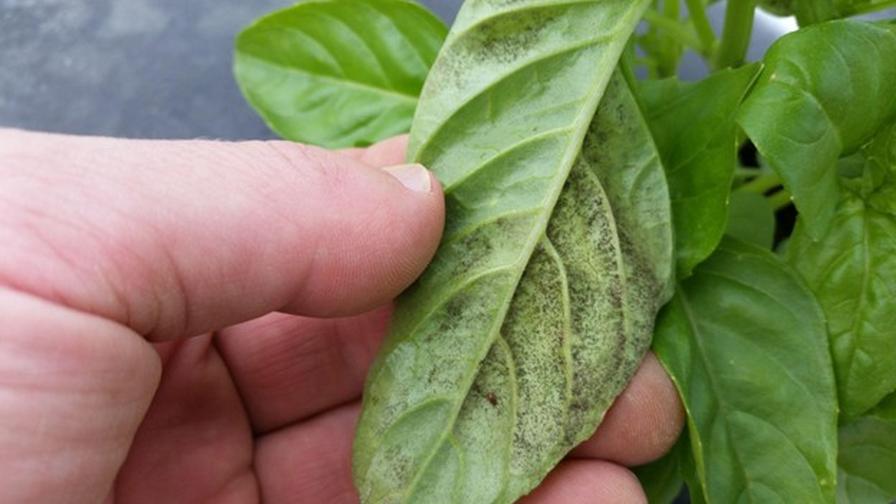
Basil downy mildew sporulating on the underside of a susceptible sweet basil leaf.
Photo: Rutgers University
Basil downy mildew has impacted basil production worldwide for the past two decades since its re-emergence in Europe in 2001 and introduction in the U.S. in 2007 and later in other parts of the world. Major crop losses have occurred, and global production has been continually at risk. To counter this risk and alleviate the high cost of crop loss, great strides were taken to help mitigate losses with the introduction of new fungicides for pathogen control. These fungicides were the first line of defense at that time, as there were no commercially available sweet basil varieties with genetic resistance to basil downy mildew.
Basil Downy Mildew-Resistant Sweet Basil Varieties To The Rescue
In 2018, after nearly a decade of research and breeding efforts around the world, new downy mildew-resistant sweet basil varieties were introduced to commercial markets and homeowners. These new varieties of sweet basil, such as the Rutgers University’s ‘Rutgers Passion DMR’, ‘Rutgers Obsession DMR’, ‘Rutgers Devotion DMR’, were released with a high level, but not complete resistance, to basil downy mildew. In 2018, Genesis Seeds Ltd. introduced to the market the ‘Prospera’ series, which was completely resistant to basil downy mildew. These new resistant varieties offered sweet basil growers a new way to mitigate losses to the disease (see photo collage below).
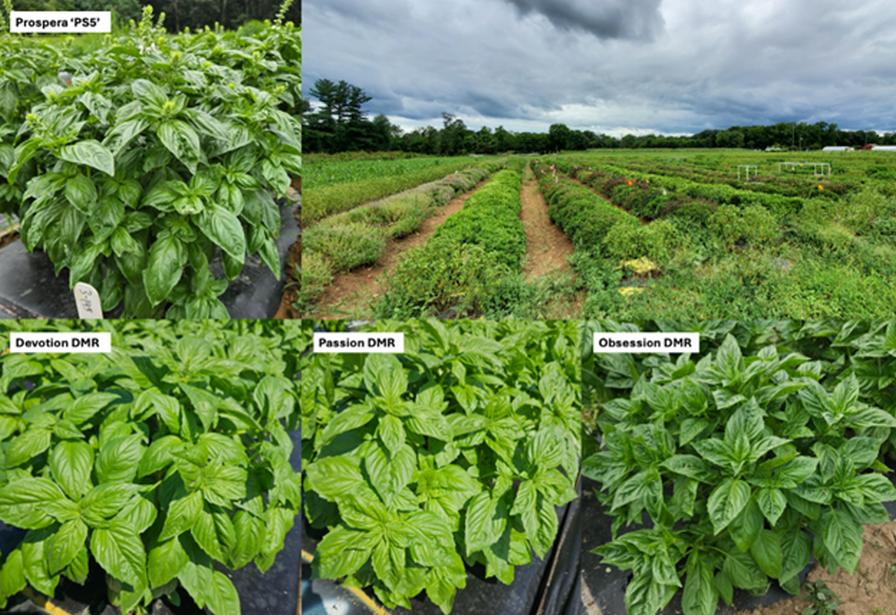
Images of Rutgers DMR and Prospera Generation 1 ‘PS5’ lines in early basil downy mildew field trials in New Jersey. An image of a large field study at the Horticulture Research Farm 3 in New Brunswick, New Jersey.
Photos: Rutgers University
Unfortunately, the pathogen Peronospora belbahrii, like many other species of downy mildew in other crops, has been able to overcome BDM resistance. In general terms, resistance can be broken down into two distinct types: quantitative resistance and qualitative resistance. In quantitative resistance, resistance in the plant is controlled by multiple resistance genes and may involve many distinct defense-related genes. This is the case in the Rutgers DMR lines, where basil downy mildew resistance is partially controlled by one major and two minor quantitative trait loci. This type of resistance is also known as horizontal, partial, intermediate, or durable resistance and is common in many crops. This type of resistance is harder for the pathogen to overcome and is particularly important when more than one pathogen race is present in the population (more on this later).
The second type of resistance, known as qualitative resistance, is characterized by complete disease resistance and is often controlled by a single resistance gene in the host plant. In qualitative resistance, the resistance demonstrated by the host is immune or extremely high until it breaks down and the pathogen is able to overcome the resistance gene. This type of resistance is also known as single-gene, vertical, or race-specific resistance and can remain effective for many years or be overcome in a very short time, depending on the pathogen’s biology and environmental conditions. The first of the ‘Prospera’ series demonstrated this type of basil downy mildew resistance (DMR), provided by the resistance gene Pb1.
Basil Downy Mildew, An Ever-Changing Pathogen
Pathogens and their hosts are in a constant war, controlling susceptibility and resistance. Shortly after their commercial releases, the breakdown of basil downy resistance in both the Rutgers DMR lines, the first ‘Prospera’ series, and other lines, suggested the development of new races of P. belbahrii. New pathogen races are classified based on the grouping of strains within a pathogen species that overcome host resistance, and therefore gain the ability to cause disease in specific resistant cultivars due to genetic changes. Race definitions are often determined by their ability to cause disease across a set of host differentials with specific and known resistance genes or phenotypes, and are formally utilized by plant breeders, plant pathologists, and seed producers in crop diseases such as lettuce downy mildew, spinach downy mildew, Fusarium wilt in melon, and several viral diseases of tomato and pepper. Utilizing this differential resistance classification system, three races of P. belbahrii have now been identified based upon their ability to cause disease in previously resistant hosts.
In basil, like many other crops susceptible to downy mildews, new races develop in response to host resistance and are further influenced by different factors. A pathogen population structure can be complex. For instance, the ability to overcome resistance may already be present in a very small percentage of the pathogen population. The adaptability of a pathogen is also remarkable, therefore, the development of the pathogen resistance can be naturally evolved because of the accumulation of mutations or sexual recombination. In either case, the population that can overcome genetic resistance in the host will have the greatest chance of survival.
Understanding The Genetics Of Downy Mildew-Resistant Sweet Basil Varieties
Proper knowledge of the downy mildew resistance profile of current varieties is critically important for mitigating losses to the disease. Presently, the Rutgers DMR varieties with resistance genes conferred from ‘Mrihani’, display high incomplete resistance to Race 0, tolerance to Race 1, and mixed resistance to Race 2; with Devotion and Passion DMR displaying high resistance. The original Prospera varieties (CG1, ILL2, PL4) with resistance conferred from the Pb1 R-gene are completely resistant to Race 0, and susceptible to both Race 1 and 2. The two related cultivars, Amazel basil and Pesto Besto with Pb1 resistance, are only resistant to Race 0 and were developed from O. americanum var. americanum PI500945 the same as ‘Prospera’.
The newer generation of ‘Prospera Active’ varieties ‘Mia’, ‘Noga’, ‘Thai Thai’, ‘Yuva’, ‘Aya’, ‘Yaraa’, ‘Renee’ and ‘Lihi’ with resistance conferred from Pb2 R-gene or pyramided Pb1/Pb2 R-genes are resistant to Race 0 and 1, and susceptible to Race 2. Pb2 gene-based varieties were developed from O. americanum var. pilosum PI500950. The Everleaf family with unknown sources of resistance confer tolerance to Race 0 but is susceptible to Race 1 and has unknown results for Race 2. The cultivar Eleonora has intermediate resistance and in most cases its effectiveness is limited. A summary of Race and variety interaction can be found in the graphic below.
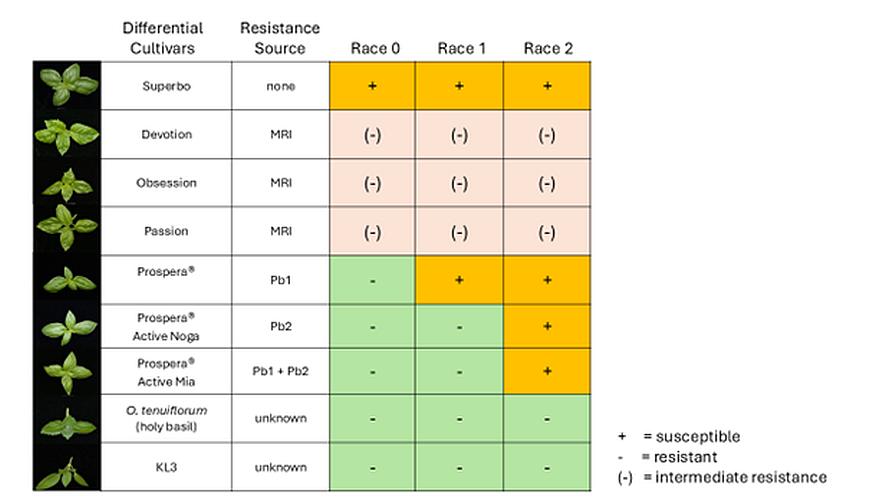
Differential Cultivar Resistance Response Across BDM Races.
Graphic: Rutgers University
New Basil Downy Mildew Races Appearing Around The World
With new basil downy mildew races emerging in different regions of the world, controlling the disease remains challenging on many fronts. Basil producers should pay close attention to local and regional basil downy mildew reports to help determine what basil varieties the pathogen is currently capable of infecting. Knowing this will help growers understand what race(s) are active in the current population in their region and help guide them to which DMR basil varieties they should be choosing to plant in their gardens and commercial operations. Unfortunately, knowing what races may be present in any given year is difficult to know without effective coordinated monitoring programs across large geographic regions.
Choosing The Right Basil Downy Mildew Resistant Varieties
Choose varieties with multiple sources of basil downy mildew resistance to help mitigate potential losses. Without knowing what BDM races are present, the easiest method for reducing losses to the disease are to plant different varieties with a number of different resistance genes. This will help reduce potential disease pressure and help limit losses to those varieties that are susceptible to specific races in your area. Even when growing a variety of resistance sources, it is still advised to spray the appropriate pesticides and maintain strong cultural control.
Monitoring The Movement Of The Pathogen In the U.S.
Ag Pest Monitoring (basil.agpestmonitor.org) is a dedicated website for the monitoring of important pests and plant diseases in the US including basil downy mildew. Researchers, growers, and ‘citizen scientists’ from across the country can log on to the website and report the occurrence of basil downy mildew where they live so others may track its whereabouts in real time. This is a critically important tool for monitoring the movement of the pathogen and allows basil growers to proactively adjust their production practices to better manage the disease. The more users who report their basil downy mildew issues and the varieties they are growing the stronger this tool is!
Use Cultural Practices To Help Mitigate Losses
Planting time. The easiest method to avoid basil downy mildew is to grow basil when basil downy mildew is not present in your region. Unfortunately, this is much easier said than done, especially if you are in the southern parts of the U.S. However, if your operation is in a more northern region of the country, spring or early summer plantings which can be harvested before BDM appears, might be a viable option. This is especially important for organic field production, where organic control options are limited.
Separate plantings during the production season. If you grow basil all season, put distance between your early, mid- and late-season plantings if possible, so if basil downy mildew shows up in your earlier plantings, those blocks are not directly next to your later plantings. This might help to reduce disease pressure in your later plantings.
Destroy the crop after harvesting. Allowing an old planting to continue after you finish harvesting the block will only act as a source of inoculum for later plantings. Thus, it is best to disc under, mow, or remove any plant material remaining in the field.
Water management. Leaf wetness is critically important for downy mildew development. In fact, it along with relative humidity is your enemy! Spacing plants and your beds appropriately while also keeping weeds at bay will improve airflow and decrease leaf wetness. Artificial ventilation of indoor plants can prevent plant infections and prevent sporulation due to leaf drying. These conditions prevent the development and spread of the disease. Keeping your leaves dry will help!
Fungicide control options. There are several commercial fungicides effective for controlling basil downy mildew. Adopting the use of BDM-resistant varieties along with preventative fungicide programs remains important for limiting losses to the disease at the commercial production level. Unfortunately, control of basil downy mildew in organic production systems remains challenging as these products, at best, only help to suppress disease development, thus planting BDM-resistant varieties is the most effective strategy for reducing losses. The same is true for homeowners and avid gardeners.
Looking Into the Future
Breeding efforts to introduce BDM resistance into new sweet and non-sweet basil species (e.g., Thai basils, Lemon-Lime, and other ornamental edible basils) using new sources of genetic resistance will need to continue at an ever-rapid pace. Such efforts in the US, Israel, Italy and other countries are ongoing with funding from national, federal, and state agencies along with private industry support. These efforts have enabled multinational collaborations to pool economic resources and research expertise, and to couple with aggressive extension outreach, grower training, the introduction of management techniques, and the training of undergraduate and graduate students to develop the next generation of plant breeders using the newest technologies. We need to merge both conventional creative breeding with innovative genetic approaches to better position ourselves to create the most disease-resistant cultivars with the field performance and quality that growers and consumers need and expect. We know that the number of races of downy mildew and other basil diseases will continue to grow so the creation of an array of new cultivars and approaches that can meet grower needs today and tomorrow is needed.
Additional Resources
‘Fields of Devotion’ is a short, award-winning film showcasing Rutgers University scientists working in close partnership with New Jersey farmers addressing their basil downy mildew concerns.
You can also follow along with new science video stories on addressing newly emergent and re-emergent diseases and creating a model for interdisciplinary science at: https://usbasilconsortium.rutgers.edu/science-video-stories or @BasilLaboratory on YouTube and @Rutgersbasil on Instagram.
Acknowledgments
Funded by the USDA/SCRI/NIFA 2022-51181-38448 with support from the New Jersey Agricultural Experiment Station, the Massachusetts Amherst Agriculture Experiment Station (Hatch Project MAS00612), the University of Florida-Everglades Research and Education Center, and Bar Ilan University.
Subscribe Today For
