



Shining a Brighter Light on Grapevine Red Blotch Virus
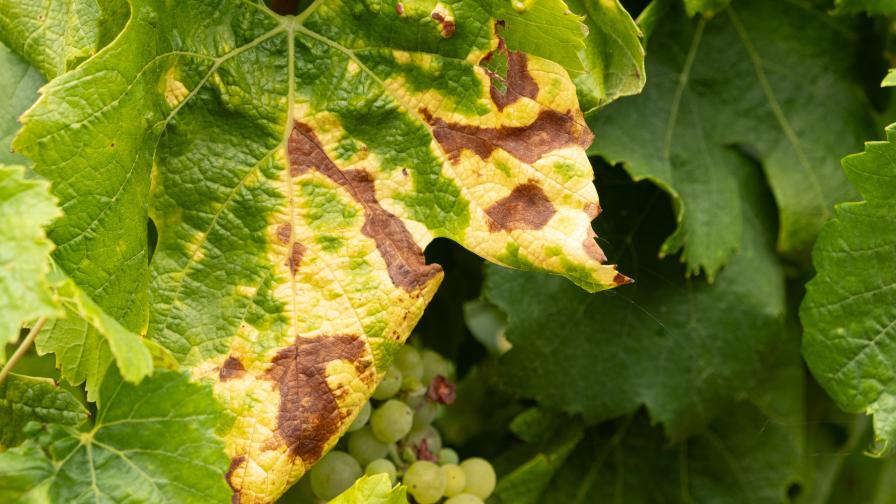
Symptoms of grapevine red blotch virus on grapes.
Photo: Zarina Lukash – stock.adobe.com
While there is no cure, effective management of grapevine red blotch virus involves correctly identifying and removing infected vines. Recent research indicates that the loop-mediated isothermal amplification (LAMP) assay is a promising, practical, and effective diagnostic tool for vineyard managers to conduct more frequent on-site testing for red blotch.
During a November 2025 webinar, Monica Cooper, DPM, Viticulture Advisor with the University of California Cooperative Extension in Napa County and UC Agriculture and Natural Resources, shared her insights on red blotch detection using the LAMP assay and how growers can use the test effectively in a vineyard setting.
Red blotch disrupts photosynthesis, causing sugars to accumulate in leaves rather than fruit. This physiological breakdown leads to berries with low sugar content, poor color, and a vegetal character that fails to meet wine quality standards.
LIMITS OF VISUAL DIAGNOSIS
Traditional mapping of red blotch relies heavily on visual symptoms, which typically manifest as irregular red blotches on leaf blades between mid-September and late October. However, Cooper said this method is challenging because visual symptoms can be difficult to identify and often vary by season, location, and cultivar. In fact, some varieties, such as Sauvignon Blanc, may never develop visual symptoms despite being infected, serving as asymptomatic sources of inoculum.
“Some seasons the symptoms are quite clear, and it’s really easy to pick out which vines are diseased,” Cooper said. “And then other years, just because of environmental conditions within that growing season, the symptoms can be really mild or very difficult to distinguish between those symptoms and say, a nutrient deficiency. So, there’s a fair amount of expertise that goes into being able to recognize these symptoms.”
HOW THE LAMP TEST WORKS
To overcome the unreliability of visual mapping and the delays of traditional diagnostic Polymerase Chain Reaction (PCR) testing, Cooper’s team refined the LAMP assay as a benchtop method, allowing grape growers to detect viral DNA in-house and without access to a diagnostic testing lab.
“What LAMP does is detect and amplifies viral DNA from red blotch-infected vines,” she said. “If there is virus in that sample, there’s a color change — pink means negative, and yellow means positive.”
According to Cooper, the project also learned that trunk tissue — rather than petiole or cane tissue — provides the most reliable, year-round source for testing and is less prone to false positives. Proper sample collection is critical because the red blotch virus is unevenly distributed within the infected vine. Therefore, Cooper advised that older tissues are more reliable to avoid false negatives. And in vines trained with bilateral or quadrilateral cordons, she recommended collecting samples from multiple locations to ensure the vine is adequately represented and to avoid mixed results.
SMARTER SAMPLING WITH STATISTICS
For vineyards where symptoms are absent or confusing, such as with Sauvignon Blanc blocks, Cooper recommended Adaptive Cluster Sampling. This statistically driven approach begins with a random sample drawn from a block divided into equal sections. When an infected vine is identified, the immediate neighbors are then tested. Cooper said this method allows growers to map the “clumped distribution” of the virus efficiently.
Lastly, Cooper stated that the risk of DNA contamination is high with the LAMP assay. Therefore, success requires maintaining a sterile environment.
“It helps if you have laboratory experience, but we found that it’s really not required. Although you do have to be dedicated and diligent about being clean,” she said. “There is a high risk of contamination. Once you have DNA somewhere that causes contamination, it can be really difficult to clean that up, and so you really want to make sure that you’re keeping your space clean; that you’re cleaning your hands, your equipment, and your tabletop. And make sure that you’re keeping any samples in a place that’s not contaminating where you’re running the assay.”
COST, LEARNING CURVE, AND GROWER ADOPTION
According to Cooper, survey data from Napa growers using LAMP to identify red blotch indicates that most users feel proficient after processing between 50 to 150 samples. With an estimated cost of $8 to $12 per sample, the assay offers a cost-effective, rapid alternative to commercial labs, empowering growers to make immediate decisions regarding vine removal.
You can access Cooper’s complete presentation at https://bit.ly/4pYJDDC.
Subscribe Today For
