



What Do ‘Star Wars’ and Onion Center Rot Have In Common? More Than You Think
A long time ago, in a laboratory far, far away, I first learned how to isolate bacteria from diseased plants so that we could identify the culprit in the lab. I was an undergraduate research assistant working in a plant pathology lab. The sunny day we scoured campus for sticky, oozing plants – a sure sign of bacterial infection – happened to be May 4th, otherwise known as “Star Wars Day” or “May the Fourth be With You.” To mark the occasion, we gave each rotting specimen we collected a movie-themed ID after the nine films in the Skywalker Saga. After all, this was just meant to be a training exercise for internal lab use. As we cultured (grew out) the bacteria, we noticed that one of them formed the yellow, dome-like colonies characteristic of Pantoea. This is one of the species that causes center rot in onions, which the lab was in the middle of investigating as part of an international, multi-institutional project.
So, we decided to sequence the genome of this strain to see if we were right and could add it to the study. Coincidentally, the strain was labeled ROTS050421 after “Revenge of the Sith” and the day we collected it (May the Fourth 2021).
That led us to the next question: Could onion center rot be caused by strains like this rogue one aptly named ROTS?
Now, this is where the fun begins! Not all strains of this bacteria cause disease in onions, and we were interested in figuring out why. The project studied 300-plus strains of P. agglomerans, and we noticed that all the strains that caused disease had the same gene cluster (group of genes found next to each other with similar functions). How would this observation hold up when it came to causing disease?
Next, we used a subset of strains to infect red onions and see what would happen. If you think a Tauntaun smells bad, imagine a laboratory full of rotting onions incubating at 82℉/28℃ for weeks (one of my main jobs was taking out the trash each day). All the strains with the specific gene cluster – and only those strains – caused onions to rot. ROTS050421 was part of the group of strains – called a phylogroup – that did not have the disease-causing gene cluster and therefore did not cause any of the onions to rot. So, while the Revenge of the Sith may have wiped out the Jedi Order, ROTS050421 is not taking out onions anytime soon.
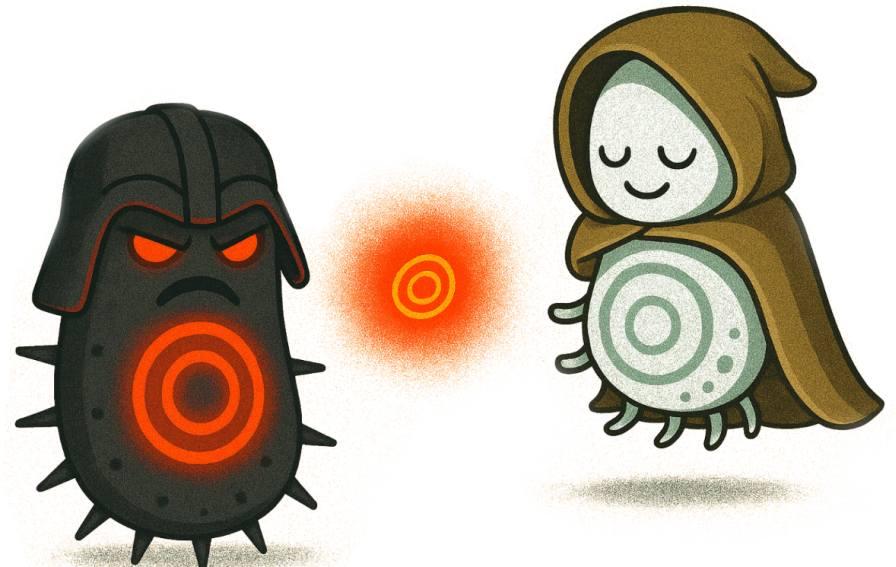
Like using “the force,” strains with pathogenic gene clusters can transfer genes to other, uncorrupted strains.
Illustration by Elena Gutierrez
But like Anakin, could this strain be corrupted and spell doom for allium-kind? If fear is the path to the dark side, plasmids could be a path for transferring disease-causing genes to otherwise harmless strains. Plasmids are small packages of DNA that bacteria use to trade genes with each other and this particular gene cluster happened to be located on one. And we all know that “once you start down the dark path, forever will it dominate your destiny.”
Emperor Palpatine/Darth Sidious set Anakin Skywalker on the path to becoming Darth Vader by implanting mistrust of the Jedi order into his mind and by offering power – unlimited power. Likewise, a pathogenic strain with the disease-causing genes would need to form a direct channel with a non-pathogenic strain to be able to transfer information, like a “hyperspace lane” connecting regions of the galaxy or a boarding ramp between ships. They form this channel using a special type of bacterial secretion system, just like how only Force users can use Jedi mind tricks.
Like Palpatine said, “Only together can we turn him to the Dark Side of the Force.” Another way to look at it is how the Republic’s “clone army” were the good guys, but once they got the message (via secretion system) to “execute Order 66” from Sidious (pathogenic gene cluster), the turned against their Jedi commanders.
RELATED CONTENT: 24 Appealing Onion Varieties To Know and Grow
A New Hope for this work is that we will better understand the Phantom Menace of why some strains underestimate the power of the Dark Side and turn pathogenic, while others resist. We hope to uncover their midichlorian count (what other gene clusters they have) and why some of them have effective deflector shields protecting them from copper-sprays?
What is their home planet (which environments are strains with these gene clusters popular in)? To bring balance to the field, more research is our only hope; no onion varieties can yet resist the power of center rot-causing strains. Finally, our research paper, “Plasmids encode and can mobilize onion pathogenicity in Pantoea agglomerans,” was published earlier this year in the International Society for Microbial Ecology. In my experience, there’s no such thing as luck, but writing this article during the 20th anniversary of “Revenge of the Sith” brings warm feelings to my heart.
Subscribe Today For
