



How Pest Management for Pears Can Bend Without Breaking
 April 9, 2026
 Pears, as growers know, offer a unique set of challenges and opportunities. That was the focus of Tianna DuPont, Washington State University Extension tree fruit specialist, who presented at the Washington State Tree Fruit Association annual meeting with a data-driven look at pear integrated pest management (IPM) under economic strain.
Hard Times, Hard Conversations
DuPont acknowledged the discomfort in the room. “You’re the ones sitting down with your consultants, doing the accounting, and deciding exactly what you’re going to do in your blocks,” she told growers. “We know these aren’t easy decisions.”
Pear growers may have more flexibility than apple growers, however flexibility still comes with risk. In pears, pear psylla dominates the conversation. Unlike codling moth in apples, some psylla damage can be tolerated, but only to a point.
Packers interviewed by DuPont’s team reported zero tolerance for heavy psylla damage and allowed only dime-sized areas of moderate damage. Once thresholds are crossed, returns fall quickly. “The challenge,” DuPont said, “is knowing where that line really is.”
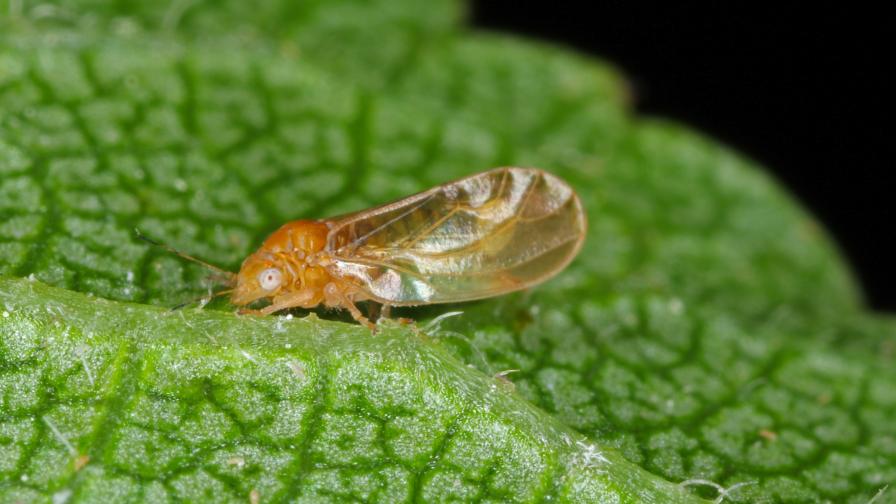
Up close and personal with the pear psylla.
Photo: Tomasz – stock.adobe.com
What the Numbers Tell Us
DuPont’s analysis drew from roughly 80 orchards, about 800 acres, across the Wenatchee Valley, with additional pilot blocks in Yakima and Hood River.
Using both USDA grading standards and a stricter commercial scale developed with packer input, her team found wide variability. Under commercial standards, fewer than half of evaluated blocks stayed under 10% insect-related downgrades.
A partial budget analysis tied those losses to economics. Net returns among blocks with complete records ranged from about $850 to $1,700 per acre. Every unprofitable block shared one trait: insect damage exceeding 20%.
“That’s just one season,” DuPont noted. “It doesn’t include the long-term cost of letting pests like codling moth get out of control.”
Where Corners Might Be Cut, Carefully
Unlike apples, pear programs sometimes allowed for restraint, but only when early-season control was strong. Successful blocks tended to start aggressively, often with multiple early particle film applications followed by well-timed insect growth regulators. That foundation created flexibility later.
“Strong early programs create options,” DuPont said. “Weak ones create debt.” Later-season sprays could sometimes be skipped, but only when scouting data and natural enemy counts supported the decision.
Biological control played a central role in lower-cost, stable programs. Predators such as Deraeocoris and Campylomma can consume hundreds of psylla eggs and nymphs over their lifetimes, according to DuPont. Recent research has confirmed psylla DNA in more than half of sampled Deraeocoris adults. “The nice thing about these guys,” DuPont said, “is we’re not paying for them.”
Protecting that free labor requires information. DuPont highlighted WSU’s scouting network and newly developed economic thresholds that help guide decisions in second and third generations. “These tools don’t eliminate risk,” she cautioned. “They help manage it.”
What Comes Next
Selective programs bring tradeoffs. As broad-spectrum materials are reduced, secondary pests, such as codling moth, rust mites, and stink bugs have reappeared in some pear blocks. Natural enemy populations also fluctuate year to year. However, the message remains consistent: Flexibility without vigilance is a gamble.
In hard years, IPM isn’t about perfection. It’s about avoiding the kind of failure that costs you next year, or the next five. For apples, that means protecting against irreversible loss. For pears, it means using data, biology, and restraint to manage variability without giving back what you saved.
Uncomfortable conversations, yes — but exactly the ones growers need to be having right now.
Subscribe Today For
