



Keeping Gophers Out of Your Fruit and Nut Orchards
 April 28, 2025
 The 2024 growing season was a great one for gophers, and a bad season for orchardists combating those gophers. Gopher populations could get an additional boost with plentiful winter and early spring rains providing an extensive food source in the form of cover crops and weed vegetation. If gopher populations aren’t reduced before weeds and cover crops dry up or are removed, they might just turn to your trees as their food source. Gopher management requires an integrated approach with proper identification followed by the integration of strategies such as biocontrol, habitat modification, baiting, trapping, and fumigation.
Highlights to note up front include:
- It’s critical to correctly identify the vertebrate species present to effectively manage populations.
- Barn owls can help maintain low populations of gophers.
- Burrow destruction, weed management, and tree protectors can dissuade vertebrates from making your orchard their home.
- Baits can be highly effective when used properly and reapplied when necessary.
- Trapping provides excellent control of gophers.
- Fumigation is effective in wet soils when animals are becoming active.
- LABEL IS LAW – always consult with your PCA and ag commissioner when considering fumigating or applying any rodenticide.
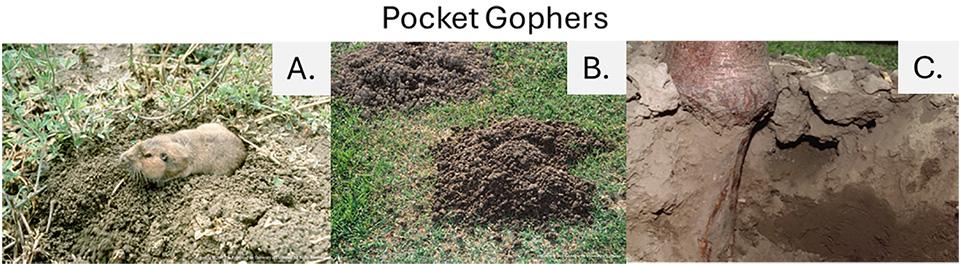
Identification of pocket gophers (A), their mound type (B), and example of damage (C).
Photos by Jack Kelly Clark (UC IPM)
BIOLOGY AND IDENTIFICATION
Pocket gophers are about 6 to 8 inches long, gray-brown (Figure A), and typically spend most of their time below ground. Their tell-tale plugged C-shaped mounds can help distinguish them from other burrowing pests (Figure B). Gophers feed directly on roots and plants and may also girdle trees below ground (Figure C). Additionally, gophers create excellent weed seed bed habitat, as well as tripping hazards and soil erosion.
BIOCONTROL
Attracting birds of prey is a helpful tool in managing gopher populations. Barn owls are good candidates as they are not territorial, so multiple owls may be attracted to a field using owl boxes. Barn owls are best used to keep low populations from growing to be unmanageable but are unlikely to provide complete control or be very effective with large populations. Owl boxes should be placed about 8 to 10 feet above ground and cleaned every two to three years to maintain viability as a good shelter option.
HABITAT MODIFICATION
Habitat modification reduces the desirability of a field or orchard for establishment of vertebrate pests. Destroying burrows and even ripping fields in extreme cases can be effective at reducing vertebrate populations. While there will likely be a reinvasion after burrow destruction, it is typically slow. Flood irrigation forces vertebrate pests to leave their burrows, where predators like coyotes, herons, and raptors can feast and do some of the hard work for you, although dogs and a sharp shovel maybe the best follow-up to flooding.
BAITING
Baits fall into one of three categories: anticoagulants, zinc phosphide, or strychnine. All three types are considered restricted use materials.
Anticoagulants require the animal to feed multiple times on the bait to be effective, and the material can be used as spot treatments, broadcast applications, or in bait stations. Do not leave piles of the bait as this can easily deliver a lethal dose to non-target vertebrates like pets and children. Anticoagulant bait should be reapplied four days after initial spot or broadcast application, and bait stations should be checked regularly to make sure there is still enough bait.
Zinc phosphide is an acute toxin, typically effective with a single dose. This product is used in spot and broadcast treatments and should not be used near buildings or in bait stations. The strong odor and taste of zinc phosphide can cause bait shyness; pre-baiting with a non-toxic bait can improve efficacy of the product.
Strychnine is the most effective rodenticide against gophers and is good for initial knockdown of populations before trapping. For small populations, using a funnel and spoon to apply the strychnine-laced bait to burrows can be effective. Larger populations may necessitate using a probe dispenser or even a burrow dispenser on a tractor. Dispensing through a shanked tunnel dug by a tractor is very hit and miss because you have to connect with the gopher’s tunnel network. Gophers can develop resistance to strychnine making it critical that you integrate it with other approaches.
TRAPPING
Trapping is an excellent control tactic for managing gopher populations. Popular traps like the McAbee and the Gophinator can be set either at the entrance of tunnels or can be covered with soil after baiting and setting; little difference in efficacy has been reported, but covering is a safer option in areas where non-target animals may access the traps. Good control is often achieved with two successive rounds of trapping. Studies have shown no difference in trap success with different attractants, and human scent does not affect efficacy. While trapping is very labor intensive, it is so efficacious against gophers that most growers find it worth the effort.
FUMIGATION
Burrow fumigation uses poison gases injected into burrow systems to kill vertebrate pest populations. Fumigation works best when soil moisture is high, trapping the gas in the burrow. Late winter to early spring is the best time to fumigate for gophers, before they begin to reproduce for the year. Gas cartridges, essentially a smoke bomb, are not effective against gophers. Aluminum phosphide is highly effective against gophers but is highly restricted. With large populations it may be worth it to use aluminum phosphide products, but it’s critical that you understand the restrictions and required documentation; consult with your ag commissioner’s office when planning an application. Pressurized exhaust machines essentially force exhaust from a small engine into the burrow system. These devices (not classified as a pesticide) are moderately effective against gophers. Carbon dioxide canisters are similar in efficacy to exhaust machines but are considered a pesticide.
Overall, the best set of management strategies employed in any given orchard will depend on population level and logistical constraints. Integrate multiple approaches for the best control. It’s important to consult with your PCA and ag commissioner to ensure proper application and always adhere to pesticide labels – LABEL IS LAW!
Acknowledgements: Thank you to Dr. Roger Baldwin (UC Davis), who gave an excellent presentation on vertebrate pest management at the North Sac Valley Prune Day in February and whose talk the original article was based on. In that original article you can also learn about ground squirrel and vole management: sacvalleyorchards.com/prunes/gophers-ground-squirrels-and-voles-oh-my.
Subscribe Today For
